GLP-1 side effects: what the four labels report, with placebo numbers
The most common side effects of Ozempic, Wegovy, Mounjaro and Zepbound, with the exact percentages from each label’s clinical trials and the placebo rate next to them.
The most common GLP-1 side effects are gastrointestinal: nausea, diarrhea, vomiting, constipation and abdominal pain. In the Wegovy 2.4 mg weight trials, 44% reported nausea versus 16% on placebo [1]. In Zepbound’s trials it was 25% to 29% versus 8% [2], in Mounjaro’s diabetes trials 12% to 18% versus 4% [3], and in Ozempic’s 15.8% to 20.3% versus 6.1% [4]. The trials differ in people, doses and length, so the numbers should not be compared across medicines. The labels step doses up gradually to reduce stomach side effects [2][4].
Before you read the numbers
Most common side effects in the trials
| Medicine and trial group | Nausea | Vomiting | Diarrhea | Constipation | Abdominal pain |
|---|---|---|---|---|---|
| Wegovy 2.4 mg weekly (weight reduction, adults). Placebo: 16, 6, 16, 11, 10 | 44% [1] | 24% [1] | 30% [1] | 24% [1] | 20% [1] |
| Zepbound 5, 10, 15 mg (weight reduction). Placebo: 8, 2, 8, 5, 5 | 25%, 29%, 28% [2] | 8%, 11%, 13% [2] | 19%, 21%, 23% [2] | 17%, 14%, 11% [2] | 9%, 9%, 10% [2] |
| Mounjaro 5, 10, 15 mg (type 2 diabetes). Placebo: 4, 2, 9, 1, 4 | 12%, 15%, 18% [3] | 5%, 5%, 9% [3] | 12%, 13%, 17% [3] | 6%, 6%, 7% [3] | 6%, 5%, 5% [3] |
| Ozempic 0.5 mg, 1 mg (type 2 diabetes). Placebo: 6.1, 2.3, 1.9, 1.5, 4.6 | 15.8%, 20.3% [4] | 5%, 9.2% [4] | 8.5%, 8.8% [4] | 5%, 3.1% [4] | 7.3%, 5.7% [4] |
Read this table down a single row, not across rows. The four trial programs enrolled different people (weight management versus type 2 diabetes), used different doses and ran for different lengths, so a higher number in one row is not evidence that one medicine causes more side effects than another.
Other common reactions the labels list
- Fatigue. Wegovy 2.4 mg: 11% versus 5% on placebo [1]. Zepbound: 5%, 6% and 7% at 5, 10 and 15 mg versus 3% [2]. The Ozempic label lists fatigue, dysgeusia and dizziness among reactions seen in more than 0.4% of patients [4].
- Decreased appetite (Mounjaro). 5%, 10% and 11% at 5, 10 and 15 mg versus 1% on placebo [3].
- Headache (Wegovy). 14% versus 10% on placebo [1].
- Injection site reactions. Zepbound: 6%, 8% and 8% versus 2% [2]. Ozempic: 0.2% of treated patients [4].
- Hair loss. See the hair loss page.
The Wegovy label reports that 6.8% of people on 2.4 mg and 3.2% on placebo permanently stopped treatment because of side effects, most often nausea (1.8% versus 0.2%), vomiting (1.2% versus 0%) and diarrhea (0.7% versus 0.1%) [1].
Why doses step up slowly
The Zepbound and Ozempic labels say their step-up schedules are meant to reduce the risk of gastrointestinal side effects [2][4]. The Wegovy label says that if a dose is not tolerated during escalation, delaying the next step for 4 weeks should be considered [1]. Only your prescriber should change that schedule. See the tirzepatide, semaglutide and Wegovy dose charts for the label schedules.
Track your own pattern
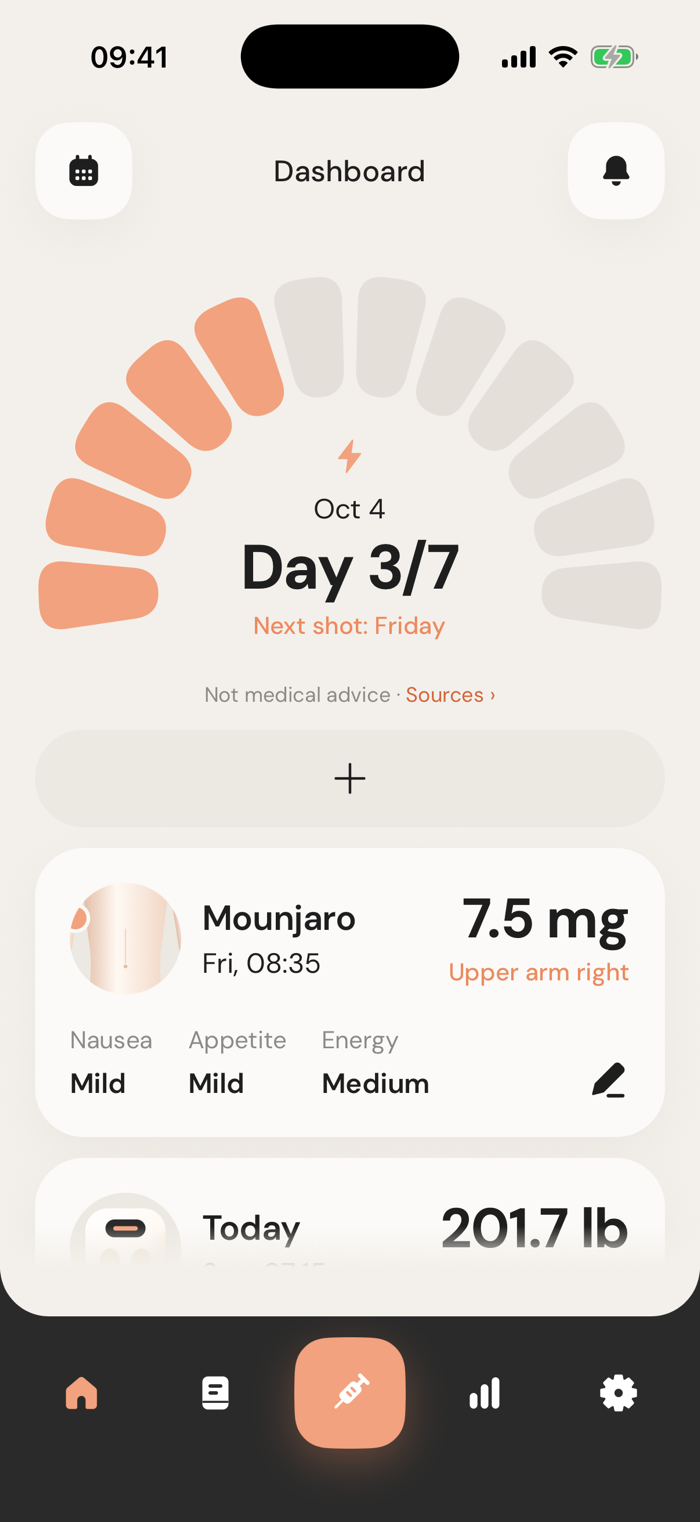
Trial percentages tell you what is common, not what will happen to you. A simple log of the day, the dose you took and how you felt makes a dose-change conversation with your prescriber much more specific.
Frequently asked questions
What are the most common side effects of GLP-1 medicines?
Gastrointestinal ones: nausea, diarrhea, vomiting, constipation and abdominal pain, according to the Ozempic, Wegovy, Mounjaro and Zepbound labels.
How common is nausea on Wegovy?
44% of adults on the 2.4 mg dose reported nausea in the label’s trials, versus 16% on placebo.
How common is nausea on Zepbound or Mounjaro?
Zepbound: 25% to 29% across doses versus 8% on placebo. Mounjaro (type 2 diabetes): 12% to 18% versus 4%.
Does fatigue come with GLP-1 medicines?
It is listed. Wegovy 2.4 mg: 11% versus 5% on placebo. Zepbound: 5% to 7% versus 3%.
Can I compare side effect rates between Ozempic and Wegovy?
Not directly. The trials enrolled different people for different conditions, used different doses and lasted different lengths.
Do the side effects go away?
The labels do not give a general time frame. The step-up schedules are designed to lower the risk of stomach side effects, so talk to your prescriber if they persist.
Sources
- WEGOVY (semaglutide) injection and tablets: full prescribing information. Novo Nordisk, revised 06/2026. Sections 2.1 to 2.5 (administration, dosage, missed doses, switching) and 3 (strengths).
- ZEPBOUND (tirzepatide) injection: full prescribing information. Eli Lilly and Company, revised 08/2026. Sections 2.1 to 2.4 (dosage, missed dose, administration) and 3 (strengths).
- MOUNJARO (tirzepatide) injection: full prescribing information. Eli Lilly and Company, revised 08/2026. Sections 2.1 and 2.2 (dosage, missed doses, administration) and 3 (strengths).
- OZEMPIC (semaglutide) injection: full prescribing information. Novo Nordisk, revised 05/2026. Sections 2.1 and 2.2 (administration, missed dose, dosage) and 3 (strengths).
How we write these. Every dose, interval and window above comes from the manufacturer’s US prescribing information, checked on 6 October 2026, and links to it. Labels are updated, so check the current label or ask your pharmacist before you act. Nerra is made by Hicham Zaidi. We do not sell any medicine and are not affiliated with any manufacturer. If you spot an error, tell us through the Nerra support page.
Keep reading
Your therapy, completely in view.
Nerra is a private GLP-1 companion for iPhone: doses you enter, injection sites, weight and check-ins. No account, no cloud, pay once.
Coming soon to the App StoreNerra is not a medical device and does not provide medical advice. You always enter the dose your prescriber gave you; Nerra never calculates or suggests one. Always follow your prescriber’s instructions. Nerra is not affiliated with any medication manufacturer. Product names belong to their owners.