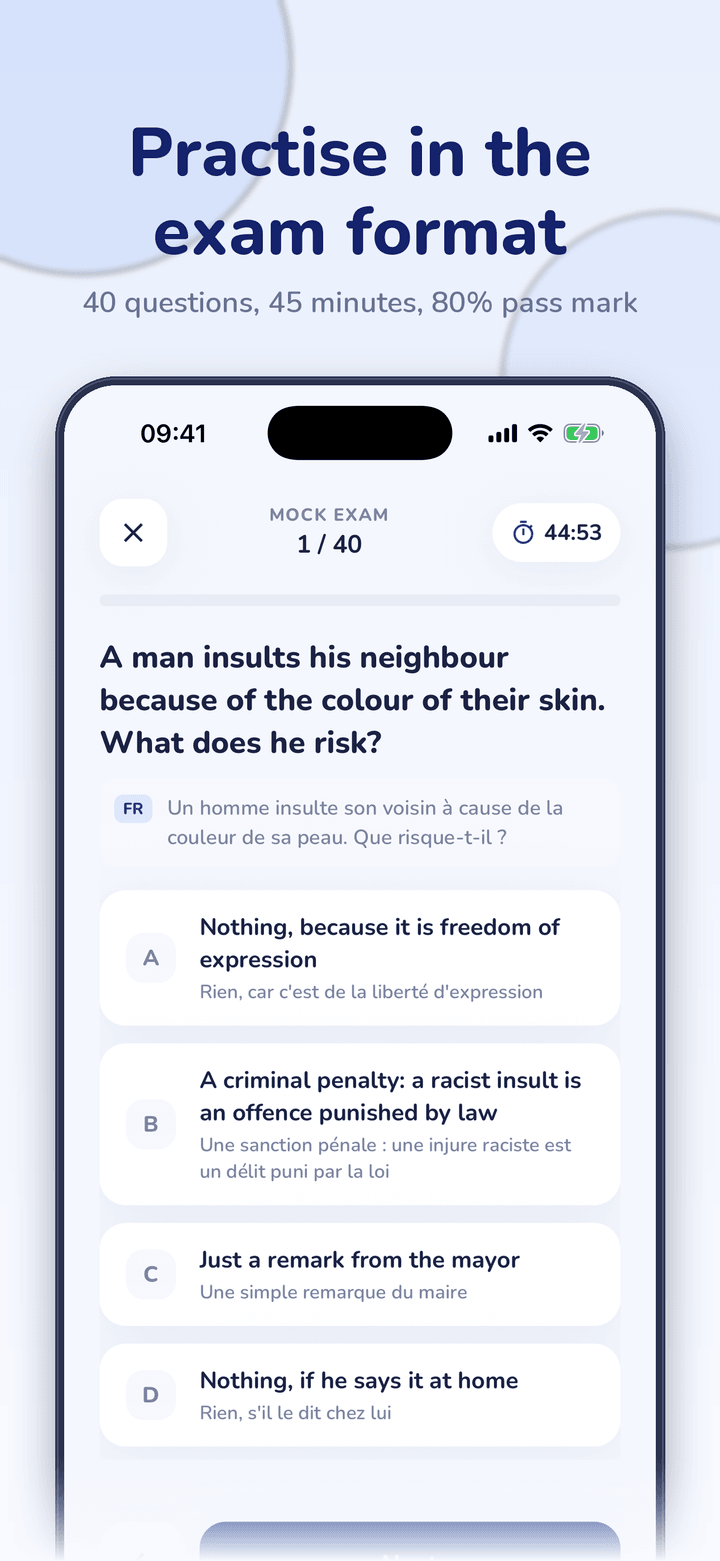
Scenario questions (mises en situation) describe a short everyday situation and ask which behaviour or principle is correct. In the French civic exam 12 of the 40 questions are scenarios, six on the principles and values of the Republic and six on rights and duties. Examen Civique Prépa includes 24 scenarios written in the same style.
| In the exam | 12 of 40 questions |
|---|---|
| Topics covered | Principles and values of the Republic; rights and duties |
| In the app | 24 scenario questions written by the app's authors |
| Official scenarios | Not public, so the app's are original |
By Ship AI Lab. Last updated . Written from how the app actually behaves.
What a scenario question looks like
Instead of asking you to recall a date or a definition, a scenario puts you in a short, concrete situation: at work, at school, in a public service or among neighbours. You choose the response that matches the values of the Republic or the rights and duties that apply.
These questions test whether you can apply what you have learned, not just repeat it. That is why they carry real weight in the exam, and why they are worth practising separately from the knowledge questions.
Why the app's scenarios are original
The exam's scenario questions are not published. Rather than guess at them, Examen Civique Prépa's authors wrote 24 original scenarios that follow the general format: a short situation, four answers and one that fits the principle in question. They are covered by the same explanations as the other questions, so you learn the reasoning, not just the answer.
The knowledge questions, by contrast, come from the lists published by the Ministry of the Interior. The app labels the difference so you know which is which.
How to approach a scenario question
- Read the situation twiceIdentify who is involved and what the question really asks.
- Link it to a principleIs it about secularism, equality, a right or a duty?
- Remove clearly wrong answersEliminate options that go against the principle.
- Read the explanationIt states the principle behind the correct answer.
Good to know
They are mixed into mock exams
You will meet 12 of them in each 40-question mock exam.
They reward understanding
Learn the reasoning behind each principle, not the exact words.
They suit non-native speakers
Read the situation in your language and check the French original.
They are fast to revise
Each one is short, so a handful per day adds up.
Limits
- The app's scenarios are modelled on the exam's format only. The real scenarios are not public and will differ.
- Scenario answers depend on French law and republican values, so always check official sources if you are unsure.
- This is exam practice, not legal advice.
Frequently asked questions
What is a mise en situation?
A short description of a situation followed by a question about the right behaviour or principle. In the civic exam, 12 of the 40 questions are mises en situation.
Are these the real exam scenarios?
No. The real ones are not public. The 24 scenarios in the app are original and follow the same format.
Which topics do scenarios cover?
In the exam, the principles and values of the Republic and rights and duties.
Are scenarios included in the free plan?
Scenarios appear within the questions and mock exam available on the free plan, subject to its limits. Full access unlocks all of them.
Are there explanations?
Yes, every scenario has a short explanation of the principle behind the answer.
For official information, see the Ministry of the Interior civic training website and the decree of 10 October 2025.