Mounjaro vs Ozempic: what the labels and the SURPASS-2 trial show
Two weekly injections for type 2 diabetes with different active ingredients. Here is how the labels differ and what the one large head-to-head trial reported.
Mounjaro contains tirzepatide, which activates both GIP and GLP-1 receptors. Ozempic contains semaglutide, which activates GLP-1 receptors [1][2]. Both are weekly injections approved for type 2 diabetes [1][2]. In SURPASS-2, a 40-week trial of 1,879 adults with type 2 diabetes, tirzepatide 5, 10 and 15 mg lowered HbA1c by 2.01, 2.24 and 2.30 percentage points, against 1.86 for semaglutide 1 mg, and body weight fell more on tirzepatide [3]. The trial was open-label, funded by Eli Lilly, and used semaglutide 1 mg, not the 2 mg dose the Ozempic label now allows [3][2].
Mounjaro and Ozempic side by side
| Mounjaro | Ozempic | |
|---|---|---|
| Active ingredient | Tirzepatide, a GIP and GLP-1 receptor agonist [1] | Semaglutide, a GLP-1 receptor agonist [2] |
| Approved uses (US label) | Improve blood sugar control in adults and in children 10 and older with type 2 diabetes. Reduce major cardiovascular events in adults with type 2 diabetes at high risk for them [1] | Improve blood sugar control in adults with type 2 diabetes. Reduce major cardiovascular events in adults with type 2 diabetes and established cardiovascular disease. Reduce the risk of sustained eGFR decline, end-stage kidney disease and cardiovascular death in adults with type 2 diabetes and chronic kidney disease [2] |
| Starting dose | 2.5 mg once weekly [1] | 0.25 mg once weekly, then 0.5 mg after 4 weeks [2] |
| Dose steps | Increase in 2.5 mg steps after at least 4 weeks on the current dose, if more blood sugar control is needed [1] | To 1 mg, then 2 mg, each after at least 4 weeks on the previous dose, if more blood sugar control is needed [2] |
| Highest dose | 15 mg once weekly in adults, 10 mg in children [1] | 2 mg once weekly [2] |
| Missed dose | As soon as possible within 4 days (96 hours). After 4 days, skip it [1] | Within 5 days of the missed dose [2] |
| Changing your injection day | Allowed if the two doses are at least 3 days (72 hours) apart [1] | Allowed if the two doses are more than 2 days (48 hours) apart [2] |
| Most common reactions (5% or more) | Nausea, diarrhea, decreased appetite, vomiting, constipation, indigestion and abdominal pain [1] | Nausea, vomiting, diarrhea, abdominal pain and constipation [2] |
What SURPASS-2 found
SURPASS-2 is the head-to-head trial the two companies’ labels do not give you. It randomised 1,879 adults with type 2 diabetes and an average starting HbA1c of 8.28% to tirzepatide 5, 10 or 15 mg or to semaglutide 1 mg, once weekly, for 40 weeks. The main result was the change in HbA1c [3].
| Result at 40 weeks | Tirzepatide 5 mg | Tirzepatide 10 mg | Tirzepatide 15 mg | Semaglutide 1 mg |
|---|---|---|---|---|
| Change in HbA1c (percentage points) | -2.01 | -2.24 | -2.30 | -1.86 |
| Difference from semaglutide | -0.15 | -0.39 | -0.45 | Comparison |
| Body weight difference from semaglutide | -1.9 kg | -3.6 kg | -5.5 kg | Comparison |
| Nausea | 17 to 22% across tirzepatide doses | 18% | ||
| Diarrhea | 13 to 16% across tirzepatide doses | 12% | ||
| Vomiting | 6 to 10% across tirzepatide doses | 8% | ||
| Serious adverse events | 5 to 7% across tirzepatide doses | 3% |
In plain terms, tirzepatide lowered HbA1c and weight more than semaglutide 1 mg in this trial, and stomach and bowel effects were the most common problems on both, mostly mild to moderate [3].
How to read that result
- The comparator was semaglutide 1 mg. The Ozempic label now includes a 2 mg dose, which was not in this trial [3][2].
- It was open-label, so patients and doctors knew which medicine was being used, and it was funded by Eli Lilly, which makes tirzepatide [3].
- It lasted 40 weeks and measured blood sugar and weight, not long-term outcomes such as heart attacks [3].
- It is an average across 1,879 people. It cannot tell you which medicine will suit you, your other conditions, your budget or your insurance.
So the honest answer to “is Mounjaro better than Ozempic?” is that tirzepatide did better than semaglutide 1 mg on HbA1c and weight in one company-funded trial, with more serious adverse events reported on tirzepatide (5 to 7% against 3%) [3]. Which one is right for a given person is a prescriber’s decision.
What about weight loss?
Mounjaro’s label covers type 2 diabetes. The same active ingredient, tirzepatide, is sold as Zepbound for weight reduction. Ozempic’s label also does not list weight reduction as a use, and semaglutide for weight is sold as Wegovy [1][2]. For the weight-loss comparison, read semaglutide vs tirzepatide, and for the two semaglutide brands, Wegovy vs Ozempic.
Keep a log of your own
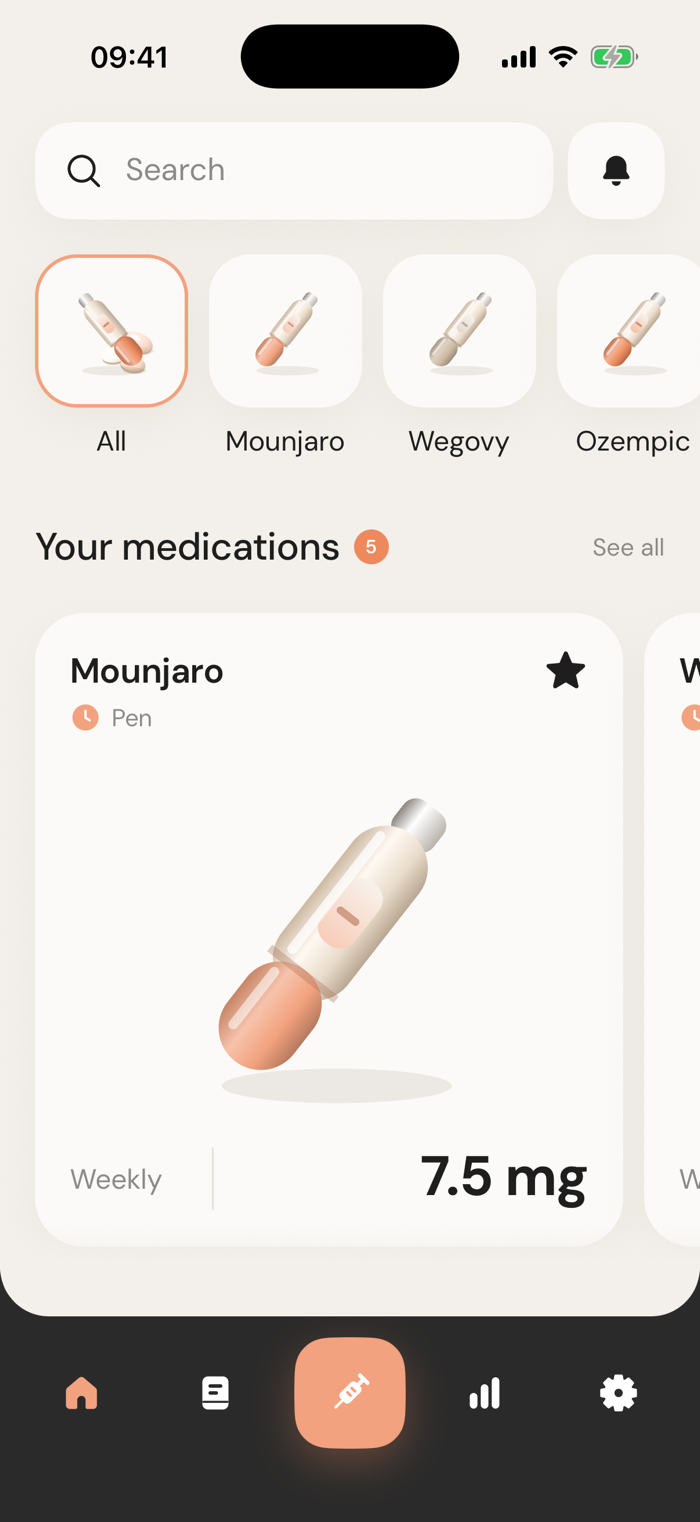
Frequently asked questions
Is Mounjaro better than Ozempic?
In SURPASS-2, a 40-week open-label trial funded by Eli Lilly, tirzepatide lowered HbA1c and body weight more than semaglutide 1 mg in adults with type 2 diabetes. Serious adverse events were reported in 5 to 7% on tirzepatide and 3% on semaglutide. The right choice for you is your prescriber’s decision.
Is tirzepatide the same as Ozempic?
No. Ozempic contains semaglutide. Tirzepatide is the active ingredient in Mounjaro and Zepbound, and it activates both GIP and GLP-1 receptors.
What is the difference between Mounjaro and Ozempic?
Different active ingredients, different dose steps, a higher maximum dose on Mounjaro (15 mg against 2 mg), and slightly different missed dose windows: 4 days for Mounjaro and 5 days for Ozempic.
Can I switch from Ozempic to Mounjaro?
Neither label gives a conversion between them. Switching, and the dose to start at, is a decision for your prescriber.
Which has fewer side effects, Mounjaro or Ozempic?
In SURPASS-2 the most common effects were stomach and bowel effects on both. Nausea was 17 to 22% on tirzepatide and 18% on semaglutide 1 mg. Serious adverse events were 5 to 7% and 3%.
Is Mounjaro approved for weight loss?
The Mounjaro label covers type 2 diabetes. Tirzepatide for weight reduction is sold as Zepbound.
Sources
- MOUNJARO (tirzepatide) injection: full prescribing information. Eli Lilly and Company, revised 08/2026. Sections 2.1 and 2.2 (dosage, missed doses, administration) and 3 (strengths).
- OZEMPIC (semaglutide) injection: full prescribing information. Novo Nordisk, revised 05/2026. Sections 2.1 and 2.2 (administration, missed dose, dosage) and 3 (strengths).
- Tirzepatide versus Semaglutide Once Weekly in Patients with Type 2 Diabetes (SURPASS-2). Frias JP et al. New England Journal of Medicine, 2021 (PubMed 34170647, doi 10.1056/NEJMoa2107519). Abstract read through Europe PMC on 22 October 2026. Open-label, 40 weeks, 1,879 adults with type 2 diabetes, tirzepatide 5, 10 or 15 mg against semaglutide 1 mg. Funded by Eli Lilly.
How we write these. Every dose, interval and window above comes from the manufacturer’s US prescribing information, checked on 6 October 2026, and links to it. Labels are updated, so check the current label or ask your pharmacist before you act. Nerra is made by Hicham Zaidi. We do not sell any medicine and are not affiliated with any manufacturer. If you spot an error, tell us through the Nerra support page.
Keep reading
Your therapy, completely in view.
Nerra is a private GLP-1 companion for Android, with iPhone coming soon: doses you enter, injection sites, weight and check-ins. No account, no cloud, pay once.
On Android now, iPhone soonNerra is not a medical device and does not provide medical advice. You always enter the dose your prescriber gave you; Nerra never calculates or suggests one. Always follow your prescriber’s instructions. Nerra is not affiliated with any medication manufacturer. Product names belong to their owners.