5 years sober: the edge of the "stable" stage
Five years is where NIAAA’s research bands change from sustained to stable. Here is what that line means, and what it does not.
Five years sober is the boundary between the "sustained" stage (1 to 5 years) and the "stable" stage (more than 5 years) in NIAAA’s research definitions [1]. The longest long-term study we cite grouped abstinence as "1 month to 5 or more years", which is why five is the top of the scale [2]. No study makes a promise at five years, and a stage is not a guarantee. At 14 US standard drinks a week, five years is 3,650 drinks skipped, about 51,100 g of alcohol and 357,700 kcal from the alcohol alone [3] [4].

The line NIAAA draws at five years
NIAAA’s recovery research definitions split time into initial (up to 3 months), early (3 months to 1 year), sustained (1 to 5 years) and stable (more than 5 years) [1]. Five years is the top of "sustained". On day 1,826 you cross into "stable". These are research categories, set up so that studies can compare people at similar points, not something the body notices.
The same definitions say recovery is a process of pursuing both remission from alcohol use disorder and an end to heavy drinking, and that people are considered "recovered" if both are achieved and maintained over time [1]. The word "maintained" is the one that matters at five years.
Track it in Sober Girl
Five years in the research
Dennis, Foss and Scott measured abstinence in bands from one month to "five or more years" in 1,162 people followed for eight years, and looked at how the duration of abstinence related to other parts of recovery and to the odds of staying abstinent the following year [2]. The abstract does not give percentages, so we will not quote the figure that circulates online that after five years the risk of relapse falls below a fixed number. We could not verify it.
What the longer follow-up by Moos and Moos adds is a caution. Even among people in remission at three years, some relapsed over the next thirteen [5]. Five years is a strong place to be, and the safest reading of the research is that the skills which got you there keep mattering [5].
Five years in numbers
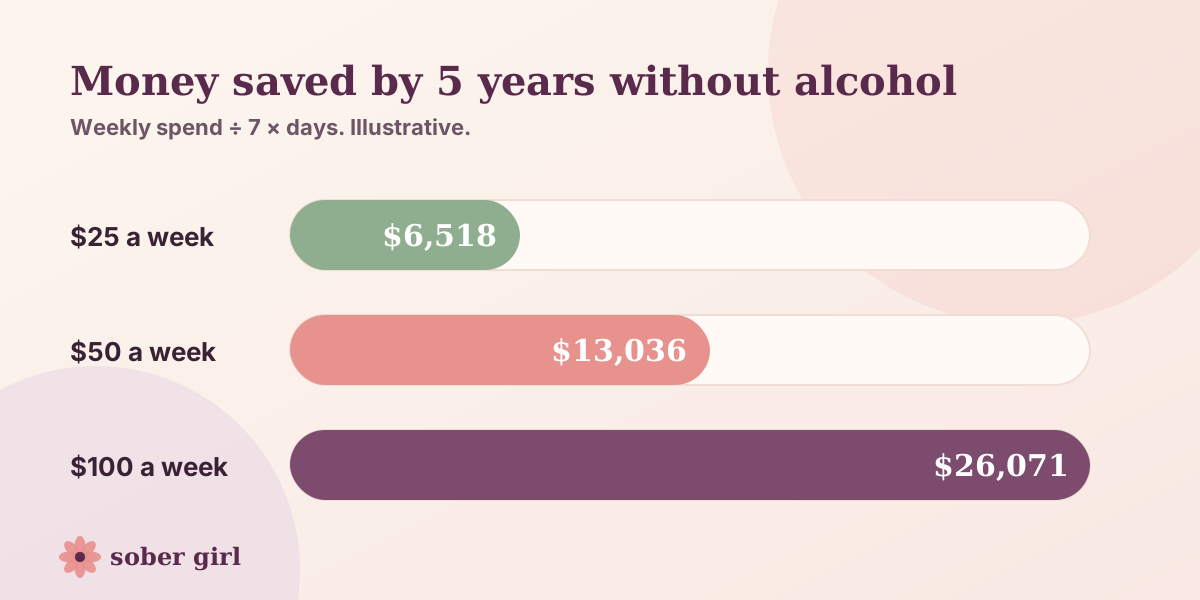
| If you used to spend | Saved by 5 years |
|---|---|
| $25 a week | $6,518 |
| $50 a week | $13,036 |
| $100 a week | $26,071 |
| If you used to drink | Drinks skipped by 5 years | Alcohol skipped | Calories from alcohol skipped |
|---|---|---|---|
| 7 standard drinks a week | 1,825 | 25,550 g | 178,850 kcal |
| 14 standard drinks a week | 3,650 | 51,100 g | 357,700 kcal |
| 21 standard drinks a week | 5,475 | 76,650 g | 536,550 kcal |
Marking five years
- Write the letter. A short note to the person on day one, and one to the person five years from now.
- Spend the number. At $50 a week the savings come to about $13,000. Decide on one thing that is worth that amount to you.
- Say thank you. Name the people who made the first year survivable.
- Help someone on day one. If you want to give something back, that is how.
For words to send to someone at this milestone, see soberversary messages. For the longer view, see years sober: 4, 7 and 10 years.
Is Sober Girl right for you?
- use an Android phone (the iPhone app is coming soon)
- want a private tracker, with your journal kept on your device
- want a day counter, money saved and a daily check-in in one calm place
- want a Craving SOS with a breathing exercise and a 10-minute timer
- want to start free and add Plus only if you need the journal, insights or milestone cards
- need it on an iPhone today (the App Store version is coming soon)
- want a community feed, live coaching or an AI chat
- want a structured multi-week education program
- need medical help for heavy drinking or withdrawal. An app is not treatment, so see the safety notes above
Frequently asked questions
What does 5 years sober mean?
In NIAAA’s research definitions, five years is the boundary between the sustained stage (1 to 5 years) and the stable stage (more than 5 years). It is a research category rather than a physical change.
Is relapse risk low after 5 years sober?
We could not verify a specific figure. Long-term studies describe recovery as a process maintained over years, and one 16-year follow-up found some people in remission at three years did relapse later.
How much money do you save in 5 years of not drinking?
Weekly spend divided by 7, times 1,825. At $50 a week, about $13,036.
Does Sober Girl have a 5-year badge?
No. The milestone list ends at 365 days. The counter, hours and money saved keep going.
Sources
- NIAAA Recovery Research Definitions. NIAAA. Research definitions for remission and recovery from alcohol use disorder, with duration bands.
- An eight-year perspective on the relationship between the duration of abstinence and other aspects of recovery. Dennis ML, Foss MA, Scott CK. Evaluation Review 2007;31(6):585-612. 1,162 people entering treatment, followed for 8 years. The abstract gives no percentages.
- What Is A Standard Drink?. NIAAA.
- Alcohol Consumption and Obesity: An Update. Traversy G, Chaput JP. Current Obesity Reports, 2015. A review. It reports that alcohol provides 7 kcal per gram and that the evidence on weight is mixed.
- Rates and predictors of relapse after natural and treated remission from alcohol use disorders. Moos RH, Moos BS. Addiction 2006. 461 people followed for 16 years. A cohort study of people who sought help, not a trial.
How we write these. Every figure above links to the source it came from, and we label self-reported and observational results as such. Where we could not find a source we trust, the page says so instead of filling the gap. Sober Girl is made by ShipAI Lab and this is not medical advice. Sources were checked on 6 October 2026. If you spot an error, email us at integrateopenai@gmail.com.
Keep reading
Today is day one.
Sober Girl is a private sobriety tracker for women, on Android now and coming soon to iPhone: day counter, money saved, craving SOS and a tree that grows with you. Free to start.