Sobriety milestones: what the research says from day 1 to year 1
Most day-by-day timelines online mix a few studies with guesswork. This one only states what a source supports, and says plainly where the evidence stops.
There is no universal sobriety timeline. MedlinePlus says alcohol withdrawal symptoms tend to start within 8 hours of the last drink and peak between 24 and 72 hours [1]. The best-studied milestone is one month: in a BMJ Open study of 94 people, insulin resistance fell 25.9% and systolic blood pressure 6.6% after a month without alcohol [2]. Beyond a month, we found no study we trust for specific dates, so this guide says so.
Before day one: a safety note
Track it in Sober Girl
There is no universal timeline
Bodies differ, and so does how much and how long someone has been drinking. The studies we can cite measure specific things over specific windows, usually a month. They do not describe what you will feel on day 47. So below, each milestone has two parts: what is documented, and ways to mark it. Where nothing is documented, we say so.
Day 1: the first 24 hours
Documented. MedlinePlus says withdrawal symptoms tend to occur within 8 hours after the last drink, but can occur days later [1]. Not everyone who stops drinking has withdrawal symptoms. If you drink heavily, see the safety note above.
Mark it. Write down your reason in one sentence. Tell one person. Pour out or move what is in the house, if that is a realistic step for you.
Week 1: sleep and mood are often the hardest part
Documented. For people who go through withdrawal, symptoms peak between 24 and 72 hours but may persist for weeks, and effects such as sleep disturbance and mood changes can last for months [1]. Alcohol also shapes sleep itself: it can sedate at first, then fragment sleep in the second half of the night, and it can reduce REM sleep [4]. So broken sleep early on is a known part of stopping. It does not mean you are doing it wrong.
Mark it. A first full week is worth a small, specific reward that is not alcohol. Log a daily check-in so you can see how mood and sleep move over time instead of relying on memory.
30 days: the best-studied milestone
Documented. A BMJ Open study followed 94 healthy people who chose to abstain from alcohol for a month, alongside 47 who kept drinking. The abstainers had been drinking about 258 g of alcohol a week on average, which is roughly 18 standard drinks if you count 14 g per drink [2] [5]. After a month, all of the following fell significantly from baseline (p < 0.001), and the researchers found none of the changes were explained by diet, exercise or smoking [2]:
What changed after one month without alcohol
Reduction from baseline in people who abstained for a month (n = 94). Bars show the size of the fall.
Read it with care. This was an observational study. People chose which group to join, the sample was small, and it excluded people with liver disease or alcohol dependence, so you cannot assume the same changes for them [2]. Blood measures like these are not things you can feel, either. What it shows is that a month off is not nothing.
What people report. Separately, Alcohol Change UK summarises a 2019 evaluation of Dry January participants, who reported that 86% saved money, 70% slept better, 66% had more energy and 54% lost weight [6]. These are self-reported results from people who chose to take part, not a controlled trial.
90 days: where the evidence runs thin
Documented. We could not find a study we trust that describes a specific change at day 90, so we will not invent one. What the literature does say about the liver is stage-based rather than date-based: fatty liver can be reversed when drinking stops, while more advanced disease can stabilise with abstinence [7]. If you are worried about your liver, ask a doctor about liver function tests. A calendar milestone cannot tell you.
Mark it. Ninety days is a natural point to look back. Check what you have saved, reread the reason you wrote on day one, and note what has got easier.
6 months and 1 year
Documented. The nearest solid number is about reduced drinking, not abstinence. Alcohol Change UK reports that six months after Dry January, seven out of ten participants continued to drink less riskily than before [8]. That describes people who tried a month off, so it does not tell you how a year of sobriety will feel.
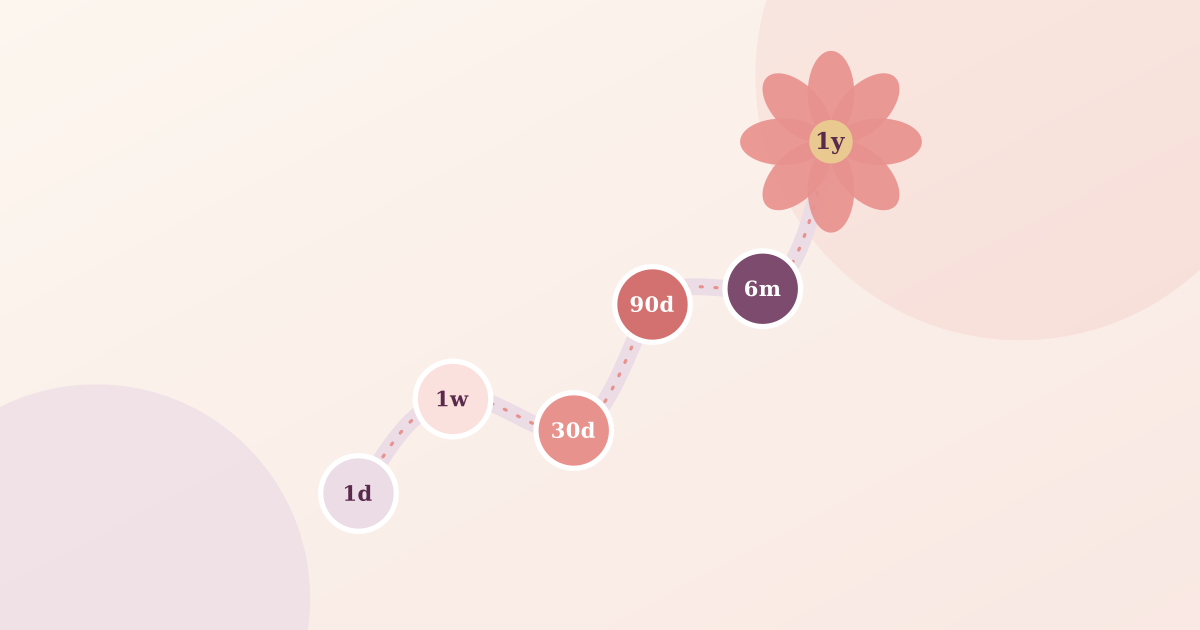
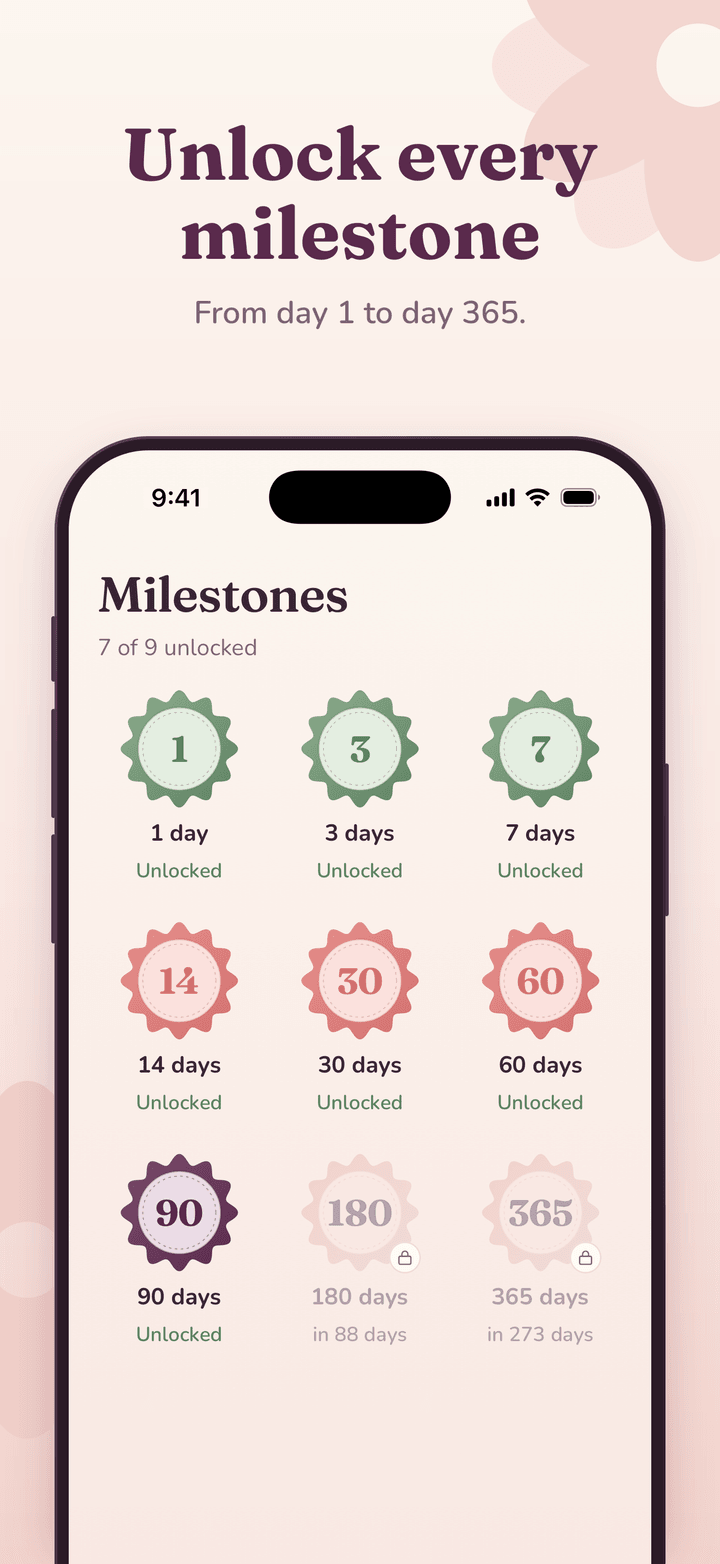
Mark it. A year is worth marking properly. In Sober Girl, the 1 year milestone unlocks a badge, and Plus members can share a milestone card. Whatever app you use, take a screenshot of the day count and write what you would tell yourself on day one.
What about sobriety coins?
In Alcoholics Anonymous and other twelve-step groups, a coin or chip marks continuous time without drinking, often at 24 hours, 30, 60 and 90 days, then a year and each year after. There is no official AA coin: they are part of AA culture, not conference-approved, the system is optional, and colours and intervals vary by group [9]. You do not need a coin to mark a milestone. A written note, a small purchase with the money you saved, or a badge in a tracker does the same job.
Work out your own money saved
Money saved is one milestone you can calculate exactly, because it is your own spending. Enter what you used to spend on alcohol in a typical week. Nothing is stored or sent anywhere.
Enter a number to see what you would save. Use your own currency.
Simple arithmetic: weekly spend ÷ 7 × days. It ignores bar tabs you would not have paid for anyway, so use your honest average.
Is Sober Girl right for you?
- use an Android phone (the iPhone app is coming soon)
- want a private tracker, with your journal kept on your device
- want a day counter, money saved and a daily check-in in one calm place
- want a Craving SOS with a breathing exercise and a 10-minute timer
- want to start free and add Plus only if you need the journal, insights or milestone cards
- need it on an iPhone today (the App Store version is coming soon)
- want a community feed, live coaching or an AI chat
- want a structured multi-week education program
- need medical help for heavy drinking or withdrawal. An app is not treatment, so see the safety notes above
Frequently asked questions
When do alcohol withdrawal symptoms start?
MedlinePlus says withdrawal symptoms tend to occur within 8 hours after the last drink, but can occur days later. They peak between 24 and 72 hours and may persist for weeks. Seizures, fever, severe confusion, hallucinations or an irregular heartbeat need emergency care.
What changes after one month without alcohol?
In a BMJ Open study of 94 people who abstained for a month, insulin resistance, blood pressure, weight and two cancer-related growth factors all fell significantly. It was observational and excluded people with liver disease or alcohol dependence.
How long does the liver take to recover?
There is no single date. Recovery depends on the stage of liver disease: fatty liver can be reversed when drinking stops, and more advanced disease can stabilise. A doctor can check your liver function.
How long until my sleep improves?
We cannot give a reliable number. MedlinePlus notes that sleep disturbance after stopping can last for months for some people. If sleep stays poor, tell a doctor.
Sources
- Alcohol withdrawal. MedlinePlus (US National Library of Medicine), reviewed 1 January 2025 by Frank D. Brodkey, MD.
- Short-term abstinence from alcohol and changes in cardiovascular risk factors, liver function tests and cancer-related growth factors: a prospective observational study. Mehta G, Macdonald S, Cronberg A, et al. BMJ Open 2018;8:e020673. Observational study. 94 people who chose to abstain for a month and 47 who kept drinking.
- National Helpline. SAMHSA. Free, confidential, 24/7 treatment referral line: 1-800-662-4357.
- Alcohol and the Sleeping Brain. PubMed Central, US National Library of Medicine.
- The Basics: Defining How Much Alcohol Is Too Much. NIAAA.
- The evidence behind the Dry January challenge: benefits and long-term impact. Alcohol Change UK, summarising evaluations by Dr Richard de Visser, University of Sussex. Self-reported results from people who signed up to Dry January, not a controlled trial.
- Alcoholic Liver Disease: Pathogenesis and Current Management. Alcohol Research: Current Reviews, vol. 38, no. 2, NIAAA.
- About Dry January. Alcohol Change UK.
- Sobriety coin. Wikipedia (secondary source; it cites AA’s own FAQ and history books). Coin colours and intervals vary between groups.
How we write these. Every figure above links to the source it came from, and we label self-reported and observational results as such. Where we could not find a source we trust, the page says so instead of filling the gap. Sober Girl is made by ShipAI Lab and this is not medical advice. Sources were checked on 6 October 2026. If you spot an error, email us at integrateopenai@gmail.com.
Keep reading
Today is day one.
Sober Girl is a private sobriety tracker for women, on Android now and coming soon to iPhone: day counter, money saved, craving SOS and a tree that grows with you. Free to start.