What happens when you stop drinking alcohol: a timeline from 8 hours to a year
Most timelines online mix a few studies with guesswork. This one lists what each source supports, links to a page for each stage, and says where the evidence stops.
What happens depends on how much you drank and for how long. MedlinePlus says withdrawal symptoms usually start within 8 hours of the last drink and tend to peak by 24 to 72 hours, may go on for weeks, and that sleep and mood changes can last for months [1]. After one month without alcohol, a BMJ Open study of 94 people found insulin resistance fell 25.9% and systolic blood pressure 6.6% [2]. After that the evidence is thin. This page covers each stage and says where it stops.
Before you read: a safety note
Track it in Sober Girl
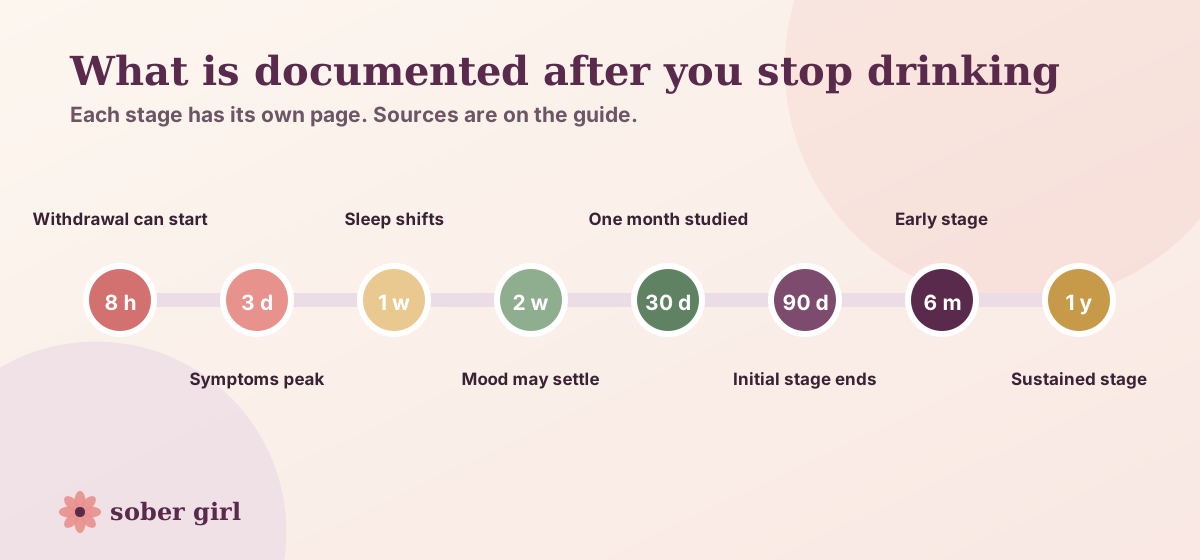
The timeline at a glance
| When | What is documented | Full page |
|---|---|---|
| 8 hours | Withdrawal symptoms usually begin within 8 hours of the last drink, though they can start days later [1] | 24 hours sober |
| 24 to 72 hours | Symptoms tend to peak [1]. Delirium tremens, the severe form, most often starts 48 to 96 hours after the last drink [4] | 3 days sober |
| 1 week | Alcohol disrupts the second half of the night and reduces REM sleep [5], so sleep is often the first thing to shift | 1 week sober |
| 2 weeks | No trustworthy study at exactly 14 days. Sleep and mood changes can last for months [1] | 2 weeks sober |
| 30 days | Insulin resistance, blood pressure and weight fell in 94 people after a month [2]. Dry January participants self-reported better sleep and more energy [6] | 30 days sober |
| 90 days | The end of the "initial" stage in NIAAA’s research definitions [7] | 90 days sober |
| 6 months | Seven in ten Dry January participants were still drinking less riskily after six months [8] | 6 months sober |
| 1 year | The start of the "sustained" stage, which runs from 1 to 5 years [7] | 1 year sober |
The best-studied point: one month
What changed after one month without alcohol
Reduction from baseline in people who abstained for a month (n = 94). Bars show the size of the fall.
The BMJ Open study followed 94 healthy people who chose to abstain for a month and 47 who kept drinking. Insulin resistance, blood pressure, weight and two cancer-related growth factors all fell in the abstinence group, and the researchers found none of those changes was explained by diet, exercise or smoking [2]. It was observational, people chose their group, and it excluded people with liver disease or alcohol dependence [2]. A month is long enough for measurable changes in people who were not dependent on alcohol.
What people notice is a different list. In a 2019 Dry January evaluation, 70% said they slept better, 66% had more energy, 54% lost weight and 86% saved money [6]. These are self-reports from people who signed up, not a trial.
Why it is different for different people
MedlinePlus says the risk of withdrawal rises with how often a person drinks, and that other medical problems can make symptoms more severe [1]. Someone who drinks two glasses of wine most nights is in a different position from someone who drinks heavily every day, and a month off will look different for each. If you are unsure which group you are in, our guide to how much alcohol is too much for a woman explains the NIAAA definitions.
The liver is a good example of why dates are the wrong frame. A review in NIAAA’s journal says alcohol-related fatty liver can be reversed when drinking stops, while more advanced disease can stabilise with abstinence [9]. It depends on the stage of disease, not the number of days.
What stopping avoids over the long run
The long-run effects are risks that stop being added, not changes you can see. NIAAA says even one drink a day can raise a woman’s breast cancer risk by 5% to 15% compared with not drinking, and that women are more susceptible than men to alcohol-related heart disease [10]. No study gives a date when those risks fall back, so we do not pretend to. Our guide to the benefits of quitting alcohol covers what the evidence supports.
What we could not find
- A study that measured skin, hair or face changes at a specific day after stopping. Online "before and after" claims are anecdotes. See alcohol face for what is documented.
- A reliable date for when sleep returns to normal. MedlinePlus says changes can last for months [1].
- A health change you can promise at 60 or 100 days. See 60 days sober and 100 days sober for what the habit research says.
See your own timeline
A published timeline cannot tell you what you will feel. Your own can: a daily check-in and, with Plus, a short journal note with a mood show how sleep and mood move, which memory does not. The sobriety counter shows your days, hours and seconds, and the calculator shows what you have skipped.
Is Sober Girl right for you?
- use an Android phone (the iPhone app is coming soon)
- want a private tracker, with your journal kept on your device
- want a day counter, money saved and a daily check-in in one calm place
- want a Craving SOS with a breathing exercise and a 10-minute timer
- want to start free and add Plus only if you need the journal, insights or milestone cards
- need it on an iPhone today (the App Store version is coming soon)
- want a community feed, live coaching or an AI chat
- want a structured multi-week education program
- need medical help for heavy drinking or withdrawal. An app is not treatment, so see the safety notes above
Frequently asked questions
What happens when you stop drinking alcohol?
It depends on how much you drank. For heavy drinkers, withdrawal symptoms usually start within 8 hours and peak by 24 to 72 hours, according to MedlinePlus. In a month-off study, insulin resistance, blood pressure and weight fell. Sleep and mood can take months to settle.
What happens to your body when you stop drinking after a month?
In a BMJ Open study of 94 people, insulin resistance fell 25.9%, systolic blood pressure 6.6% and weight 1.5% after a month without alcohol. It was observational and excluded people with alcohol dependence.
How long does it take for your body to recover from alcohol?
There is no single date. Withdrawal usually peaks within 72 hours, sleep and mood changes can last months, and the liver depends on the stage of disease: fatty liver can be reversed when drinking stops.
What are the benefits of stopping drinking alcohol?
Measured in a month-off study: lower insulin resistance, blood pressure and weight. Self-reported in Dry January: saving money, better sleep and more energy. Long term, you stop adding risks such as breast cancer, which NIAAA says rises 5% to 15% with one drink a day.
Is it safe to stop drinking suddenly?
Not always. If you drink heavily or every day, alcohol withdrawal can be dangerous and a doctor should be involved. MedlinePlus says to call 911 for seizures, fever, severe confusion, hallucinations or an irregular heartbeat.
Sources
- Alcohol withdrawal. MedlinePlus (US National Library of Medicine), reviewed 1 January 2025 by Frank D. Brodkey, MD.
- Short-term abstinence from alcohol and changes in cardiovascular risk factors, liver function tests and cancer-related growth factors: a prospective observational study. Mehta G, Macdonald S, Cronberg A, et al. BMJ Open 2018;8:e020673. Observational study. 94 people who chose to abstain for a month and 47 who kept drinking.
- National Helpline. SAMHSA. Free, confidential, 24/7 treatment referral line: 1-800-662-4357.
- Delirium tremens. MedlinePlus (US National Library of Medicine), reviewed 1 January 2025.
- Alcohol and the Sleeping Brain. PubMed Central, US National Library of Medicine.
- The evidence behind the Dry January challenge: benefits and long-term impact. Alcohol Change UK, summarising evaluations by Dr Richard de Visser, University of Sussex. Self-reported results from people who signed up to Dry January, not a controlled trial.
- NIAAA Recovery Research Definitions. NIAAA. Research definitions for remission and recovery from alcohol use disorder, with duration bands.
- About Dry January. Alcohol Change UK.
- Alcoholic Liver Disease: Pathogenesis and Current Management. Alcohol Research: Current Reviews, vol. 38, no. 2, NIAAA.
- Women and Alcohol. NIAAA fact sheet, updated December 2025.
How we write these. Every figure above links to the source it came from, and we label self-reported and observational results as such. Where we could not find a source we trust, the page says so instead of filling the gap. Sober Girl is made by ShipAI Lab and this is not medical advice. Sources were checked on 6 October 2026. If you spot an error, email us at integrateopenai@gmail.com.
Keep reading
Today is day one.
Sober Girl is a private sobriety tracker for women, on Android now and coming soon to iPhone: day counter, money saved, craving SOS and a tree that grows with you. Free to start.