Is red wine good for you? What the evidence shows
The idea that a glass of red a night is protective is everywhere. Here is where it came from, why it has fallen apart, and what is left.
Not in a way research has been able to show. A systematic review of 87 studies and nearly 4 million people found low-volume drinkers had lower mortality before adjustment (relative risk 0.86), but studies that corrected design flaws, such as counting former drinkers as abstainers, found no net mortality benefit compared with lifetime abstention or occasional drinking [1]. For red wine’s antioxidant resveratrol, a study of 783 adults aged 65 and over found urinary resveratrol levels were not significantly associated with all-cause mortality over nine years [2]. Meanwhile the 2025 US Surgeon General advisory said alcohol contributes to nearly 100,000 cancer cases a year [3].
Where the idea comes from
Older meta-analyses of cohort studies found a J-shaped curve: people who drank a little had lower all-cause mortality than people who drank nothing, and people who drank a lot did worst [1]. Red wine became the poster drink for that curve, helped by the finding that grapes contain resveratrol, a polyphenol thought to have antioxidant and anti-inflammatory effects [2].
Track it in Sober Girl
Why the curve does not hold up
Stockwell and colleagues pointed out the problem: low-volume drinkers may look healthy only because the “abstainers” they are compared with are skewed towards ill health. Former drinkers, who may have stopped because they got sick, were often counted as abstainers [1].
Their review pooled 87 studies covering 3,998,626 people and 367,103 deaths. Without adjustment it reproduced the classic curve, with low-volume drinkers (1.3 to 24.9 g of alcohol a day) at relative risk 0.86 [1]. Once they controlled for study characteristics such as misclassified abstainers, they found that low-volume drinking had no net mortality benefit compared with lifetime abstention or occasional drinking [1]. The review’s abstract does not single out red wine, but it addresses the claim at the root: the apparent protection of moderate drinking.
What about resveratrol?
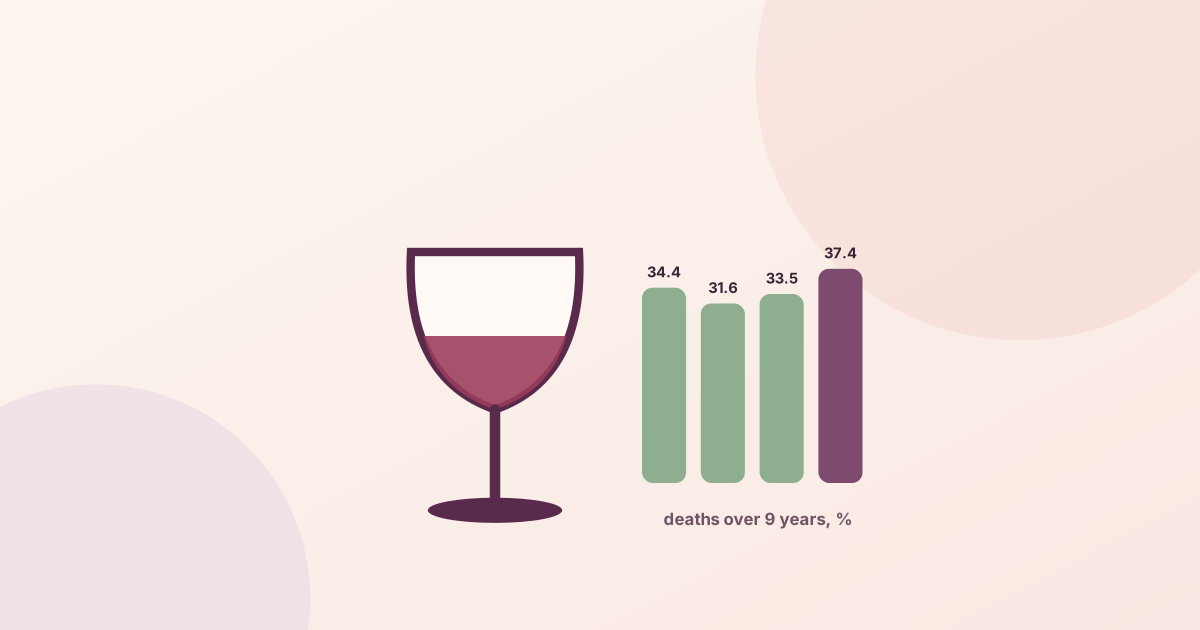
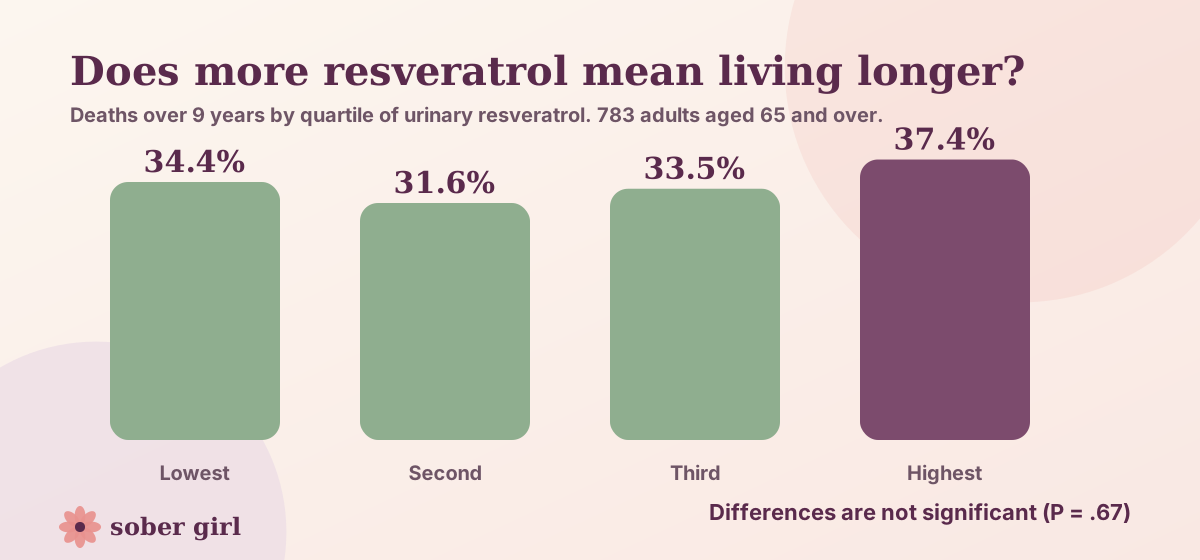
The InCHIANTI study tested the idea directly. Researchers measured urinary resveratrol metabolites in 783 adults aged 65 and over in the Chianti region of Italy, and followed them for nine years. Across quartiles from lowest to highest resveratrol, 34.4%, 31.6%, 33.5% and 37.4% of participants died, a difference that was not significant (P = .67) [2]. Those in the lowest quartile had a hazard ratio for mortality of 0.80 (95% CI 0.54 to 1.17) against the highest, which is compatible with no difference [2].
The study is observational and in older adults in one region, so it cannot close the question. It does show that, among people who eat and drink in the Chianti way, higher resveratrol levels achieved with diet did not go with longer life [2].
What the same drink costs
The US Surgeon General’s January 2025 advisory reported that alcohol contributes to nearly 100,000 US cancer cases and about 20,000 deaths a year, and named seven cancers including breast cancer in women [3]. NIAAA says even one drink a day can raise a woman’s breast cancer risk by 5% to 15% compared with not drinking [4]. NIAAA’s overall message on health is that for those who drink, the less, the better [5].
The honest bottom line
- No good evidence that red wine protects, and a careful review of the whole question found no net mortality benefit for low-volume drinking.
- Resveratrol from diet did not predict longer life in the one cohort that measured it.
- Alcohol raises some cancer risks, including breast cancer, at low levels of drinking.
- None of this is a reason to feel guilty about the glass you had. It is a reason not to start for health, or to keep one going on that basis.
If you are thinking about the nightly glass, our guide on how to stop drinking wine every night has a practical plan, and how much alcohol is too much for a woman has the NIAAA definitions.
Is Sober Girl right for you?
- use an Android phone (the iPhone app is coming soon)
- want a private tracker, with your journal kept on your device
- want a day counter, money saved and a daily check-in in one calm place
- want a Craving SOS with a breathing exercise and a 10-minute timer
- want to start free and add Plus only if you need the journal, insights or milestone cards
- need it on an iPhone today (the App Store version is coming soon)
- want a community feed, live coaching or an AI chat
- want a structured multi-week education program
- need medical help for heavy drinking or withdrawal. An app is not treatment, so see the safety notes above
Frequently asked questions
Is a glass of red wine a day good for you?
Research has not been able to show it. A review of 87 studies found no net mortality benefit for low-volume drinking once design flaws were corrected, and alcohol raises some cancer risks, including breast cancer.
Does resveratrol in red wine help you live longer?
In a nine-year study of 783 older adults, resveratrol levels from diet were not significantly associated with all-cause mortality.
Is red wine better for your heart than other alcohol?
We did not find a source that supports it. A review of low-volume drinking found no net mortality benefit once design flaws were corrected, and its abstract does not single out red wine.
Does red wine cause cancer?
Alcohol, in any form, is linked with cancers. The US Surgeon General named seven, including breast cancer, and NIAAA says one drink a day can raise a woman’s breast cancer risk by 5% to 15%.
What if I already drink red wine every night?
You do not need to feel guilty, but the health case for it is weak. If you want to cut back, a plan helps more than willpower.
Sources
- Do "Moderate" Drinkers Have Reduced Mortality Risk? A Systematic Review and Meta-Analysis of Alcohol Consumption and All-Cause Mortality. Stockwell T, Zhao J, Panwar S, et al. Journal of Studies on Alcohol and Drugs 2016;77(2):185-198. 87 studies, 3,998,626 people, 367,103 deaths.
- Resveratrol levels and all-cause mortality in older community-dwelling adults. Semba RD, Ferrucci L, Bartali B, et al. JAMA Internal Medicine 2014. InCHIANTI cohort: 783 adults aged 65 and over, followed for 9 years.
- Surgeon General's Report Calls for Cancer Warning Labels on Alcoholic Beverages. The ASCO Post, January 2025, reporting the US Surgeon General advisory of 3 January 2025. Reports that alcohol contributes to nearly 100,000 US cancer cases and about 20,000 deaths a year, and names seven cancers including breast cancer in women.
- Women and Alcohol. NIAAA fact sheet, updated December 2025.
- The Basics: Defining How Much Alcohol Is Too Much. NIAAA.
How we write these. Every figure above links to the source it came from, and we label self-reported and observational results as such. Where we could not find a source we trust, the page says so instead of filling the gap. Sober Girl is made by ShipAI Lab and this is not medical advice. Sources were checked on 6 October 2026. If you spot an error, email us at integrateopenai@gmail.com.
Keep reading
Today is day one.
Sober Girl is a private sobriety tracker for women, on Android now and coming soon to iPhone: day counter, money saved, craving SOS and a tree that grows with you. Free to start.