Alcohol alternatives: what to drink instead, moment by moment
The drink was rarely about the alcohol alone. It was the fizz at 6 pm, the glass with dinner, something in your hand at a party. Here are swaps for each of those moments, what the labels really mean, and the swaps worth skipping in early sobriety.
The best alcohol alternatives match the moment you used to drink: sparkling water with lime for the after-work glass, a non-alcoholic wine or beer with dinner, a mocktail at a party, herbal tea at bedtime. On US beer labels, “non-alcoholic” can still mean up to 0.5% alcohol; only “alcohol free” means none [1]. Kombucha can reach 0.5% or more [2], and kava has been linked to rare but serious liver injury [3]. If you are newly sober, drinks that taste like your old drink can be a trigger, so start with ones that do not.
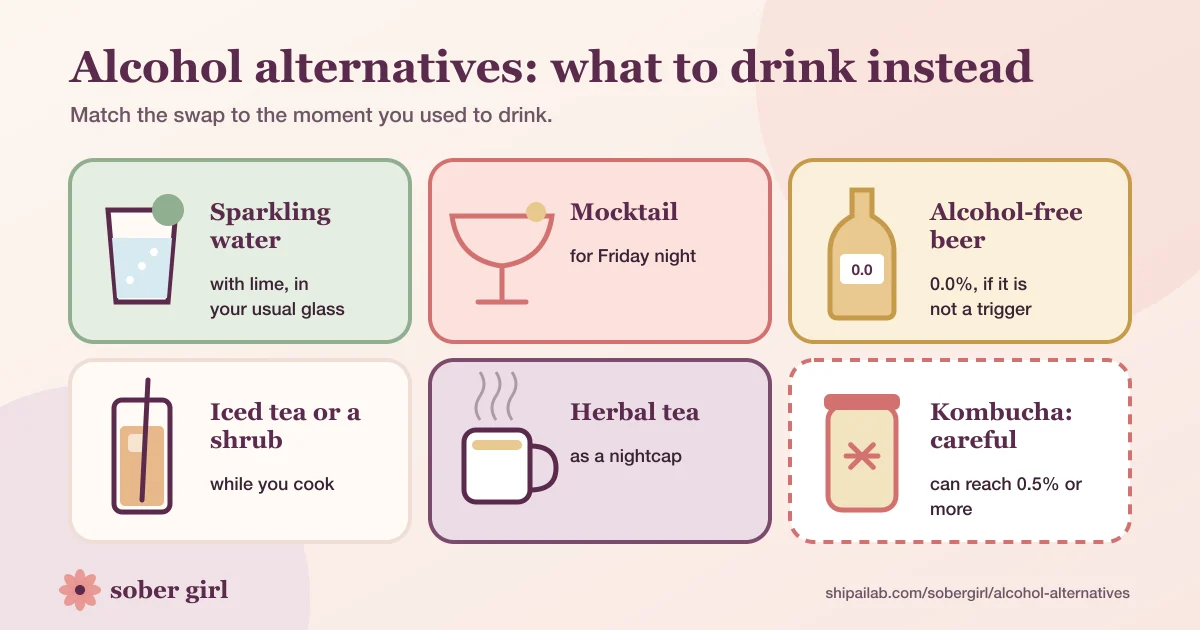
Alcohol alternatives for every drinking moment
Start with when you drank, not what you drank. Each moment had a different job: winding down, celebrating, fitting in, filling time. A good swap does the same job.
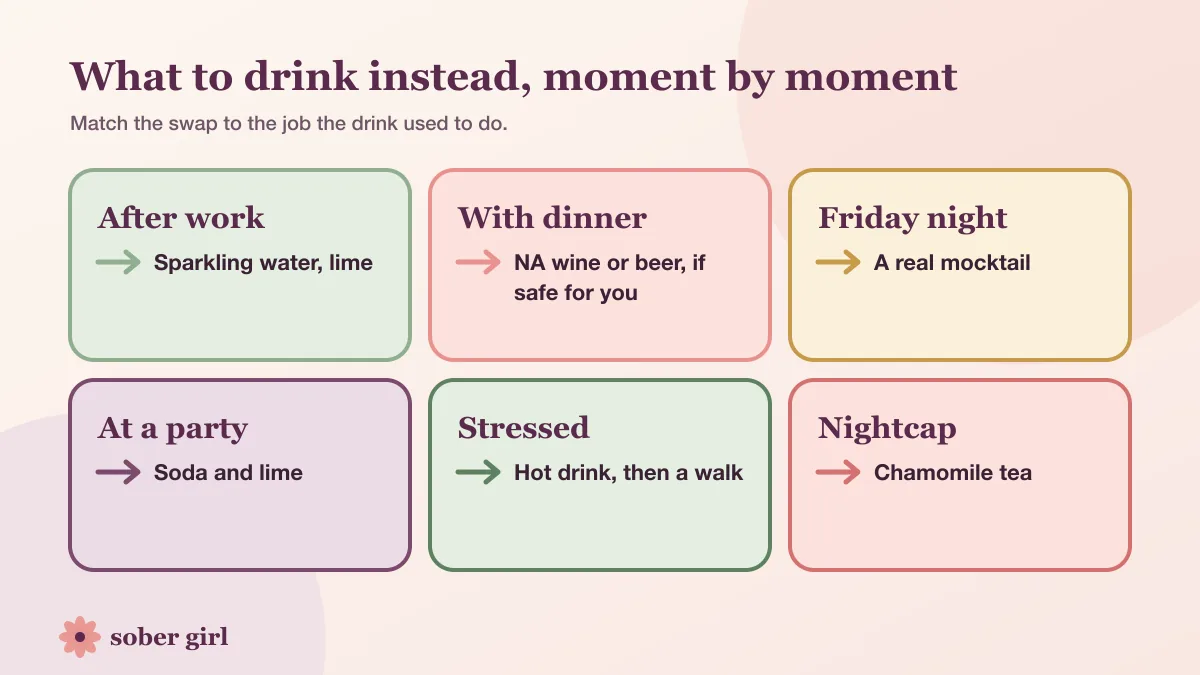
| When you used to drink | What the drink did | Try instead |
|---|---|---|
| After work, around 6 pm | Marked the end of the day | Sparkling water in your usual glass with lime, cucumber or a splash of juice |
| While cooking | Something to sip | Iced tea, or a shrub (a vinegar-based fruit syrup) topped with soda |
| With dinner | Went with the food | Non-alcoholic wine or beer, if they are not a trigger for you |
| Friday night | Felt like a reward | A proper mocktail in a nice glass; see our easy mocktails |
| At a party or a bar | Something in your hand | Soda water with lime, which looks like any other drink, or a mocktail from the bar |
| Stressed or sad | Took the edge off | A hot drink and ten minutes outside, then name what you feel |
| A nightcap | Helped you switch off | Chamomile or another caffeine-free tea, or warm milk |
| A slow weekend afternoon | Filled the time | Flavoured sparkling water and something to do with your hands |
For things to do rather than drink, see what to do instead of drinking.
Track it in Sober Girl
“Non-alcoholic” vs “alcohol-free”: what the label means
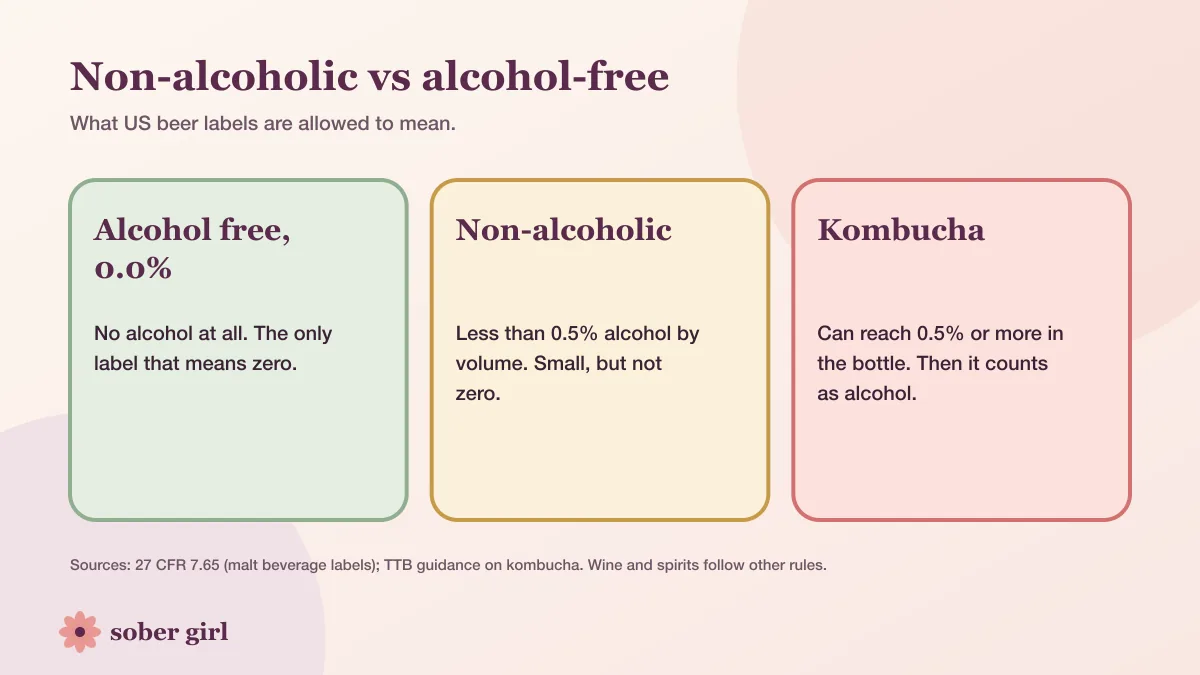
On US beer labels the two terms are not the same. “Non-alcoholic” may only be used with the statement “contains less than 0.5 percent alcohol by volume” next to it. “Alcohol free” may only be used on malt beverages that contain no alcohol, and a label may only say 0.0% if it also says alcohol free [1].
| On the label | Alcohol | What to know |
|---|---|---|
| Alcohol free, 0.0% | None | The only beer label that means zero [1] |
| Non-alcoholic | Less than 0.5% ABV | Small, but not zero |
| Kombucha | Varies, and can rise in the bottle | At 0.5% or more it counts as an alcohol beverage under federal rules [2]; one lab study found 1.12% to 2.00% in commercial samples [4] |
| Low-alcohol or “light” | Varies | Still alcohol, so not an alternative if your goal is none |
The main kinds of alcohol alternatives
- Sparkling water and sodas. Cheap, everywhere, and they give you the fizz. Add fruit, herbs or a splash of juice.
- Non-alcoholic beer and wine. The closest to the taste of the real thing; see non-alcoholic beer and non-alcoholic wine.
- Non-alcoholic spirits. Made to be mixed. Pricey per bottle, and they taste of botanicals more than of alcohol.
- Mocktails. A ritual as much as a drink: a good glass, ice and a garnish.
- Kombucha. Tangy and fizzy, but it can carry alcohol (see the label table); read does kombucha have alcohol.
- Tea and coffee. Hot drinks make a good bedtime or stress swap; skip caffeine late in the day.
- Functional drinks. Cans with adaptogens, kava or hemp, sold as a calm “buzz”. Read the next section first.
Alcohol alternatives to be careful with
- Kava drinks. NCCIH says kava products have been linked to rare cases of liver injury, some serious or fatal, including drinks made with water, and lists taking kava with alcohol as one suggested cause [3]. Talk to a doctor first, especially if drinking has already been hard on your liver.
- THC and hemp drinks. These swap one intoxicant for another. The CDC estimates about 3 in 10 people who use cannabis have cannabis use disorder [5]. Our guide to California sober covers the wider debate.
- Drinks that copy your old drink exactly. If you always drank IPA, a non-alcoholic IPA in the same glass at the same hour can bring the craving straight back. Many people find it easier to change the flavour as well as the alcohol in the first weeks.
- Bitters and some syrups. Most cocktail bitters are made with alcohol. A few dashes is a tiny amount, but if your goal is zero, read the label.
Should you drink non-alcoholic beer or wine in early sobriety?
There is no single answer. For some people a non-alcoholic beer at a barbecue keeps them in the group without drinking. For others, the taste, the bottle and the ritual pull straight back towards the real thing. Ask yourself three questions:
- Does it make me want the real version, during or after?
- Am I drinking it where and when I used to drink, alone, to switch off?
- Am I having more of it than I would of sparkling water?
If any answer is yes, take it off the list for now and try again after a milestone such as 90 days. The goal is a drink that does the job the alcohol did, without starting the old conversation in your head.
Find out which moments are hardest
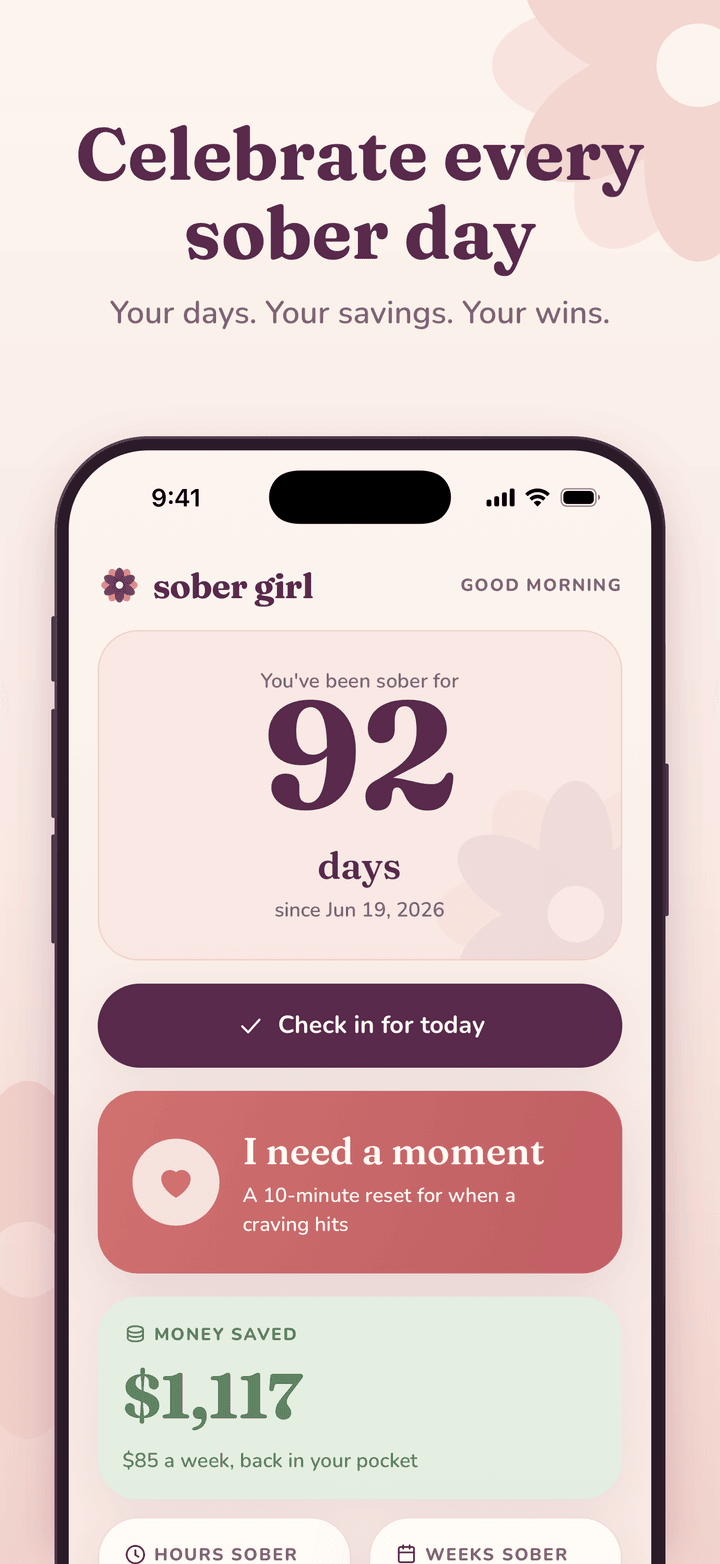
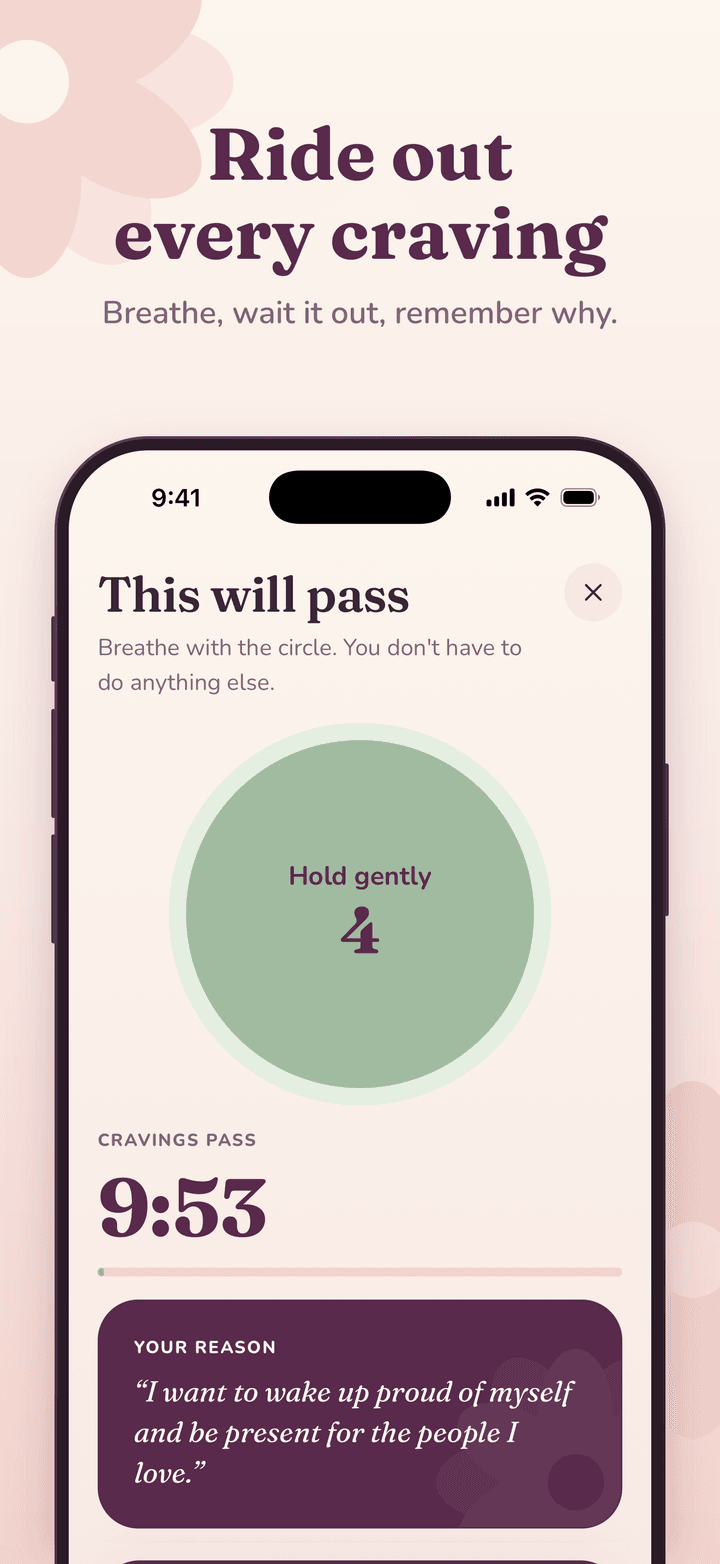
The swap table works best when you know your hard moments. Sober Girl, which we make, lets you note what set off a craving when you use the SOS screen (stress, being out, boredom, feeling low, celebrating or routine), and shows which one comes up most and at what time of day. It also counts the money you have kept since your last drink, which pays for a lot of good sparkling water.
Is Sober Girl right for you?
- use an iPhone or an Android phone
- want a private tracker, with your journal kept on your device
- want a day counter, money saved and a daily check-in in one calm place
- want a Craving SOS with a breathing exercise and a 10-minute timer
- want to start free and add Plus only if you need the journal, insights or milestone cards
- want a community feed, live coaching or an AI chat
- want a structured multi-week education program
- need medical help for heavy drinking or withdrawal. An app is not treatment, so see the safety notes above
Frequently asked questions
What is the best alternative to alcohol?
The one that does the same job your drink did. Sparkling water with lime covers most after-work moments; a mocktail covers celebrations; herbal tea covers the nightcap.
What can I drink at night instead of alcohol?
Chamomile or another caffeine-free tea, warm milk, or sparkling water in a nice glass. Avoid caffeine late if sleep is a problem.
Is non-alcoholic beer really alcohol-free?
Not always. In the US, “non-alcoholic” beer can contain up to 0.5% alcohol. Only beer labelled “alcohol free” (or 0.0%) contains none.
What drink gives you a buzz without alcohol?
Drinks sold for a “buzz” usually contain kava, hemp or THC, or a lot of caffeine. Kava has been linked to rare liver injury and THC is an intoxicant in its own right, so if your goal is sobriety, a calm routine works better than a substitute high.
Can alcohol alternatives help you quit drinking?
They make the hardest moments easier, but they are a tool, not a plan. Pair them with a clear reason, a day count and someone to talk to.
Sources
- 27 CFR 7.65: Alcohol content (malt beverage labeling). Electronic Code of Federal Regulations, read 13 November 2026. “Non-alcoholic” only with “contains less than 0.5 percent alcohol by volume” next to it; “alcohol free” only on malt beverages containing no alcohol; 0.0% may be stated only if also labeled alcohol free.
- Kombucha. US Alcohol and Tobacco Tax and Trade Bureau (TTB), last updated 13 August 2019. Kombucha at 0.5% alcohol by volume or more is an alcohol beverage under federal rules, including when it reaches that level through continued fermentation in the bottle.
- Kava. National Center for Complementary and Integrative Health (NIH), read 13 November 2026. Kava products have been linked to rare cases of liver injury, some serious or fatal, including kava beverages prepared with water; taking kava together with alcohol is one suggested cause.
- Examination of the Varied and Changing Ethanol Content of Commercial Kombucha Products. Talebi M, Frink LA, Patel RA, Armstrong DW. Food Analytical Methods 2017;10:4062–4067. Lab test of commercial kombucha samples: 1.12% to 2.00% alcohol by volume, rising significantly during 60 days of storage both refrigerated (4 °C) and at room temperature (22 °C).
- Understanding Your Risk for Cannabis Use Disorder. CDC, page dated 5 December 2024. Approximately 3 in 10 people who use cannabis have cannabis use disorder; higher risk with youth onset and frequent use; lists signs.
- Alcohol withdrawal. MedlinePlus (US National Library of Medicine), reviewed 1 January 2025 by Frank D. Brodkey, MD.
- National Helpline. SAMHSA. Free, confidential, 24/7 treatment referral line: 1-800-662-4357.
How we write these. Every figure above links to the source it came from, and we label self-reported and observational results as such. Where we could not find a source we trust, the page says so instead of filling the gap. Sober Girl is made by ShipAI Lab and this is not medical advice. Sources were checked on 6 October 2026. If you spot an error, email us at [email protected].
Keep reading
Today is day one.
Sober Girl is a private sobriety tracker for women, on iPhone and Android: day counter, money saved, craving SOS and a tree that grows with you. Free to start.