Alcohol weight loss calculator: how much weight will you lose if you stop drinking?
Enter what you drink in a normal week. The calculator adds up the calories and estimates the weight change from stopping, using a published model of how weight responds to eating less, not the old 3,500-calorie rule.
Alcohol weight loss calculator
Enter how many of each drink you have in a typical week. Then choose how much of those calories you think will come back as snacks, desserts or sugary drinks once you stop. Pick "None" for the most optimistic estimate and "Half" for a cautious one.
How many of each do you drink in a typical week?
How much of those calories might come back as snacks or soft drinks?
Enter at least one drink to see your estimate.
Estimate only. Calories per drink are NIAAA averages. Weight uses the Hall et al. (Lancet, 2011) rule for an average adult with overweight: every lasting 24 calories a day less leads to about 1 kg (2.2 lb) less, about half within a year. Your body, activity and what you eat instead all change the result. Nothing you enter is stored or sent.
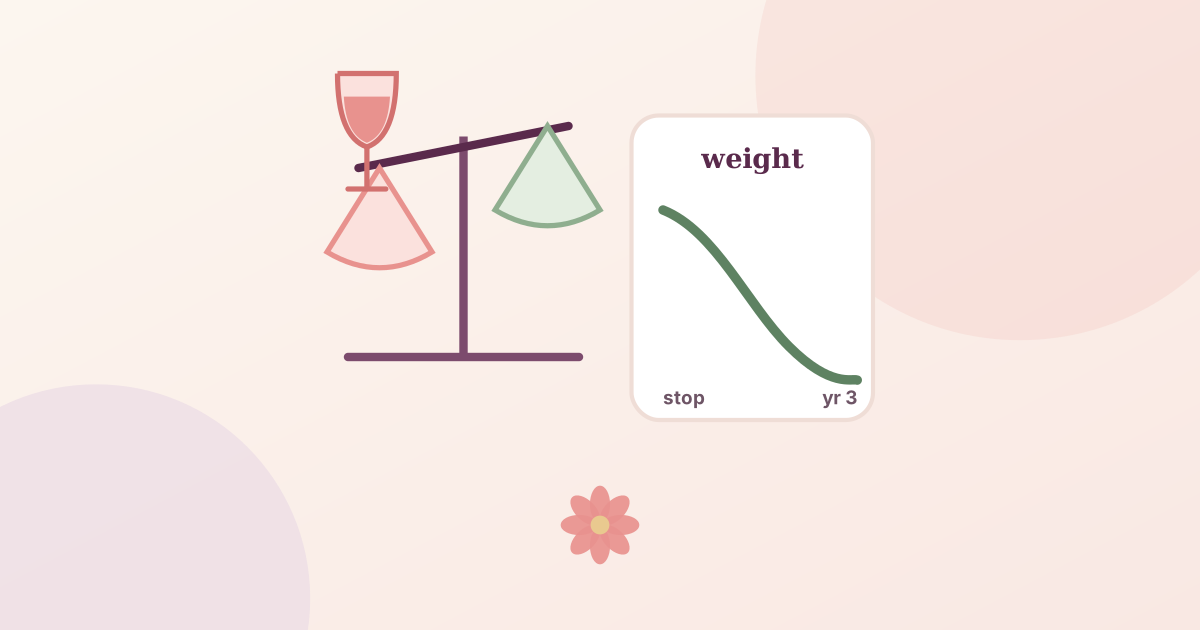
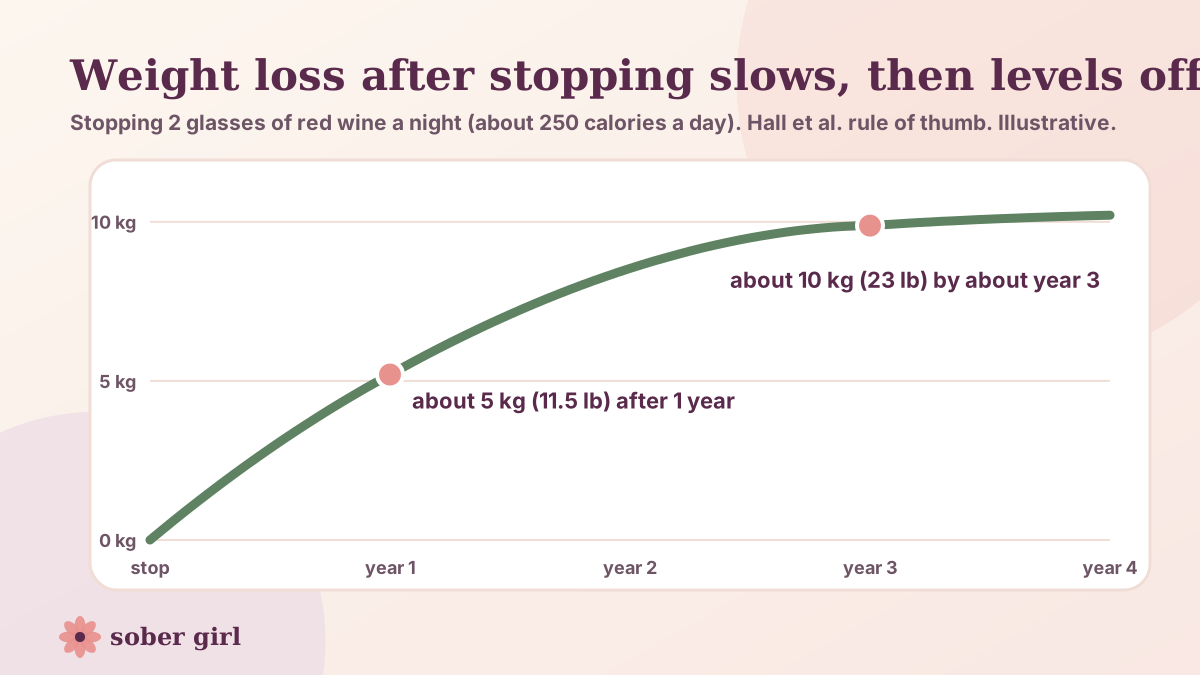
If nothing replaces them, every 24 calories a day you stop drinking leads to about 1 kg (2.2 lb) less body weight in the long run, with about half of that lost in the first year and about 95% within about 3 years [1]. Two 5 oz glasses of red wine a night are about 250 calories a day, using NIAAA’s average of 125 calories a glass [2], which works out to about 5 kg (11.5 lb) in the first year and about 10 kg (23 lb) eventually. In a BMJ Open study, 94 people who stopped drinking for a month lost 1.5% of their body weight on average [3]. Real results are usually smaller, because some of those calories come back as food.
Track it in Sober Girl
How the calculator works
- Calories per drink. Each drink uses NIAAA’s average: 153 calories for a 12 oz regular beer, 103 for a light beer, 125 for a 5 oz glass of red wine, 121 for white, 84 for a 4 oz glass of champagne, 97 for a 1.5 oz shot of 80-proof spirits, 168 for a margarita, 146 for a cosmopolitan and 143 for a mojito [2].
- Calories a day. Your weekly total is divided by 7, then reduced by the share you expect to replace with other food or drink.
- Weight. Hall and colleagues modelled how body weight responds to a lasting change in what people take in. Their rule of thumb is that a permanent change of 100 kJ a day (about 24 calories) leads to an eventual weight change of about 1 kg, that it takes about a year to reach half of it, and that about 95% arrives within about 3 years [1]. The calculator divides your calories a day by 24 for the eventual figure and halves it for the first year.
The rule was worked out for an average adult with overweight. If you are lighter, very active, older or younger than that, your own number will differ. Treat the result as a sense of scale, not a forecast.
Why not the 3,500-calorie rule?
Many calculators assume that every 3,500 calories you cut removes a pound, forever, in a straight line. Hall’s team showed that this overestimates long-term weight loss, because the body uses less energy as it gets lighter, so the loss slows down and levels off [1]. By the old rule, 250 calories a day would mean about 26 lb a year, every year. By the Hall rule, it is about 11.5 lb in the first year and about 23 lb in total.
How much weight you could lose: worked examples
| Drinking habit | Calories a day | Estimated loss after 1 year | Estimated eventual loss |
|---|---|---|---|
| 4 shots of vodka with soda water at the weekend | about 55 | about 1.2 kg (2.5 lb) | about 2.3 kg (5 lb) |
| 1 glass of red wine (5 oz) every night | about 125 | about 2.6 kg (5.7 lb) | about 5.2 kg (11.5 lb) |
| 3 regular beers on Friday and on Saturday | about 131 | about 2.7 kg (6 lb) | about 5.5 kg (12 lb) |
| 1 regular beer every night | about 153 | about 3.2 kg (7 lb) | about 6.4 kg (14 lb) |
| A margarita and 2 glasses of white wine, 3 nights a week | about 176 | about 3.7 kg (8 lb) | about 7.3 kg (16 lb) |
| 2 glasses of red wine every night | about 250 | about 5.2 kg (11.5 lb) | about 10.4 kg (23 lb) |
| A bottle of red wine (five 5 oz glasses) every night | about 625 | about 13 kg (29 lb) | about 26 kg (57 lb) |
The last row is the least reliable. Very heavy drinking often changes how much people eat in ways no simple model captures, and anyone drinking a bottle a day should talk to a doctor before stopping (see the safety note below). For what a bottle a day means on the guidelines, see is a bottle of wine a day too much?.
How fast the weight comes off
- After 1 month. The best measured figure is from a BMJ Open study: 94 people who had been drinking about 18 standard drinks a week and stopped for a month lost 1.5% of their body weight on average [3]. For someone who weighs 80 kg (176 lb), that is about 1.2 kg (2.6 lb). Some of the early drop may be water rather than fat. In Alcohol Change UK’s summary of a 2019 Dry January evaluation, 54% of participants said they had lost weight [4].
- After 1 year. About half of the eventual change, by the Hall rule [1].
- After about 3 years. About 95% of it, after which weight levels off at a new, lower point as long as the change lasts [1].
Why your real weight loss may be smaller
Calories from alcohol are real: alcohol itself carries about 7 calories per gram [5], and a US standard drink holds about 14 grams of it [6], so a drink has close to 100 calories before any mixer. But the research on drinking and body weight is mixed. A review found that light to moderate drinking is not consistently linked to weight gain, while heavy drinking is more consistently linked to it [5]. Several things narrow the gap between the calculator and the scale:
- The calories move. A glass of wine at 7 p.m. can turn into chocolate at 7 p.m. That is why the calculator lets you set a share that comes back.
- You drank less than you think, or more. Home pours are often bigger than 5 oz, which would make the real saving larger.
- Light drinkers have less to lose. If you have a few drinks a week, the change will be small, whatever the headlines say.
- Late-night food. Some people eat less after stopping, because drinking used to come with takeaways or snacks. That is a practical observation, not a research finding, but it can push the result the other way.
For the wider picture, see alcohol and weight and alcohol belly and bloating.
What changes besides the scale
Weight was the smallest change in the BMJ Open study. The same month without alcohol also cut insulin resistance by 25.9% and lowered blood pressure [3]. It was observational and excluded people with liver disease or alcohol dependence, so it shows what happened to that group, not what will happen to you.
If weight is your reason to stop, it is a good one, but a slow one. Many people find that better sleep, money saved and steadier mornings show up long before the scale moves. A tracker that counts the days and the money can keep that visible.
Is Sober Girl right for you?
- use an iPhone or an Android phone
- want a private tracker, with your journal kept on your device
- want a day counter, money saved and a daily check-in in one calm place
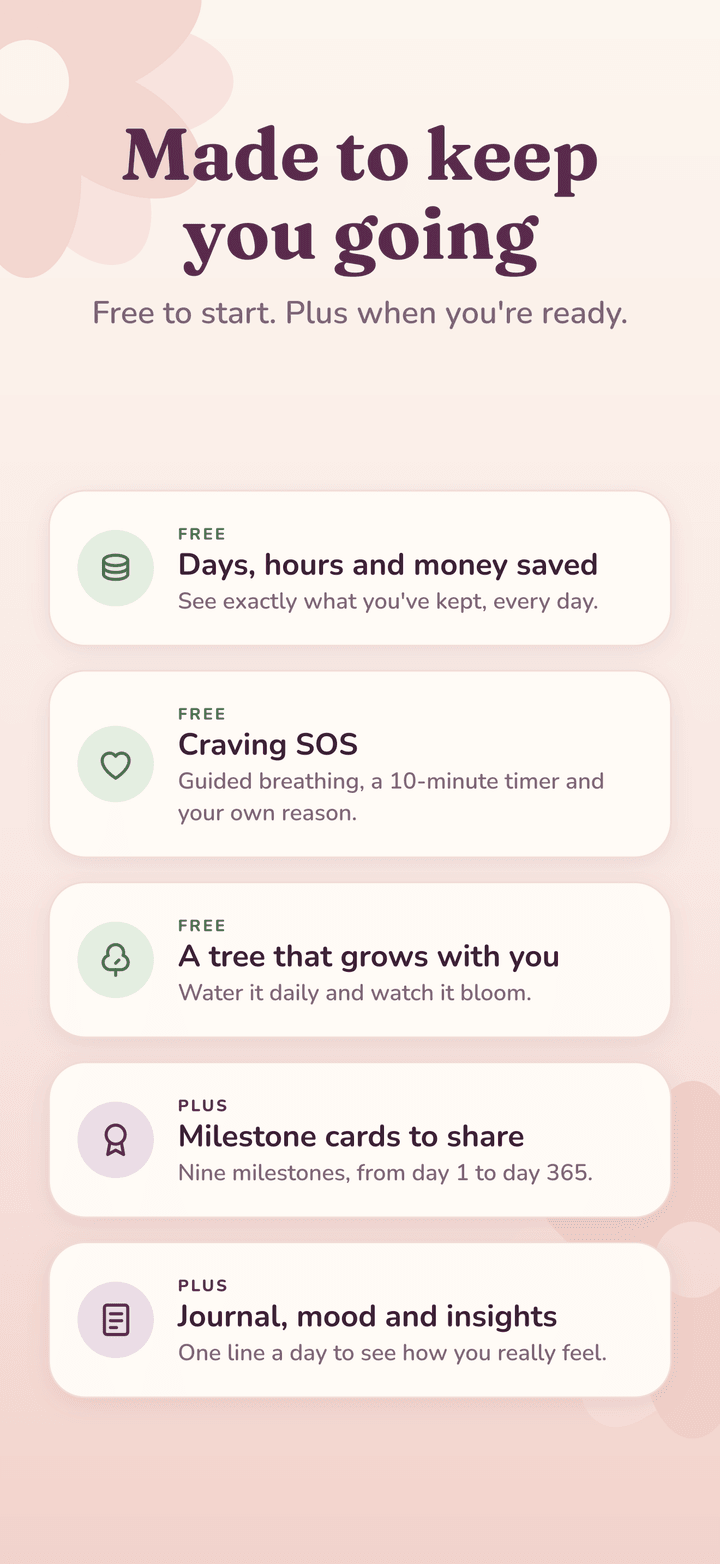
- want a Craving SOS with a breathing exercise and a 10-minute timer
- want to start free and add Plus only if you need the journal, insights or milestone cards
- want a community feed, live coaching or an AI chat
- want a structured multi-week education program
- need medical help for heavy drinking or withdrawal. An app is not treatment, so see the safety notes above
Frequently asked questions
How much weight will I lose if I stop drinking alcohol?
It depends on how much you drink. As a rule of thumb from a Lancet model, every 24 calories a day you stop leads to about 1 kg (2.2 lb) less in the long run, about half in the first year. Two glasses of red wine a night, about 250 calories a day, works out to about 5 kg (11.5 lb) in a year and about 10 kg (23 lb) eventually, if nothing replaces those calories.
How much weight will I lose if I stop drinking for a month?
A little. In a BMJ Open study, people who had been drinking about 18 standard drinks a week lost 1.5% of their body weight after a month without alcohol. For someone who weighs 80 kg (176 lb), that is about 1.2 kg (2.6 lb).
Will I lose weight if I stop drinking wine?
Probably, if you drank regularly and do not replace the calories. A 5 oz glass of red wine has about 125 calories on NIAAA’s figures, so one glass a night is about 875 calories a week, or roughly 2.6 kg (5.7 lb) over the first year by the Hall rule.
How many calories are in alcohol?
Alcohol itself has about 7 calories per gram, so a US standard drink with 14 grams has about 98 before any mixer. NIAAA’s averages are 153 for a regular beer, 125 for a 5 oz glass of red wine and 97 for a 1.5 oz shot of spirits.
Why am I not losing weight after quitting alcohol?
Common reasons are that some of the calories came back as food or sugary drinks, that you were a light drinker with little to lose, or that it is still early: by the Lancet model, only about half the eventual change arrives in the first year.
Is this calculator accurate?
It gives a sense of scale, not a forecast. Calories per drink are NIAAA averages, and the weight rule was worked out for an average adult with overweight. Your body, activity and what you eat instead change the result.
Sources
- Quantification of the effect of energy imbalance on bodyweight. Hall KD, Sacks G, Chandramohan D, et al. The Lancet 2011;378(9793):826–837. A validated model. Rule of thumb for an average adult with overweight: a lasting change of 100 kJ (about 24 kcal) a day leads to about 1 kg of eventual weight change, half within about a year and 95% within about 3 years.
- Alcohol Calorie Calculator. NIAAA, Rethinking Drinking. Average calories per serving, for example 153 for a 12 oz regular beer and 125 for a 5 oz glass of red wine. Read 7 November 2026.
- Short-term abstinence from alcohol and changes in cardiovascular risk factors, liver function tests and cancer-related growth factors: a prospective observational study. Mehta G, Macdonald S, Cronberg A, et al. BMJ Open 2018;8:e020673. Observational study. 94 people who chose to abstain for a month and 47 who kept drinking.
- The evidence behind the Dry January challenge: benefits and long-term impact. Alcohol Change UK, summarising evaluations by Dr Richard de Visser, University of Sussex. Self-reported results from people who signed up to Dry January, not a controlled trial.
- Alcohol Consumption and Obesity: An Update. Traversy G, Chaput JP. Current Obesity Reports, 2015. A review. It reports that alcohol provides 7 kcal per gram and that the evidence on weight is mixed.
- What Is A Standard Drink?. NIAAA.
- Alcohol withdrawal. MedlinePlus (US National Library of Medicine), reviewed 1 January 2025 by Frank D. Brodkey, MD.
- National Helpline. SAMHSA. Free, confidential, 24/7 treatment referral line: 1-800-662-4357.
How we write these. Every figure above links to the source it came from, and we label self-reported and observational results as such. Where we could not find a source we trust, the page says so instead of filling the gap. Sober Girl is made by ShipAI Lab and this is not medical advice. Sources were checked on 6 October 2026. If you spot an error, email us at [email protected].
Keep reading
Today is day one.
Sober Girl is a private sobriety tracker for women, on iPhone and Android: day counter, money saved, craving SOS and a tree that grows with you. Free to start.