What does “sober curious” mean?
It means questioning your drinking without committing to never drinking again. Here is where the idea comes from, what the data shows and how to try it.
Sober curious means questioning your drinking and trying time without alcohol, without committing to quit for good. The phrase was popularised by Ruby Warrington’s 2018 book Sober Curious [1]. Gallup found 54% of US adults drank in 2025, down from 67% in 2022, and 51% of women, down from 62% in 2023 [2].
The short answer
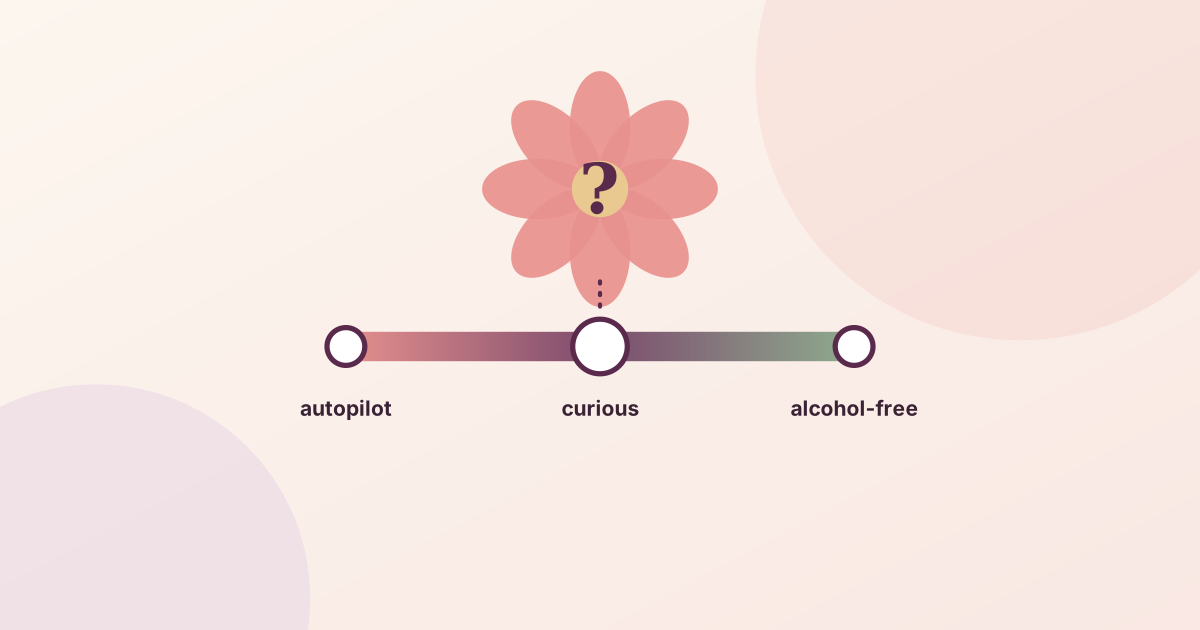
“Sober curious” describes someone who is questioning their relationship with alcohol, and trying time without it, without necessarily committing to quitting for good. The phrase was popularised by Ruby Warrington’s 2018 book Sober Curious, published by HarperOne [1]. It sits between drinking on autopilot and permanent sobriety, and it is a personal choice rather than a diagnosis.
Track it in Sober Girl
Why so many people are asking the question
Gallup’s 2025 poll found 54% of US adults say they drink alcohol, down from 67% in 2022. Among women the figure fell from 62% in 2023 to 51% in 2025. For the first time a majority, 53%, said moderate drinking is bad for health, up from 28% in 2018 [2].
US adults who say they drink alcohol
Share of adults, Gallup Consumption Habits survey
This is a telephone poll of 1,002 adults with a margin of error of about 4 points, so small year-to-year changes should be read loosely. The direction across four years is clear, though [2].
Sober curious, sober and moderating
| Sober curious | Sober | Moderating | |
|---|---|---|---|
| The idea | Testing time without alcohol and noticing what changes | Not drinking, often long term | Drinking less, with limits you set |
| Commitment | Open-ended, can be a 30-day experiment | A firm line | Rules like a weekly cap or drinking days |
| A tracker helps by | Showing days, money saved and mood changes | Counting the streak and marking milestones | Logging each drink against your limit |
It helps to know how the numbers are defined. In the US a standard drink contains 14 grams of pure alcohol. NIAAA defines binge drinking for women as 4 or more drinks within about 2 hours, and heavy drinking as 4 or more on any day or 8 or more in a week. It also says the less alcohol, the better [3].
The health context, honestly
On 3 January 2025 the US Surgeon General issued an advisory identifying alcohol as the third leading preventable cause of cancer in the US, after smoking and obesity [4]. And a BMJ Open study of 94 people who abstained for a month found significant falls in insulin resistance, blood pressure, weight and two cancer-related growth factors, against 47 who kept drinking. It was observational and excluded people with liver disease or alcohol dependence, so it is suggestive and not proof [5].
How to run a low-pressure experiment
- Choose a window. Thirty days is long enough to notice things and short enough to feel doable.
- Write your question. “How do I sleep without alcohol?” is easier to answer than “Should I quit?”
- Track it. Count the days, note your mood in a daily check-in and record what you spend. Memory edits the story.
- Plan the social parts. Decide in advance what you will order and when you will leave.
- Review at the end. What changed? What did not? Then decide what comes next, whether that is more time off, drinking less or carrying on.
When curiosity is not enough
Alcohol use disorder is common. In 2024, 8.0% of US women aged 18 and over had it in the past year [6]. If you have tried to cut down and could not, or you feel unwell when you stop, speak to a doctor, and do not stop suddenly if you drink heavily [7]. The NIAAA Alcohol Treatment Navigator helps adults find evidence-based care [8], and the SAMHSA National Helpline (1-800-662-4357) is free, confidential and open 24/7 [9].
Is Sober Girl right for you?
- use an Android phone (the iPhone app is coming soon)
- want a private tracker, with your journal kept on your device
- want a day counter, money saved and a daily check-in in one calm place
- want a Craving SOS with a breathing exercise and a 10-minute timer
- want to start free and add Plus only if you need the journal, insights or milestone cards
- need it on an iPhone today (the App Store version is coming soon)
- want a community feed, live coaching or an AI chat
- want a structured multi-week education program
- need medical help for heavy drinking or withdrawal. An app is not treatment, so see the safety notes above
Frequently asked questions
What does sober curious mean?
It means questioning your drinking and trying time without alcohol, without committing to quit permanently. The term was popularised by Ruby Warrington’s 2018 book Sober Curious.
Is sober curious the same as being sober?
No. Sober means not drinking. Sober curious is the experimental stage: you are exploring what life is like with less or no alcohol.
Are fewer Americans really drinking?
Gallup’s 2025 poll found 54% of US adults drink, down from 67% in 2022, and 51% of women, down from 62% in 2023. It is a poll with a margin of error of about 4 points.
Do I need an app to be sober curious?
No, but a tracker makes the experiment concrete by showing the days and money saved. Sober Girl is a free option built around that, on Android now and coming soon to iPhone.
Sources
- Sober Curious: The Blissful Sleep, Greater Focus, Limitless Presence, and Deep Connection Awaiting Us All on the Other Side of Alcohol. Ruby Warrington, HarperOne, 2018.
- U.S. Drinking Rate at New Low as Alcohol Concerns Surge. Gallup, Lydia Saad, August 2025. Telephone poll, 7 to 21 July 2025, 1,002 US adults, margin of error ±4 points.
- The Basics: Defining How Much Alcohol Is Too Much. NIAAA.
- Surgeon General's Report Calls for Cancer Warning Labels on Alcoholic Beverages. The ASCO Post, January 2025, reporting the US Surgeon General advisory of 3 January 2025. Reports that alcohol contributes to nearly 100,000 US cancer cases and about 20,000 deaths a year, and names seven cancers including breast cancer in women.
- Short-term abstinence from alcohol and changes in cardiovascular risk factors, liver function tests and cancer-related growth factors: a prospective observational study. Mehta G, Macdonald S, Cronberg A, et al. BMJ Open 2018;8:e020673. Observational study. 94 people who chose to abstain for a month and 47 who kept drinking.
- Alcohol Use Disorder (AUD) in the United States: Age Groups and Demographic Characteristics. NIAAA, using the 2024 National Survey on Drug Use and Health.
- Alcohol withdrawal. MedlinePlus (US National Library of Medicine), reviewed 1 January 2025 by Frank D. Brodkey, MD.
- NIAAA Alcohol Treatment Navigator. NIAAA.
- National Helpline. SAMHSA. Free, confidential, 24/7 treatment referral line: 1-800-662-4357.
How we write these. Every figure above links to the source it came from, and we label self-reported and observational results as such. Where we could not find a source we trust, the page says so instead of filling the gap. Sober Girl is made by ShipAI Lab and this is not medical advice. Sources were checked on 6 October 2026. If you spot an error, email us at integrateopenai@gmail.com.
Keep reading
Today is day one.
Sober Girl is a private sobriety tracker for women, on Android now and coming soon to iPhone: day counter, money saved, craving SOS and a tree that grows with you. Free to start.