Does alcohol cause cancer? The cancers it is linked to, and how much risk each drink adds
The glass of wine with dinner is the drink most people assume is harmless. The evidence on cancer is more specific than that, and more useful than a scare.
Yes. Alcohol is classified as a Group 1 carcinogen by the International Agency for Research on Cancer, with sufficient evidence that it causes cancers of the mouth, throat, voice box, esophagus and liver, and it is also linked to breast and colorectal cancers [1]. Alcohol caused about 5% of US cancer cases (nearly 100,000) and about 4% of cancer deaths (nearly 25,000) in 2019 [1]. Risk rises with how much you drink, and even light drinkers have some added risk: women who have one drink a day have a higher breast cancer risk than those who drink less than one a week [1]. It may take years for risk to fall after you stop, but it is never too late [1].

Does alcohol cause cancer?
Most people have never seen alcohol on a cancer-risk list, because the message on labels and in ads goes the other way. The scientific position is clear. The National Cancer Institute (NCI) says there is strong scientific evidence that drinking alcohol can cause cancer. The International Agency for Research on Cancer classified alcohol as a Group 1 carcinogen in 1987, and the US National Toxicology Program has listed alcoholic beverages as a known human carcinogen since 2000 [1].
In numbers, alcohol was responsible for about 5% of the 1.8 million cancers diagnosed in the US in 2019, nearly 100,000 cases, and about 4% of the 600,000 cancer deaths, nearly 25,000 [1]. A US standard drink is 14 grams of pure alcohol, the amount in a 12 oz beer, a 5 oz glass of wine or a 1.5 oz shot [1].
Track it in Sober Girl

Which cancers are linked to alcohol?
| Cancer | Light drinkers | Moderate drinkers | Heavy drinkers |
|---|---|---|---|
| Mouth and throat | 1.1 times as likely | 5 times as likely | |
| Voice box (larynx) | 0.9 times | 2.6 times | |
| Esophagus (squamous cell) | 1.3 times | 5 times | |
| Liver | 2 times | ||
| Breast | 1.04 times | 1.23 times | 1.6 times |
| Colorectal | 1.2 to 1.5 times (moderate to heavy) |
NCI also says some evidence links alcohol to melanoma and to cancers of the pancreas, prostate and stomach. For bladder, ovarian and uterine cancers, no association has been found or the evidence is inconsistent, and some studies find lower risk of kidney and thyroid cancers and non-Hodgkin lymphoma in drinkers, although far fewer cases are involved than those caused by alcohol [1].
Relative risk alone can mislead. NCI explains that for a rare cancer, even a large relative risk may be a small change in actual chance, while for a common cancer like breast cancer a small relative risk can mean a large absolute risk [1]. The absolute numbers below show what that looks like.
How much risk does each drink add? Absolute numbers
The Surgeon General’s advisory, using Australian data recalculated for US drinks, gives the number of people out of 100 who will develop an alcohol-related cancer at different drinking levels, as reported by NCI [1]:
| Drinking level | Women (per 100) | Men (per 100) |
|---|---|---|
| Less than 1 drink a week | about 17 | 10 |
| 1 drink a day | about 19 (up 2) | 11 (up 1) |
| 2 drinks a day | about 22 (up 5) | 13 (up 3) |
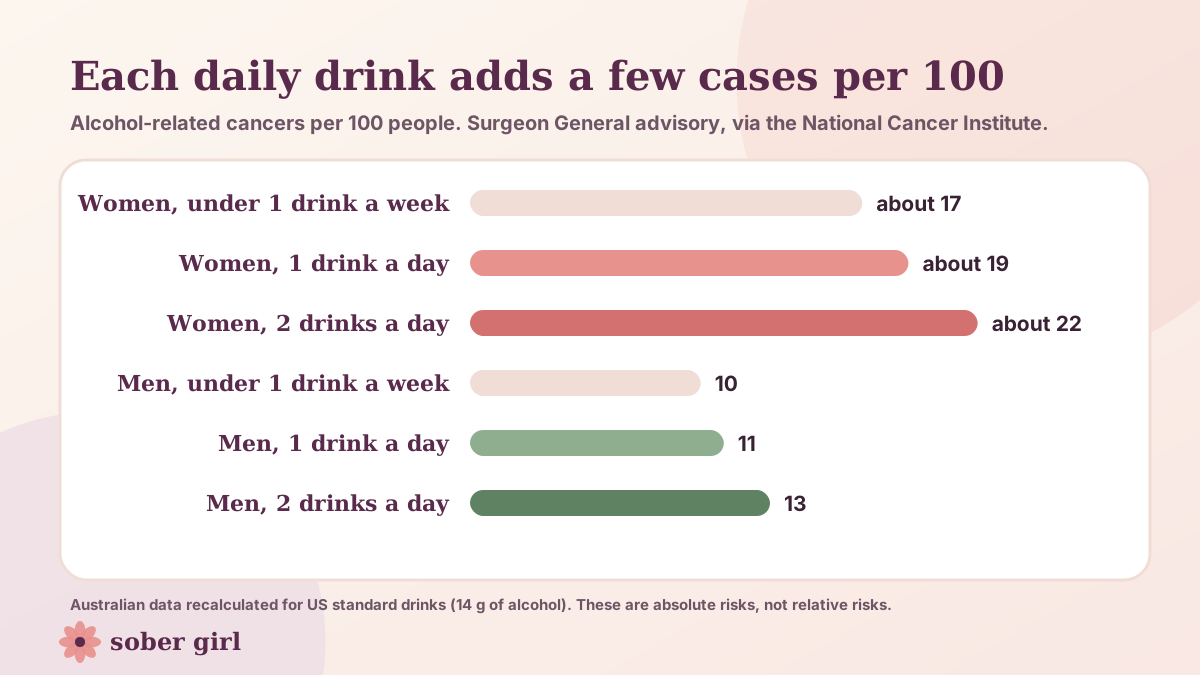
So one drink a day raises a woman’s absolute risk of an alcohol-related cancer by about 2 in 100 and two drinks a day by about 5 in 100, and a man’s by about 1 and 3 in 100 [1]. Across millions of drinkers those small steps add up, and they come on top of any other risks you carry.
How does alcohol cause cancer?
NCI describes several routes researchers have proposed [1]:
- Acetaldehyde. The body breaks alcohol down into acetaldehyde, a toxic chemical and probable human carcinogen that can damage DNA and proteins.
- Oxidative damage. Alcohol generates reactive oxygen species that can damage DNA, proteins and fats.
- Nutrients. Alcohol impairs the body’s ability to break down and absorb nutrients linked to lower cancer risk, including folate and vitamins A, C, D and E.
- Easier absorption of other carcinogens, such as chemicals from cigarette smoke, in the mouth and throat.
- Higher estrogen, which at high levels can cause breast cancer.
Alcohol and tobacco together are worse than either alone. For oral and throat cancers the harms are multiplicative, greater than adding the two together [1]. Genes matter too. Many people of East Asian descent carry a variant that lets acetaldehyde build up, causing flushing and palpitations; most of them drink little and so have a low risk, but those who drink despite it face a higher risk [1]. See alcohol flush reaction.
Does quitting or cutting down lower the risk?
NCI says it may take years for the risks of cancer to return to those of never drinkers, but it is never too late to stop drinking and reduce the risks [1]. The risk climbs with amount, so even partial cuts help: the table above shows that going from two drinks a day to one lowers the figure for women from about 22 to about 19 per 100, and from 13 to 11 for men [1].
This is why NCI notes that a recent Surgeon General’s advisory called for reconsidering the US drinking limits because of cancer risk at or below the guideline levels [1]. The Dietary Guidelines still say that people who do not drink should not start for any reason, and that those who drink should keep to two drinks or fewer a day for men and one or fewer for women [1].
If you want to act on this, the benefits of quitting alcohol, how much alcohol is too much, alcohol and weight and mindful drinking cover the practical steps. If you are having cancer treatment, check with your health care team about alcohol [1]; a doctor can also tell you how this fits your own history.
Is Sober Girl right for you?
- use an iPhone or an Android phone
- want a private tracker, with your journal kept on your device
- want a day counter, money saved and a daily check-in in one calm place
- want a Craving SOS with a breathing exercise and a 10-minute timer
- want to start free and add Plus only if you need the journal, insights or milestone cards
- want a community feed, live coaching or an AI chat
- want a structured multi-week education program
- need medical help for heavy drinking or withdrawal. An app is not treatment, so see the safety notes above
Frequently asked questions
Does alcohol cause cancer?
Yes. Alcohol is an IARC Group 1 carcinogen and a known human carcinogen in the US. It is linked to cancers of the mouth, throat, voice box, esophagus, liver, breast and colon and rectum.
Is any amount of alcohol safe for cancer risk?
Risk rises with amount, but even light drinkers have some added risk for certain cancers; for example, women who have one drink a day have a higher breast cancer risk than those who drink less than one a week.
How many cancers does alcohol cause each year?
About 5% of US cancer cases (nearly 100,000) and about 4% of cancer deaths (nearly 25,000) in 2019 were attributed to alcohol, according to the National Cancer Institute.
How does alcohol raise cancer risk?
Mainly by breaking down into acetaldehyde, which damages DNA, and through oxidative damage, lower nutrient absorption, easier entry of other carcinogens and higher estrogen.
What counts as one drink when measuring cancer risk?
A US standard drink holds 14 grams of pure alcohol: a 12 oz beer, an 8 to 10 oz malt liquor, a 5 oz glass of wine or a 1.5 oz shot of 80-proof liquor, according to NCI.
Does quitting alcohol reduce cancer risk?
It may take years for risk to return to that of never drinkers, but NCI says it is never too late to stop drinking and reduce the risks.
Is drinking and smoking worse than either alone?
Yes. For cancers of the mouth, throat, voice box and esophagus, the combined harm is multiplicative, greater than the sum of the two.
How much does one drink a day raise the risk?
About 2 extra alcohol-related cancers per 100 women and 1 per 100 men compared with drinking less than one a week; two a day adds about 5 per 100 women and 3 per 100 men.
Sources
- Alcohol and Cancer Risk. National Cancer Institute fact sheet, read 7 November 2026. Alcohol is an IARC Group 1 carcinogen. Alcohol caused about 5% of US cancer cases (nearly 100,000) and about 4% of US cancer deaths (nearly 25,000) in 2019. Relative risks by cancer type, and the Surgeon General absolute-risk figures per 100 people.
How we write these. Every figure above links to the source it came from, and we label self-reported and observational results as such. Where we could not find a source we trust, the page says so instead of filling the gap. Sober Girl is made by ShipAI Lab and this is not medical advice. Sources were checked on 6 October 2026. If you spot an error, email us at [email protected].
Keep reading
Today is day one.
Sober Girl is a private sobriety tracker for women, on iPhone and Android: day counter, money saved, craving SOS and a tree that grows with you. Free to start.