Gray area drinking: what it means, and what to do with the question
It describes drinking that is not at rock bottom but that you are not comfortable with. Here is where the term comes from, the measurable lines, and a better question than “which label am I?”.
Gray area drinking is a popular label for drinking between occasional and dependent, popularised by Jolene Park; it is not a clinical diagnosis [1]. NIAAA defines binge drinking for women as 4 or more drinks within about 2 hours, and heavy drinking as 4 or more on any day or 8 or more in a week [2]. Alcohol Change UK suggests a simpler question than a label: are you happy with how much you drink?
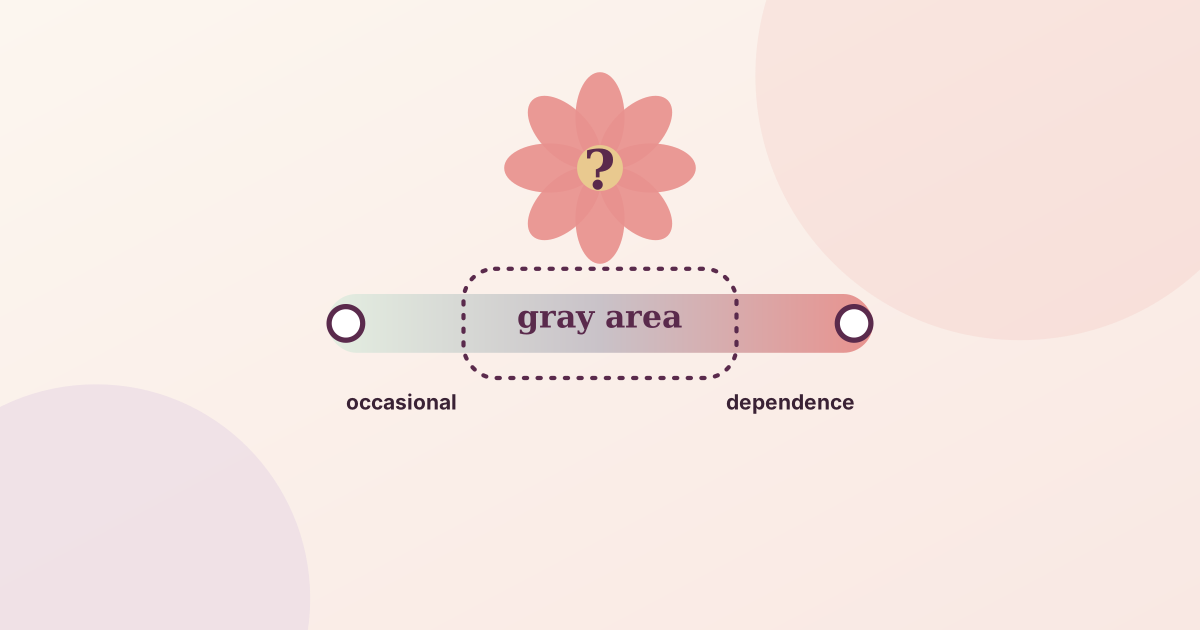
What gray area drinking means
“Gray area drinking”, or “grey area” in British spelling, is a popular label for the space between occasional drinking and physical alcohol dependence. Alcohol Change UK describes it as a middle ground on a spectrum, noting that for some people in that space drinking appears to cause few problems, while for others it feels far less manageable [1]. Jolene Park, a self-described functional nutritionist, popularised the term through a TEDx talk [1].
It is a description people use, not a clinical category.
Track it in Sober Girl
Does the label help?
Alcohol Change UK questions whether sorting drinking into categories is useful at all. It suggests a simpler question: are you happy with how much you drink? It also reminds readers there is no such thing as risk-free drinking, and that individual risk varies a lot [1]. We agree with the spirit of that. A label can feel like relief or like judgement. What helps is the pattern you can actually see.
The measurable lines
These are the definitions NIAAA uses. A standard drink holds 14 grams of pure alcohol. For women, binge drinking is 4 or more drinks within about 2 hours, and heavy drinking is 4 or more drinks on any day or 8 or more in a week. NIAAA also says the less alcohol, the better [2].
Counting is harder than it sounds, because a generous pour can hold more than one standard drink. If you have never counted, a week of honest tracking is informative on its own.
Questions that are more useful than a label
- Am I happy with how much I drink?
- Do I use alcohol to manage anxiety, stress or sleep?
- Do I regret how much or how often I drank, more than occasionally?
- Have I made rules about drinking and broken them?
- What would I notice if I did not drink for a month?
These are prompts, not a screening tool and not a diagnosis. The last one can be tested. In one BMJ Open study, 94 people who abstained for a month saw significant falls in insulin resistance, blood pressure, weight and two cancer-related growth factors. It was observational and excluded people with liver disease or alcohol dependence [3]. A month off is also a way to learn how you feel without it.
When to talk to someone
In 2024, 8.0% of US women aged 18 and over had alcohol use disorder in the past year [4]. If you have tried to cut down and could not, or you feel unwell when you stop, speak to a doctor. If you drink heavily, do not stop suddenly on your own, because withdrawal can be dangerous [5]. The NIAAA Alcohol Treatment Navigator helps adults find evidence-based care [6], and the SAMHSA National Helpline (1-800-662-4357) is free, confidential and open 24/7 [7].
Is Sober Girl right for you?
- use an Android phone (the iPhone app is coming soon)
- want a private tracker, with your journal kept on your device
- want a day counter, money saved and a daily check-in in one calm place
- want a Craving SOS with a breathing exercise and a 10-minute timer
- want to start free and add Plus only if you need the journal, insights or milestone cards
- need it on an iPhone today (the App Store version is coming soon)
- want a community feed, live coaching or an AI chat
- want a structured multi-week education program
- need medical help for heavy drinking or withdrawal. An app is not treatment, so see the safety notes above
Frequently asked questions
What is gray area drinking?
A popular label for drinking that sits between occasional drinking and physical dependence: not at rock bottom, but not something you feel comfortable with. It is not a clinical diagnosis.
Who coined the term gray area drinking?
Jolene Park, a self-described functional nutritionist, popularised it through a TEDx talk, according to Alcohol Change UK.
How much is too much for a woman?
NIAAA defines binge drinking for women as 4 or more drinks in about 2 hours, and heavy drinking as 4 or more on any day or 8 or more in a week. It also says the less alcohol, the better.
Is gray area drinking the same as sober curious?
They overlap. Gray area drinking describes a pattern people are uneasy about, while sober curious describes the choice to question it and try time without alcohol.
Sources
- Grey area drinking: what is it and does it add anything to the alcohol debate?. Alcohol Change UK, Mark Leyshon, April 2024.
- The Basics: Defining How Much Alcohol Is Too Much. NIAAA.
- Short-term abstinence from alcohol and changes in cardiovascular risk factors, liver function tests and cancer-related growth factors: a prospective observational study. Mehta G, Macdonald S, Cronberg A, et al. BMJ Open 2018;8:e020673. Observational study. 94 people who chose to abstain for a month and 47 who kept drinking.
- Alcohol Use Disorder (AUD) in the United States: Age Groups and Demographic Characteristics. NIAAA, using the 2024 National Survey on Drug Use and Health.
- Alcohol withdrawal. MedlinePlus (US National Library of Medicine), reviewed 1 January 2025 by Frank D. Brodkey, MD.
- NIAAA Alcohol Treatment Navigator. NIAAA.
- National Helpline. SAMHSA. Free, confidential, 24/7 treatment referral line: 1-800-662-4357.
How we write these. Every figure above links to the source it came from, and we label self-reported and observational results as such. Where we could not find a source we trust, the page says so instead of filling the gap. Sober Girl is made by ShipAI Lab and this is not medical advice. Sources were checked on 6 October 2026. If you spot an error, email us at integrateopenai@gmail.com.
Keep reading
Today is day one.
Sober Girl is a private sobriety tracker for women, on Android now and coming soon to iPhone: day counter, money saved, craving SOS and a tree that grows with you. Free to start.