High functioning alcoholic: signs you are holding it together, and paying for it
Good job, tidy house, nobody worried. And a bottle most nights that you would rather not count. This page is for that gap between how it looks and how it feels.
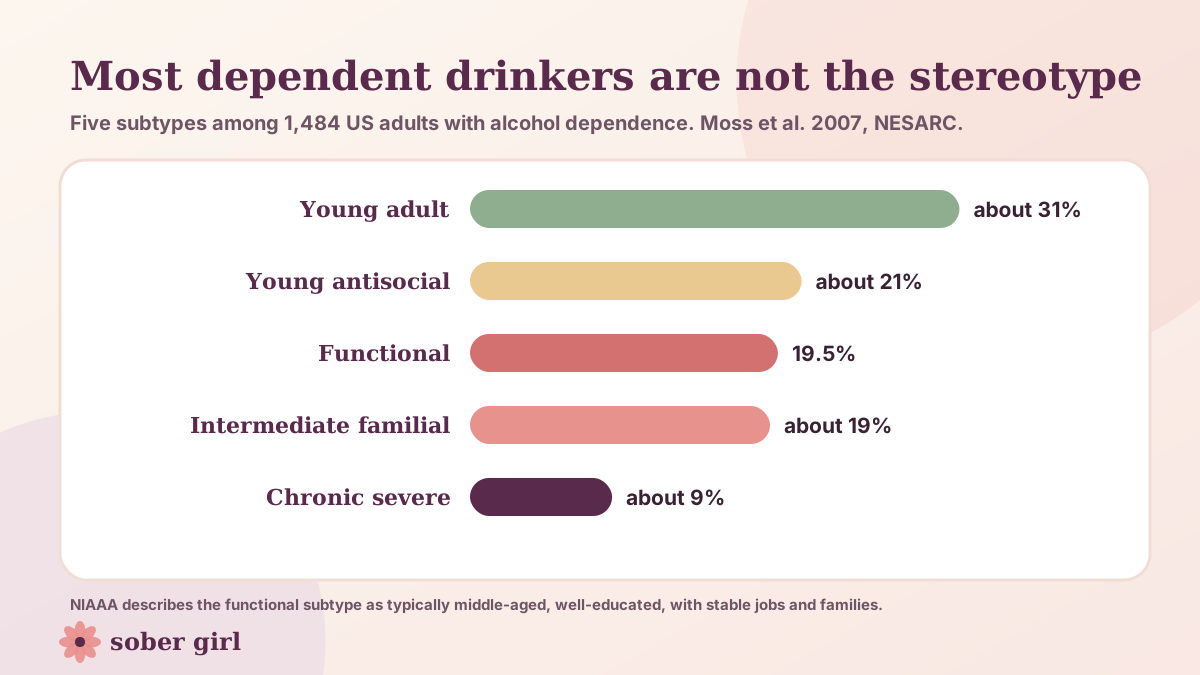
“High functioning alcoholic” is not a medical diagnosis, but the pattern is real. In a national US study of adults with alcohol dependence, about 19.5% fell into a functional subtype: typically middle-aged, well-educated, with stable jobs and families [1]. Doctors do not ask whether you function; they diagnose alcohol use disorder from 11 questions about the past year, such as drinking more than you meant to, wanting to cut down and not managing it, or carrying on despite problems. Two or three yes answers mean mild, four or five moderate, six or more severe [2]. You can be successful and still meet that bar, and help works at every level.
What a high functioning alcoholic looks like
It usually starts as something that does not look like a problem at all: a glass while cooking, another with dinner, the rest of the bottle on the sofa. The work gets done. The kids get to school. Nobody has ever seen you drunk. The only person keeping score is you, at 3 a.m., when you wake up with your heart racing and promise that tonight will be different.
Researchers have a name for this profile. When NIAAA scientists sorted 1,484 US adults with alcohol dependence into subtypes, about 19.5% formed a “functional” group: typically middle-aged, well-educated, with stable jobs and families [1]. They were not the people anyone imagined when they heard the word alcoholic, which is exactly why the label “high functioning” stuck.
Track it in Sober Girl
The 11 questions that matter more than “functioning”
Doctors diagnose alcohol use disorder, a medical condition in which your ability to stop or control drinking is impaired despite the consequences [2]. They use 11 questions about the past year. NIAAA lists them in plain language [2]:
- Have you ended up drinking more, or for longer, than you meant to?
- Have you wanted to cut down or stop, or tried, and not managed it?
- Have you spent a lot of time drinking, being sick from it or getting over it?
- Have you wanted a drink so badly you could not think of anything else?
- Has drinking, or being sick from it, got in the way of home, family, work or school?
- Have you kept drinking even though it caused trouble with family or friends?
- Have you given up or cut back on things you enjoyed so you could drink?
- Have you got into situations while or after drinking that raised your chances of getting hurt?
- Have you kept drinking even though it made you feel depressed or anxious, worsened another health problem, or after a memory blackout?
- Have you needed more to get the effect you want, or found your usual amount does less?
- When the alcohol wore off, have you had withdrawal symptoms such as trouble sleeping, shakiness, restlessness, nausea, sweating or a racing heart?
Two or three yes answers point to mild alcohol use disorder, four or five to moderate, and six or more to severe [2]. Notice how many of these questions can be true while your work reviews are excellent. Functioning is about what other people see. These questions are about what drinking is doing to you.
Signs that are easy to explain away
- Rules that keep moving. Only on weekends, then only after six, then only wine.
- Counting other people’s drinks so yours look normal.
- Waking at 3 a.m. with a racing heart or hangxiety. Alcohol fragments sleep in the second half of the night [3].
- A morning tremor or sweats that settle once you drink. That is withdrawal, one of the 11 questions above [2]. See alcohol shakes.
- Gaps in memory from the night before [4].
- Being above the weekly line without anyone noticing. For women, NIAAA counts 8 or more drinks a week as heavy drinking [5].
What to do if this sounds like you
High functioning is often what keeps people from getting help: life has not fallen apart, so it does not feel urgent. Of the 14.1 million US adults with alcohol use disorder in 2019, only 1.6% used a medication for it [6]. You do not need a crisis to change something.
- Count for two weeks without changing anything. Write down every drink. The number is information, not a verdict.
- Try a defined break, such as a 30-day challenge. If it is much harder than you expected, that is useful to know.
- Talk to a doctor. There are nonaddictive medicines that reduce the urge to drink [7]; see naltrexone and other medicines.
- Find your kind of support. Peer groups, therapy and apps all count. The NIAAA Alcohol Treatment Navigator helps you find evidence-based care [8].
In the US, the SAMHSA National Helpline (1-800-662-4357) is free, confidential and open 24/7 [10]. For a faster private check, take the 3-question drinking quiz.
Is Sober Girl right for you?
- use an iPhone or an Android phone
- want a private tracker, with your journal kept on your device
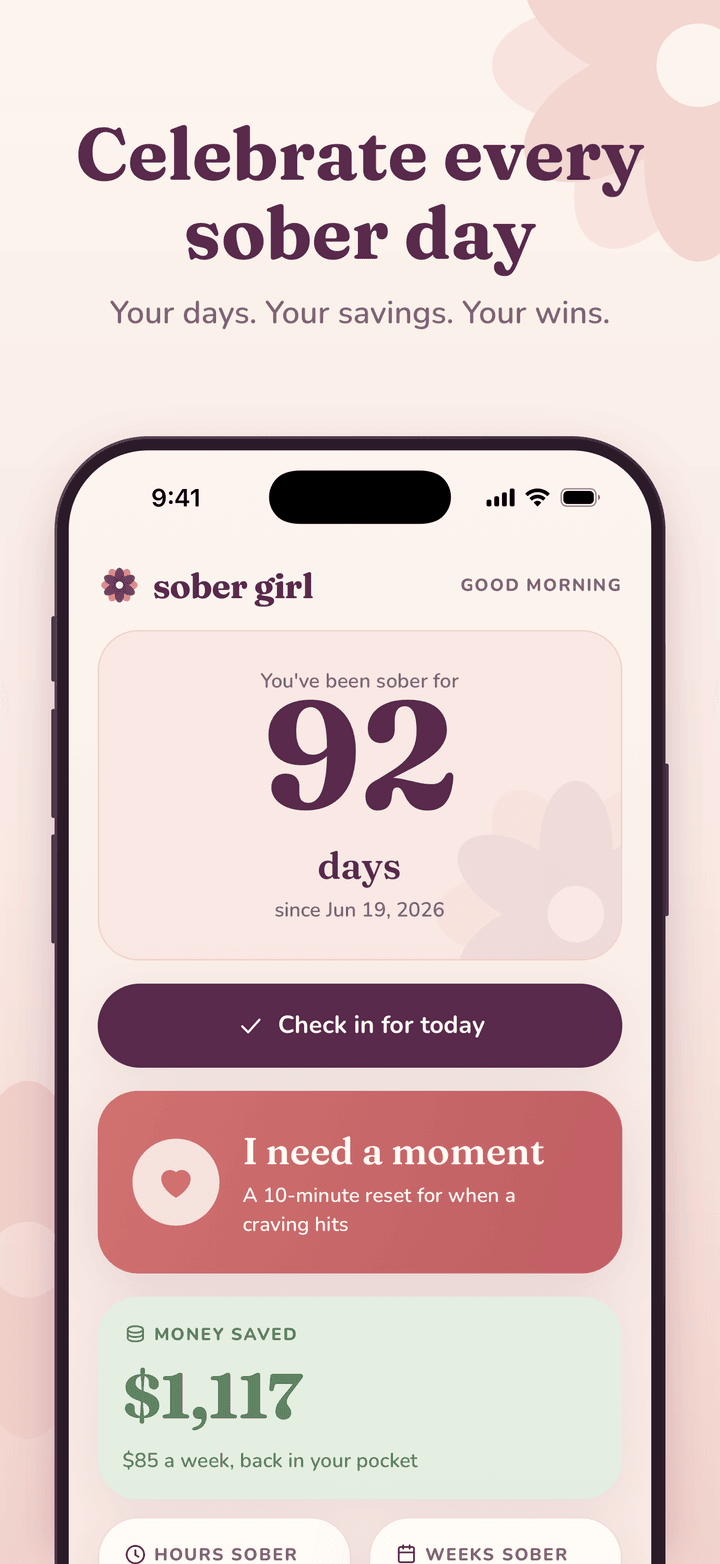
- want a day counter, money saved and a daily check-in in one calm place
- want a Craving SOS with a breathing exercise and a 10-minute timer
- want to start free and add Plus only if you need the journal, insights or milestone cards
- want a community feed, live coaching or an AI chat
- want a structured multi-week education program
- need medical help for heavy drinking or withdrawal. An app is not treatment, so see the safety notes above
Frequently asked questions
What is a high functioning alcoholic?
Someone who meets the criteria for alcohol use disorder while keeping up work, family and appearances. It is not a medical diagnosis. In a US study, about 19.5% of adults with alcohol dependence fit a functional profile: middle-aged, well-educated, with stable jobs and families.
How do I know if I am a functioning alcoholic?
Use the 11 questions doctors use for alcohol use disorder, about the past year: drinking more than intended, failing to cut down, cravings, withdrawal and so on. Two or three yes answers mean mild, four or five moderate, six or more severe.
Can a high functioning alcoholic stop on their own?
Some people cut down or stop without formal treatment, but if you drink heavily every day, talk to a doctor first because withdrawal can be dangerous. Medicines and support make it easier.
Is drinking a bottle of wine a night high functioning alcoholism?
A bottle of wine is about 5 standard drinks, above NIAAA’s heavy drinking line for women of 4 on any day. Whether it is alcohol use disorder depends on the 11 questions, but it is worth taking seriously.
Why don’t functional drinkers get help?
Often because nothing has visibly fallen apart. Treatment is rare in general: in 2019 only 1.6% of US adults with alcohol use disorder used a medication for it.
Sources
- Subtypes of alcohol dependence in a nationally representative sample. Moss HB, Chen CM, Yi HY. Drug and Alcohol Dependence 2007;91(2–3):149–158. 1,484 US adults with past-year alcohol dependence (NESARC survey). NIAAA describes the functional subtype, 19.5%, as typically middle-aged, well-educated, with stable jobs and families.
- Understanding Alcohol Use Disorder. NIAAA fact sheet, updated January 2025.
- Alcohol and the Sleeping Brain. PubMed Central, US National Library of Medicine.
- Interrupted Memories: Alcohol-Induced Blackouts. NIAAA fact sheet, updated June 2025.
- Understanding Alcohol Drinking Patterns. NIAAA.
- Use of Medications for Alcohol Use Disorder in the US: Results From the 2019 National Survey on Drug Use and Health. Han B, Jones CM, Einstein EB, Powell PA, Compton WM. JAMA Psychiatry 2021;78(8):922–924. Of 14.1 million US adults with past-year alcohol use disorder, 1.6% (about 223,000) reported using a medication for it.
- Treatment for Alcohol Problems: Finding and Getting Help. NIAAA, updated February 2025.
- NIAAA Alcohol Treatment Navigator. NIAAA.
- Alcohol withdrawal. MedlinePlus (US National Library of Medicine), reviewed 1 January 2025 by Frank D. Brodkey, MD.
- National Helpline. SAMHSA. Free, confidential, 24/7 treatment referral line: 1-800-662-4357.
How we write these. Every figure above links to the source it came from, and we label self-reported and observational results as such. Where we could not find a source we trust, the page says so instead of filling the gap. Sober Girl is made by ShipAI Lab and this is not medical advice. Sources were checked on 6 October 2026. If you spot an error, email us at [email protected].
Keep reading
Today is day one.
Sober Girl is a private sobriety tracker for women, on iPhone and Android: day counter, money saved, craving SOS and a tree that grows with you. Free to start.