Naltrexone for alcohol, acamprosate and Antabuse: how the medicines that help you quit work
Most people who could use a medicine to drink less have never been offered one. Here is what each of the three approved options does, what the trials found, and what to ask your doctor.
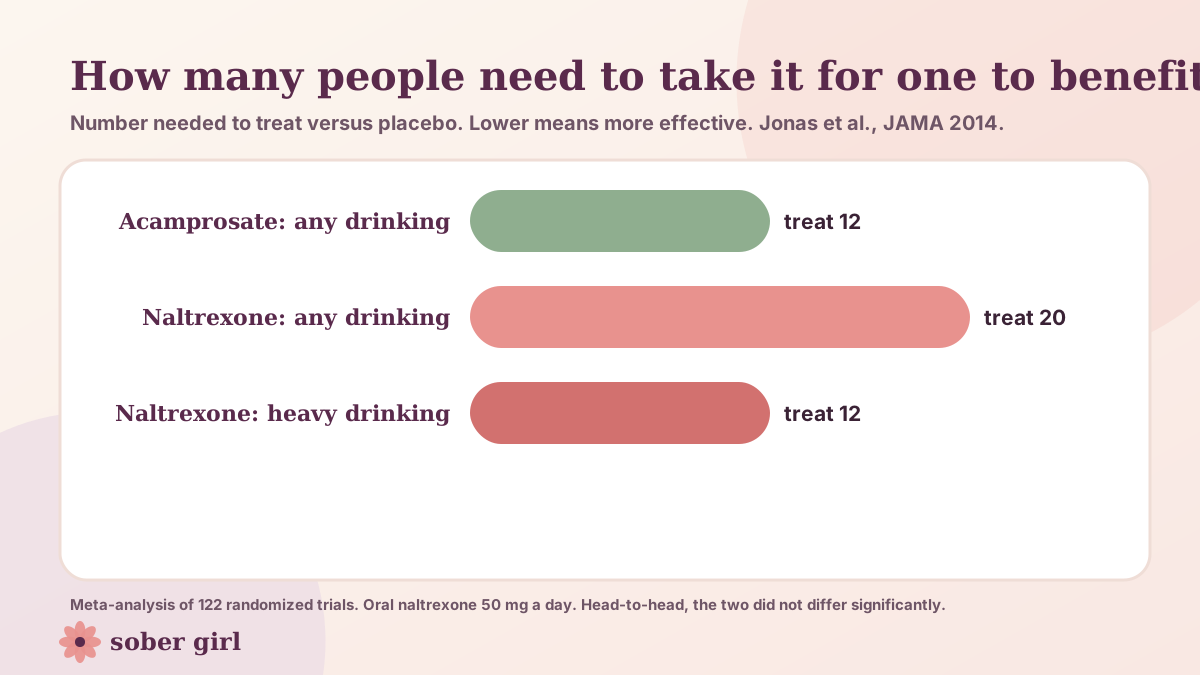
Three medicines are approved in the US to treat alcohol use disorder, and all are nonaddictive: naltrexone, a pill or monthly injection that reduces the urge to drink; acamprosate, a pill that eases the uncomfortable feelings some people have in early abstinence; and disulfiram (Antabuse), a pill that makes drinking cause unpleasant symptoms [1]. In a meta-analysis of 122 trials, for every 12 people treated with acamprosate and every 20 treated with oral naltrexone, one more avoided any return to drinking than on a placebo; for heavy drinking the figure for naltrexone was 1 in 12 [2]. Yet only 1.6% of US adults with alcohol use disorder used one in 2019 [3]. Naltrexone must not be combined with opioids [4].
The three approved medicines at a glance
| Medicine | How it helps | What trials found | Good to know |
|---|---|---|---|
| Naltrexone (pill or monthly injection) | Reduces the urge to drink [1] | Treat 20 for one more to avoid any drinking; treat 12 for one more to avoid heavy drinking (oral, 50 mg a day) [2] | Not with opioid painkillers or opioid drugs; tell your doctor about any opioid use in the last 7 to 10 days [4] |
| Acamprosate (pill) | Eases the negative feelings some people have during abstinence [1] | Treat 12 for one more to avoid any return to drinking [2] | No significant difference from naltrexone in head-to-head trials [2] |
| Disulfiram, brand name Antabuse (pill) | Drinking while on it causes unpleasant symptoms [1] | Puts you off drinking rather than easing cravings | Only for people aiming to stop completely |
Track it in Sober Girl
Naltrexone for alcohol: how it works and who it suits
Naltrexone works by decreasing the craving for alcohol and blocking the effects of opioids [4]. It comes as a daily pill or a monthly injection [1]. In the JAMA meta-analysis, the strongest result for oral naltrexone was on heavy drinking: for every 12 people treated, one more avoided returning to heavy drinking than with a placebo [2]. That makes it a common choice for people whose goal is to cut down as well as for people who want to stop.
- Opioids are the big exception. Do not take opioid medicines or street opioids during treatment, and tell your doctor about any opioid use in the 7 to 10 days before starting. Taking high doses of opioids to override it can cause serious injury, coma or death [4].
- Liver. Tell your doctor if you have, or have had, liver or kidney disease, and call them right away about yellowing skin or eyes or dark urine [4].
- Common side effects include nausea, headache, dizziness, tiredness, anxiety and trouble sleeping [4]. In trials, for every 48 people treated, one more dropped out because of side effects than on a placebo [2].
Acamprosate and Antabuse (disulfiram)
Acamprosate is meant for people who have already stopped drinking. It decreases the negative symptoms that are sometimes felt during abstinence [1], and in trials, for every 12 people treated, one more avoided any return to drinking than on a placebo [2]. Trials comparing it head to head with naltrexone found no statistically significant difference between the two [2], so the choice often comes down to your goal, your other medicines and your health.
Disulfiram (Antabuse) is the oldest of the three. It discourages drinking by causing unpleasant symptoms when alcohol is consumed [1]. It does nothing for cravings, so it suits people who have firmly decided to stop and want a reason not to have the first drink, often with someone supporting them to take it daily.
Why so few people are offered a medicine
Of an estimated 14.1 million US adults with alcohol use disorder in 2019, only about 223,000, or 1.6%, used a medication for it [3]. All three approved medicines are nonaddictive, and they can be used alone or alongside other treatment [1]. You do not need to be in rehab, and you do not need to call yourself an alcoholic, to ask about them. A family doctor can prescribe them.
- Say what you want: “I want to cut down” or “I want to stop” changes which medicine fits.
- List everything you take, especially opioid painkillers, and mention any liver or kidney problems [4].
- Ask how long to try it and what counts as working: fewer heavy days, fewer drinks, or none.
- Ask about support alongside it. Medicine and counseling or a peer group can be combined [1].
If you are unsure where to start, the NIAAA Alcohol Treatment Navigator helps adults find evidence-based care [5], and the SAMHSA National Helpline (1-800-662-4357) is free, confidential and open 24/7 [6].
Is Sober Girl right for you?
- use an iPhone or an Android phone
- want a private tracker, with your journal kept on your device
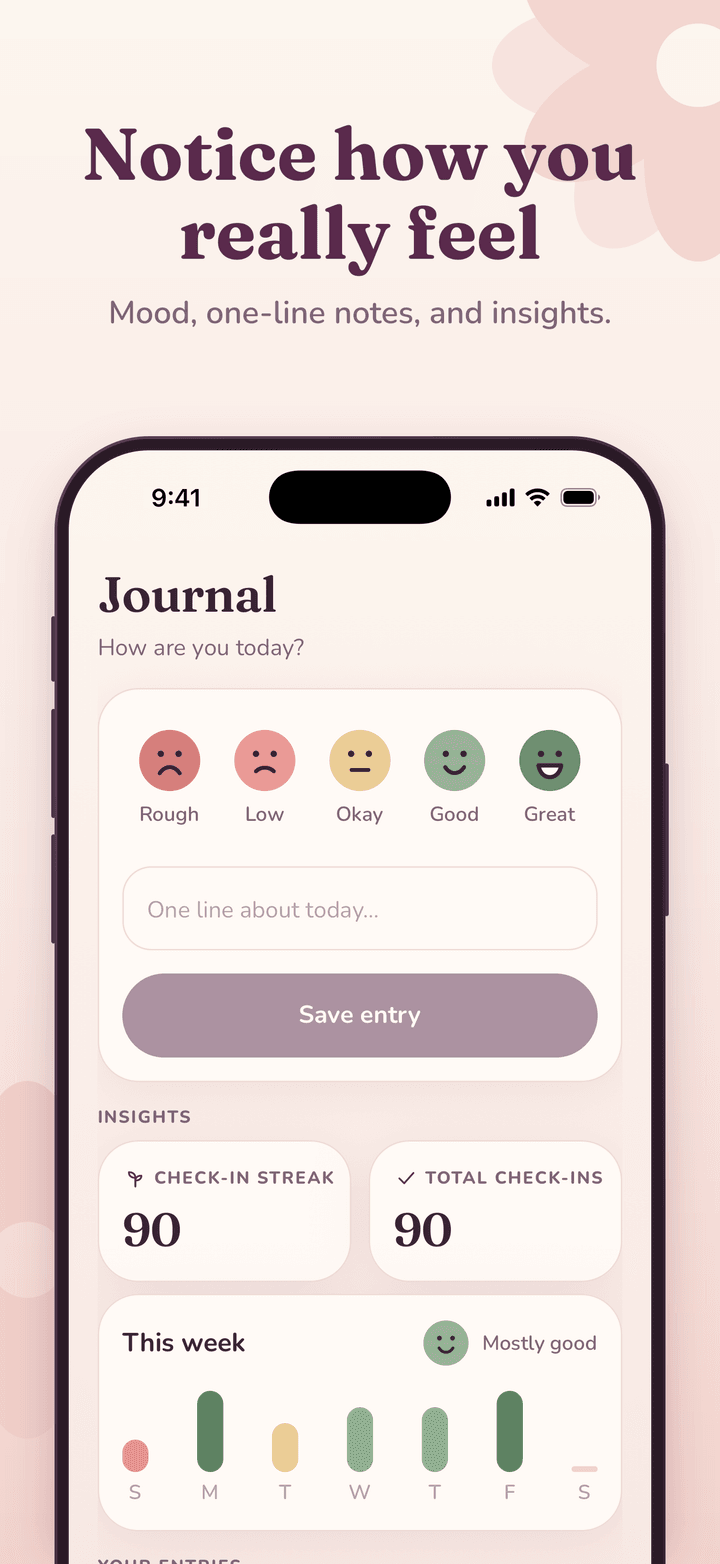
- want a day counter, money saved and a daily check-in in one calm place
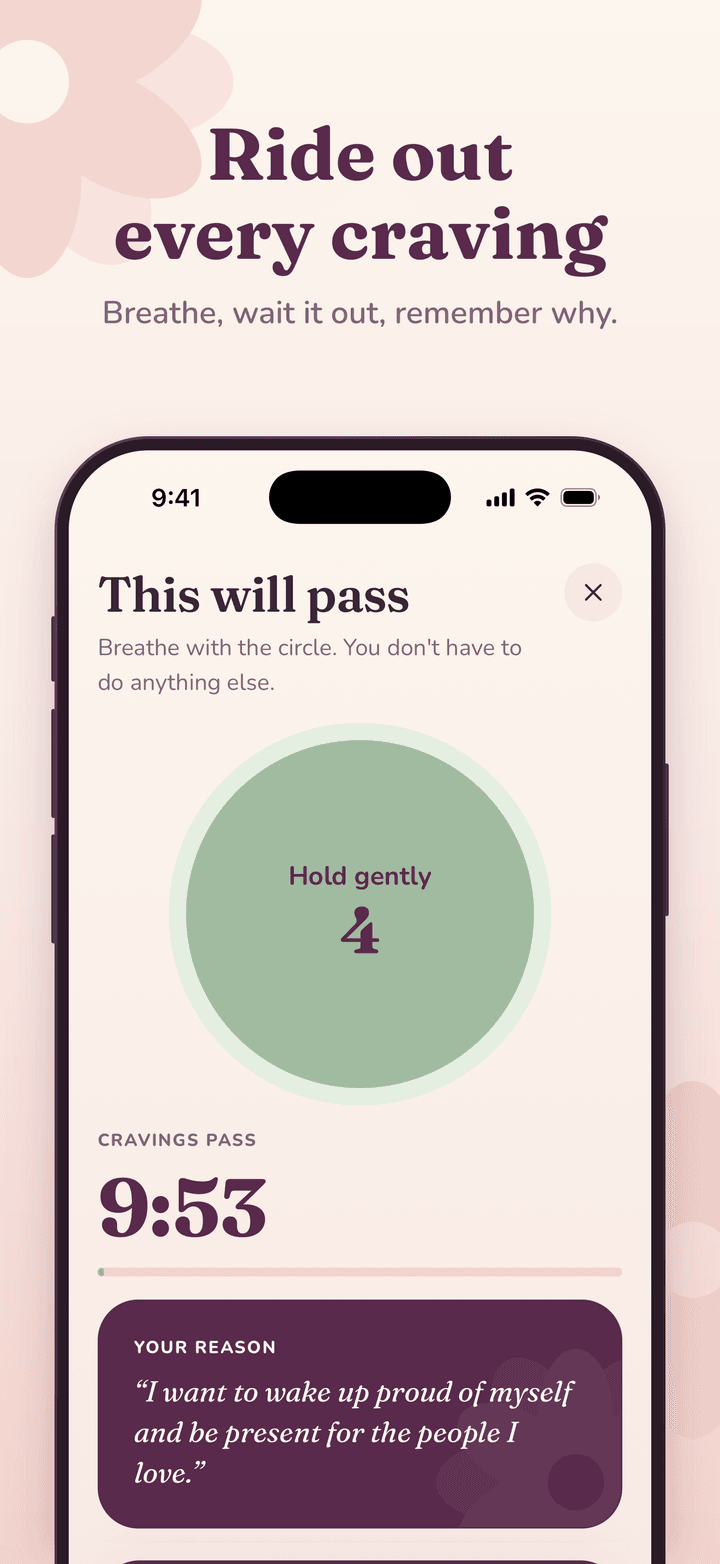
- want a Craving SOS with a breathing exercise and a 10-minute timer
- want to start free and add Plus only if you need the journal, insights or milestone cards
- want a community feed, live coaching or an AI chat
- want a structured multi-week education program
- need medical help for heavy drinking or withdrawal. An app is not treatment, so see the safety notes above
Frequently asked questions
Does naltrexone work for alcohol?
For many people, yes. In a meta-analysis of randomized trials, for every 12 people taking oral naltrexone, one more avoided returning to heavy drinking than with a placebo. It works by reducing the urge to drink.
Can you drink alcohol while taking naltrexone?
Naltrexone is often used by people who want to cut down, and it reduces the urge to drink rather than causing a reaction. Follow your prescriber’s advice. Disulfiram (Antabuse) is different: drinking on it causes unpleasant symptoms.
What is the difference between naltrexone and acamprosate?
Naltrexone reduces the urge to drink and has evidence for cutting heavy drinking. Acamprosate eases the uncomfortable feelings of early abstinence and suits people who have already stopped. Head-to-head trials found no significant difference between them for returning to drinking.
Is Antabuse still used?
Yes. Disulfiram (Antabuse) is one of three medicines approved in the US for alcohol use disorder. It causes unpleasant symptoms if you drink, so it suits people aiming to stop completely.
Are medicines for alcohol addictive?
No. NIAAA says all approved medications for alcohol use disorder are nonaddictive.
Who should not take naltrexone?
Anyone taking opioid medicines or opioid drugs, or who has used them in the last 7 to 10 days. People with liver or kidney disease should tell their doctor before starting.
Sources
- Treatment for Alcohol Problems: Finding and Getting Help. NIAAA, updated February 2025.
- Pharmacotherapy for Adults With Alcohol Use Disorders in Outpatient Settings: A Systematic Review and Meta-analysis. Jonas DE, Amick HR, Feltner C, et al. JAMA 2014;311(18):1889–1900. Meta-analysis of 122 randomized trials and 1 cohort study (22,803 participants). Number needed to treat to prevent return to any drinking: 12 for acamprosate, 20 for oral naltrexone; to prevent return to heavy drinking: 12 for oral naltrexone. No significant difference between the two.
- Use of Medications for Alcohol Use Disorder in the US: Results From the 2019 National Survey on Drug Use and Health. Han B, Jones CM, Einstein EB, Powell PA, Compton WM. JAMA Psychiatry 2021;78(8):922–924. Of 14.1 million US adults with past-year alcohol use disorder, 1.6% (about 223,000) reported using a medication for it.
- Naltrexone. MedlinePlus (US National Library of Medicine), revised 15 September 2026.
- NIAAA Alcohol Treatment Navigator. NIAAA.
- National Helpline. SAMHSA. Free, confidential, 24/7 treatment referral line: 1-800-662-4357.
- Alcohol withdrawal. MedlinePlus (US National Library of Medicine), reviewed 1 January 2025 by Frank D. Brodkey, MD.
How we write these. Every figure above links to the source it came from, and we label self-reported and observational results as such. Where we could not find a source we trust, the page says so instead of filling the gap. Sober Girl is made by ShipAI Lab and this is not medical advice. Sources were checked on 6 October 2026. If you spot an error, email us at [email protected].
Keep reading
Today is day one.
Sober Girl is a private sobriety tracker for women, on iPhone and Android: day counter, money saved, craving SOS and a tree that grows with you. Free to start.