Alcohol withdrawal timeline: what happens hour by hour and day by day
If you drink every day and want to stop, the first three days matter most. Here is when symptoms usually start, when they peak, which signs are an emergency, and what can linger for weeks.
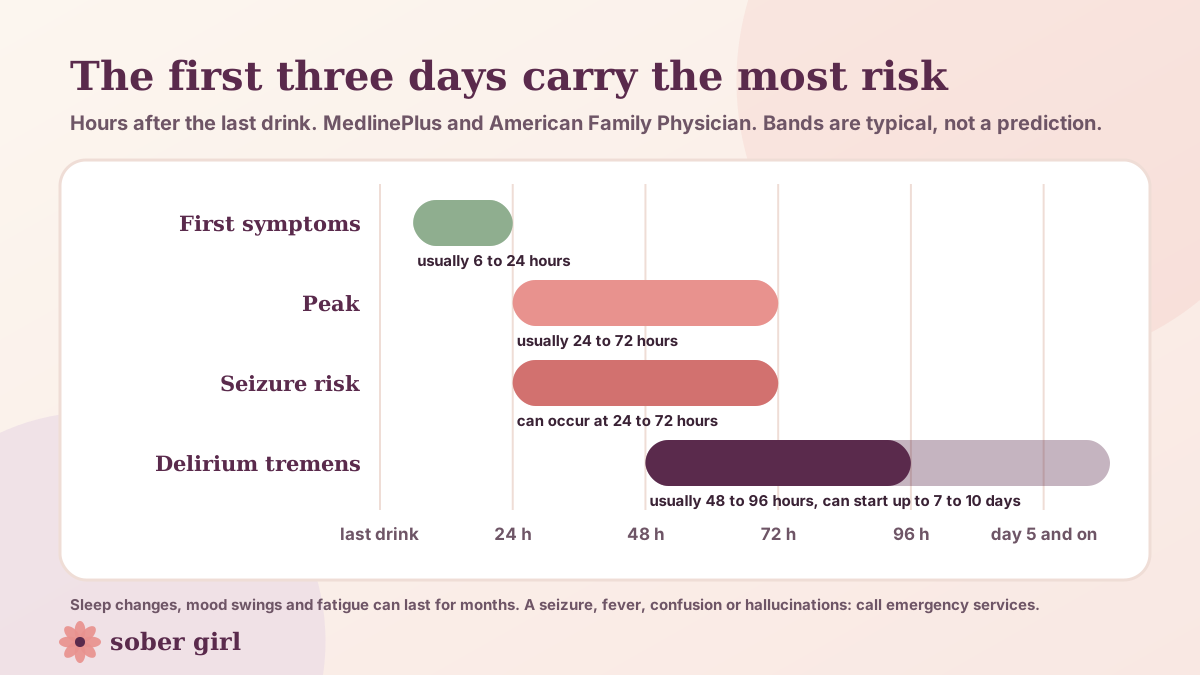
Alcohol withdrawal symptoms usually begin 6 to 24 hours after the last drink [1], sometimes within 8 hours and sometimes days later, and tend to peak between 24 and 72 hours [2]. Withdrawal seizures can occur 24 to 72 hours after the last drink [1]. Delirium tremens, the most dangerous form, usually starts 48 to 96 hours after the last drink but can appear 7 to 10 days later, and it is a medical emergency [3]. Sleep changes, mood swings and fatigue can last for months [2]. Not everyone who stops has withdrawal, but anyone who has been drinking heavily every day should talk to a doctor before stopping.
The alcohol withdrawal timeline at a glance
| Time since last drink | What can happen | What to do |
|---|---|---|
| 6 to 24 hours | First symptoms: anxiety, shakiness, irritability, poor sleep [1] [2] | Stay with someone if you can. Have your doctor’s number ready. |
| 24 to 72 hours | Symptoms are usually at their worst [2]. Withdrawal seizures can occur in this window [1] | A seizure, fever, severe confusion or hallucinations mean calling emergency services. |
| 48 to 96 hours | Usual window for delirium tremens, a medical emergency [3] | Sudden confusion, fever or seeing things that are not there: emergency care now. |
| Up to 7 to 10 days | Delirium tremens can still start this late [3] | Do not assume you are out of danger after day 3 if you were a heavy daily drinker. |
| Weeks | Milder symptoms can go on for weeks [2] | Keep sleep, food and support steady. |
| Months | Sleep changes, mood swings and fatigue can last for months [2] | Normal in recovery. Tell your doctor if they get worse, not better. |
Track it in Sober Girl
Common symptoms, and the ones that are an emergency
Common symptoms
MedlinePlus lists anxiety or nervousness, depression, fatigue, irritability, jumpiness or shakiness, mood swings, nightmares and not thinking clearly as common symptoms [2]. They are unpleasant, and for many people with mild to moderate symptoms they can be treated without a hospital stay, under a doctor’s care [2].
Call emergency services for any of these
- A seizure. Withdrawal seizures can happen 24 to 72 hours after the last drink [1].
- Fever, severe confusion or hallucinations. These are signs of delirium tremens [2].
- An irregular heartbeat [2].
Delirium tremens occurs most often in people who have had alcohol withdrawal before, and it commonly affects people who have been drinking for more than 10 years [3]. If either applies to you, plan a medically supervised stop rather than going it alone.
What is delirium tremens (DTs)?
Delirium tremens, often called the DTs, is the severe form of alcohol withdrawal. MedlinePlus describes agitation, sudden severe confusion, fever, hallucinations and seizures, and calls it a medical emergency that can be life-threatening [3]. It is rare compared with ordinary withdrawal, and it is the reason the first days matter so much.
- When: usually 48 to 96 hours after the last drink, though it can start 7 to 10 days later [3].
- Who is most at risk: people who have had alcohol withdrawal before, and people who have been drinking for more than 10 years. A head injury, infection or illness can also trigger it in someone who drinks heavily [3].
- What to do: call 911 or your local emergency number. Do not wait to see whether it passes [3].
The practical lesson: if you drink heavily every day, the plan for stopping should include a doctor and another person who knows what to watch for, not just willpower.
How long does alcohol withdrawal last?
For most people the worst is over within a few days: symptoms usually peak by 24 to 72 hours [2]. Two things can stretch that. Milder symptoms can carry on for weeks [2], and delirium tremens can begin as late as 7 to 10 days after the last drink [3]. Then there is the long tail: sleep changes, fast mood shifts and tiredness can last for months [2]. Some people call this stretch post-acute withdrawal. Whatever you call it, it fades with time, and it is not a sign the effort is failing.
For what each day feels like after the first week, see what happens when you stop drinking, 3 days sober and 1 week sober. For broken sleep in particular, see sleep after quitting alcohol.
Who gets withdrawal, and who does not
- Occasional or light drinkers usually notice little more than a few restless nights when they stop.
- Daily or heavy drinkers are the people withdrawal is most likely to affect, and the longer and heavier the drinking, the higher the risk of the severe forms [3].
- People who have been through withdrawal before are most at risk of delirium tremens [3].
If you are not sure where you fall, the 3-question drinking quiz is a quick screen, and how much alcohol is too much for a woman shows the daily and weekly lines. Neither replaces a conversation with a doctor.
A safer way to stop
- Talk to a doctor first if you drink every day. Mild to moderate withdrawal can often be managed as an outpatient; moderate to severe withdrawal may need a hospital or treatment facility where you are watched closely [2].
- Pick your start day so the first 72 hours fall on days you can rest and have someone around.
- Tell one person what to look out for: seizures, fever, confusion or hallucinations.
- Keep food, water and sleep simple. Small meals and an early night beat a perfect plan.
- Count the hours, then the days. Seeing the number go up helps on the hard nights.
In the US, the SAMHSA National Helpline (1-800-662-4357) is free, confidential and open 24/7. In an emergency, call 911 or your local emergency number.
Is Sober Girl right for you?
- use an iPhone or an Android phone
- want a private tracker, with your journal kept on your device
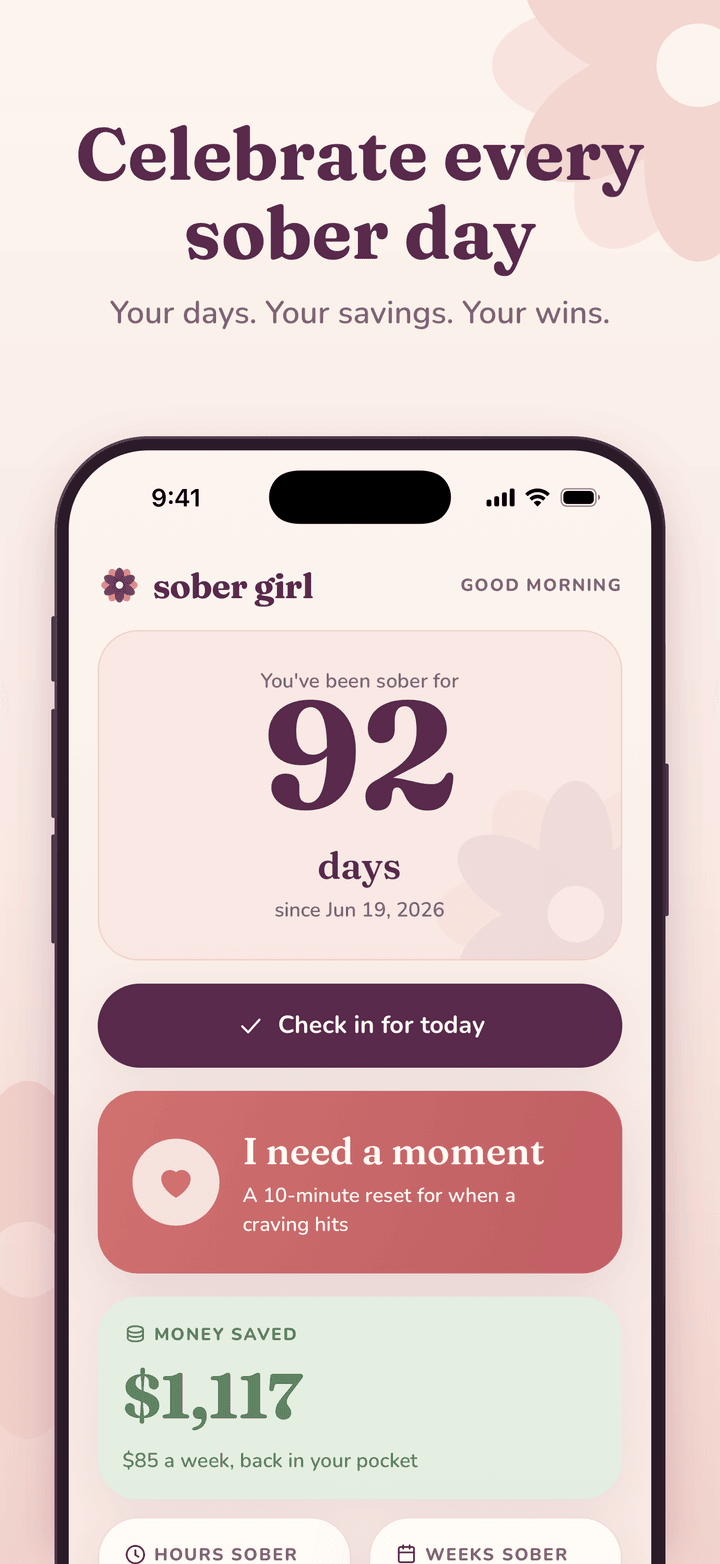
- want a day counter, money saved and a daily check-in in one calm place
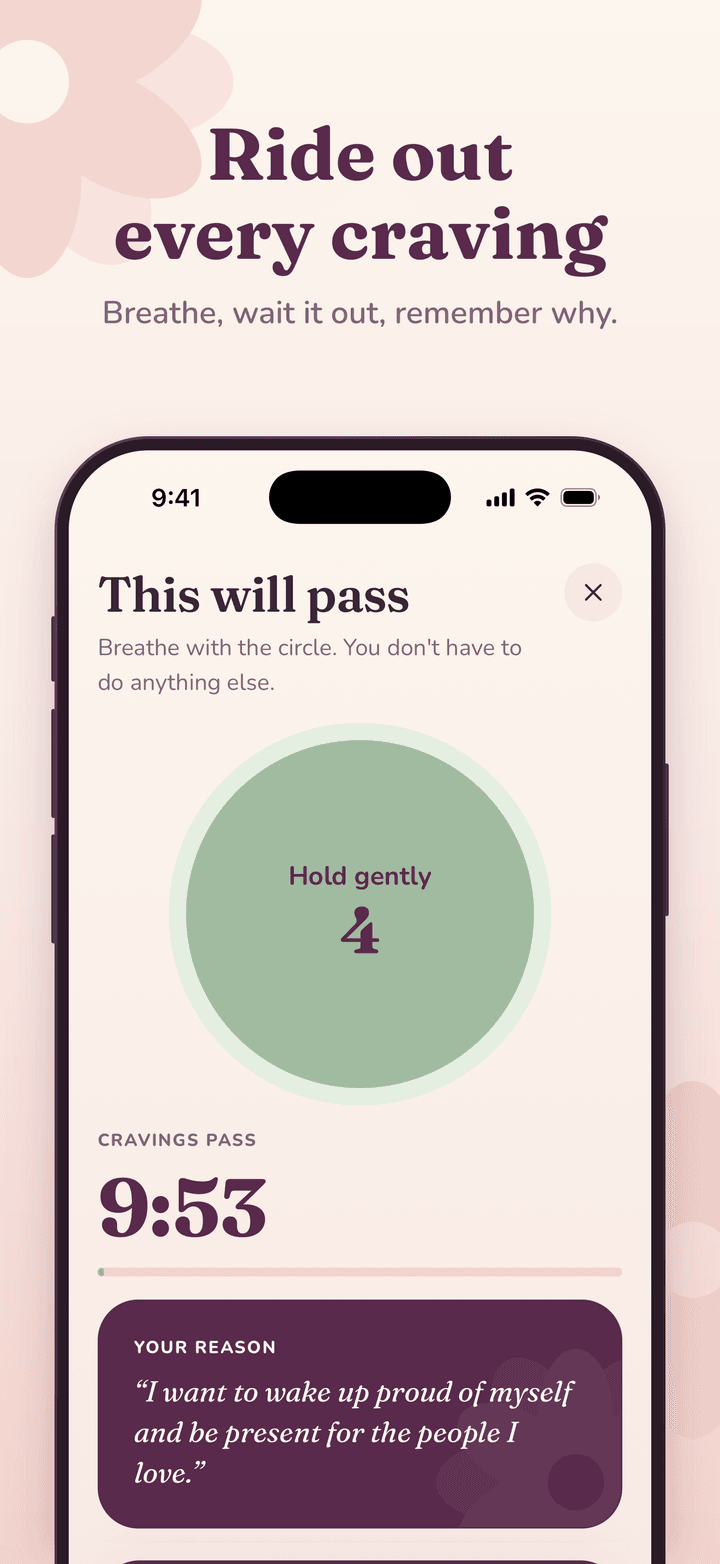
- want a Craving SOS with a breathing exercise and a 10-minute timer
- want to start free and add Plus only if you need the journal, insights or milestone cards
- want a community feed, live coaching or an AI chat
- want a structured multi-week education program
- need medical help for heavy drinking or withdrawal. An app is not treatment, so see the safety notes above
Frequently asked questions
When does alcohol withdrawal start?
Usually 6 to 24 hours after the last drink, sometimes within 8 hours. It can also start days later.
How long does alcohol withdrawal last?
Symptoms usually peak at 24 to 72 hours. Milder symptoms can last for weeks, and sleep changes, mood swings and fatigue can last for months.
What is the most dangerous day of alcohol withdrawal?
Days 2 to 4 carry the most risk. Withdrawal seizures can occur 24 to 72 hours after the last drink, and delirium tremens usually starts 48 to 96 hours after it, though it can begin as late as 7 to 10 days.
What are delirium tremens?
The severe form of alcohol withdrawal, with agitation, sudden severe confusion, fever, hallucinations and seizures. It usually starts 48 to 96 hours after the last drink, can begin 7 to 10 days later, and is a medical emergency: call 911.
Can I detox from alcohol at home?
Mild to moderate withdrawal can often be managed as an outpatient under a doctor’s care. Moderate to severe withdrawal, past delirium tremens or more than 10 years of heavy drinking are reasons for medical supervision. Speak to a doctor before you stop.
What are the first signs of alcohol withdrawal?
Anxiety, shakiness, irritability, poor sleep and trouble thinking clearly are among the common early signs.
When is alcohol withdrawal an emergency?
A seizure, fever, severe confusion, hallucinations or an irregular heartbeat. Call 911 or your local emergency number.
Sources
- Outpatient Management of Alcohol Withdrawal Syndrome. Muncie HL Jr, Yasinian Y, Oge’ L. American Family Physician 2013;88(9):589–595. Clinical review. Withdrawal symptoms begin 6 to 24 hours after the last drink; withdrawal seizures can occur 24 to 72 hours after it.
- Alcohol withdrawal. MedlinePlus (US National Library of Medicine), reviewed 1 January 2025 by Frank D. Brodkey, MD.
- Delirium tremens. MedlinePlus (US National Library of Medicine), reviewed 1 January 2025.
- National Helpline. SAMHSA. Free, confidential, 24/7 treatment referral line: 1-800-662-4357.
How we write these. Every figure above links to the source it came from, and we label self-reported and observational results as such. Where we could not find a source we trust, the page says so instead of filling the gap. Sober Girl is made by ShipAI Lab and this is not medical advice. Sources were checked on 6 October 2026. If you spot an error, email us at [email protected].
Keep reading
Today is day one.
Sober Girl is a private sobriety tracker for women, on iPhone and Android: day counter, money saved, craving SOS and a tree that grows with you. Free to start.