Delirium tremens: what the DTs are, when they start, and why they need a hospital
It is the severe end of alcohol withdrawal, and the part that most people have never been told about. Here is what it looks like, who is at risk, and what to do.
Delirium tremens (the DTs) is the most severe form of alcohol withdrawal: sudden confusion, hallucinations, fever, a racing heart and body tremors. It usually starts 48 to 96 hours after the last drink, and sometimes 7 to 10 days after [1]. It is a medical emergency that needs a hospital stay, and it can be life-threatening [1]. It is most common after months or years of heavy daily drinking, especially in people who have had withdrawal before [1]. If you drink heavily every day, do not stop suddenly on your own; talk to a doctor first.
What are delirium tremens?
Imagine someone who has had a drink every day for years decides to stop, cold, on a Sunday. Monday is shaky and sweaty. By Wednesday night they are sure there are people in the corner of the room, they do not know what day it is, and their heart is pounding. That is not a bad hangover. That is what doctors call delirium tremens.
MedlinePlus describes delirium tremens as a severe form of alcohol withdrawal with sudden and severe changes in mental function or the nervous system [1]. The American Family Physician review puts it in stages: mild withdrawal (anxiety, tremor, trouble sleeping), moderate (sweating, higher blood pressure, mild confusion), and stage 3, delirium tremens, with disorientation, impaired attention, hallucinations and seizures [2].
It does not come out of nowhere. The earlier stages can progress quickly when withdrawal is untreated or undertreated, which is why a mild start is not a reason to relax if you were drinking heavily [2]. For the full hour-by-hour picture, see the alcohol withdrawal timeline.
Track it in Sober Girl
When do the DTs start?
| What | When it usually happens | Source |
|---|---|---|
| First withdrawal symptoms (shakes, sweating, nausea) | 6 to 24 hours | AAFP [2] |
| Seizures | Most common 12 to 48 hours; can happen without other symptoms | MedlinePlus [1] |
| Delirium tremens | Most often 48 to 96 hours; can be 7 to 10 days | MedlinePlus [1] |
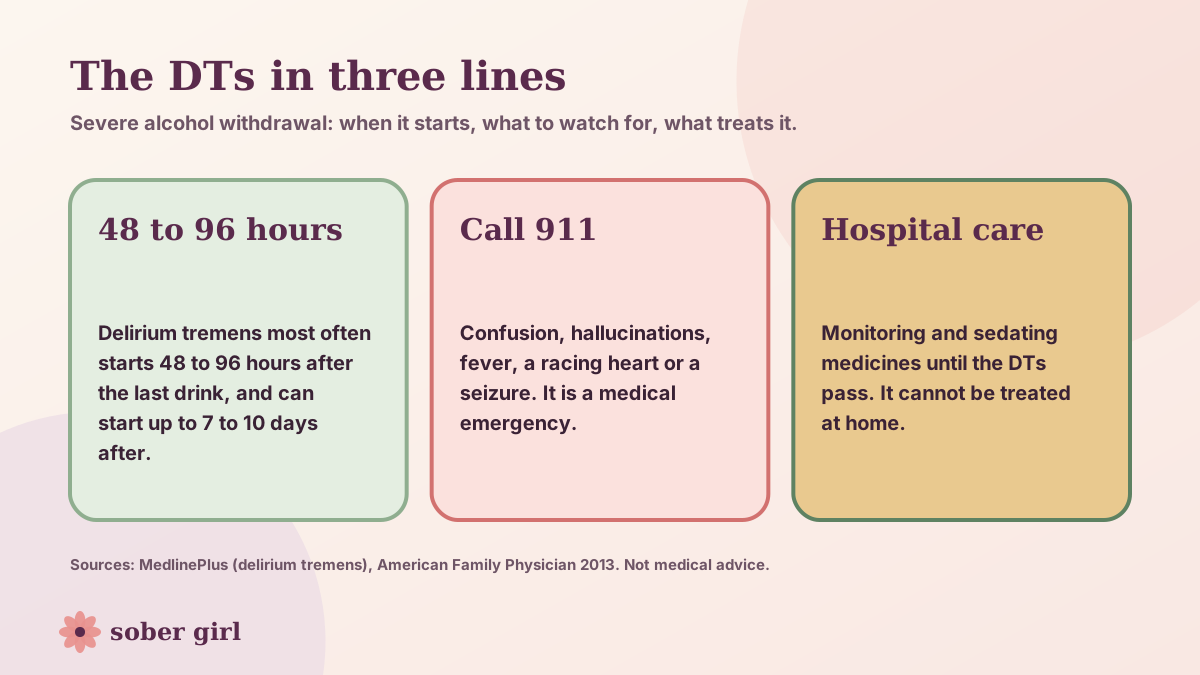
The timing catches people out. The shakes of day one can ease, and then the most dangerous part arrives days later. Up to a third of people with withdrawal who have a related seizure go on to develop delirium tremens [2], so a seizure on its own is itself a reason to get help.
Symptoms of delirium tremens
Symptoms can get worse quickly. MedlinePlus lists these [1]:
- Sudden, severe confusion (delirium) and changes in mental function
- Seeing or feeling things that are not really there (hallucinations)
- Fever, heavy sweating, rapid breathing and a rapid or irregular heartbeat
- Body tremors, agitation, restlessness, excitement or fear
- Sensitivity to light, sound and touch
- Seizures, most often in the first 12 to 48 hours
- Deep sleep that lasts for a day or longer
One detail is worth knowing if you are looking after someone: the hallucinations are mostly visual, and they are distressing but not dangerous in themselves. The risks come from the seizures, the fever and the heart rhythm [2].
Who is at risk?
MedlinePlus says delirium tremens is especially common in people who drink about 4 to 5 pints of wine, 7 to 8 pints of beer or a pint of liquor every day for several months, and in people who have used alcohol for more than 10 years. It most often happens in people with a history of alcohol withdrawal, and not eating enough while drinking adds to the risk. A head injury, infection or illness can trigger it too [1].
The American Family Physician review lists the risk factors as sustained heavy drinking, age over 30, more days since the last drink, and a previous episode of delirium tremens [2]. A past episode matters most: if you have had the DTs or a withdrawal seizure before, plan any change in your drinking with a doctor.
How are the DTs treated?
The goals are to save the person’s life, relieve symptoms and prevent complications. A hospital stay is needed. The team checks vital signs and blood tests such as electrolyte levels, and gives medicines to keep the person calm and sedated until the DTs pass and to treat seizures, anxiety or tremors [1].
Benzodiazepines are the standard medicines for withdrawal: they reduce symptoms and can prevent withdrawal seizures [2]. Mild and moderate withdrawal can sometimes be managed as an outpatient, but severe symptoms, a high risk of complications, or serious psychiatric or medical problems call for inpatient care [2]. If you go to a hospital for any other reason, tell the staff you have been drinking heavily so they can watch for withdrawal [1].
After recovery, long-term treatment starts: a period with no alcohol, counseling and support groups [1]. Medicines that help you stay stopped are part of that conversation too.
If you want to stop drinking safely
- Tell a doctor how much you really drink, and whether you have had shakes, seizures or hallucinations when you went without. They can plan a safe taper or supervised withdrawal.
- Do not do it alone in the first days if you drink every day. Ask someone to be with you or to check in often.
- Know the emergency signs: seizure, fever, severe confusion or hallucinations. Call 911 or your local emergency number [1].
- Find treatment: NIAAA explains how to find and get help for alcohol problems [5].
- Track your days after you are through withdrawal. The Sober Girl app counts your days and has a craving timer for the hard moments.
Delirium tremens vs ordinary alcohol withdrawal
Most withdrawal is not delirium tremens, and most people who go through it do not reach the DTs. The difference is how far it goes. The American Family Physician review sorts alcohol withdrawal into three stages, and the DTs sit at the top [2].
| Stage | What it looks like |
|---|---|
| 1 (mild) | Anxiety, tremor, insomnia, headache, palpitations, stomach upset |
| 2 (moderate) | Mild symptoms plus sweating, higher blood pressure, fast breathing and heart rate, confusion, mild fever |
| 3 (delirium tremens) | Moderate symptoms plus disorientation, impaired attention, visual or auditory hallucinations, seizures |
The point of the table is that progression can be fast. Going from stage 1 or 2 to stage 3 can happen quickly without treatment [2]. A mild first day does not guarantee a mild third day. If you are not sure which stage you or someone else is in, treat the uncertainty as a reason to call a doctor.
How doctors check for it
Delirium tremens is a medical emergency, so a health care provider starts with a physical exam. MedlinePlus lists the signs they look for: heavy sweating, an increased startle reflex, an irregular heartbeat, problems with eye muscle movement, rapid breathing, a rapid heart rate and rapid muscle tremors [1].
Tests that may follow include blood magnesium and phosphate levels, a comprehensive metabolic panel, an electrocardiogram (ECG), an electroencephalogram (EEG) and a toxicology screen to check for other drugs [1]. In the American Family Physician review, clinicians also use a validated scoring tool such as the CIWA-Ar to rate how severe withdrawal is [2].
Complications and what can linger
The risks go beyond the delirium itself. MedlinePlus lists injury from falls during seizures, injury to yourself or others caused by an altered mental state, an irregular heartbeat that may be life-threatening, and seizures [1]. Heavy drinking can also leave other conditions that need treatment on their own, including heart muscle disease, liver disease, nerve and brain damage, and Wernicke-Korsakoff syndrome, a serious brain disease caused by a lack of vitamin B1 [1].
Recovery does not always end when the delirium does. Some symptoms linked to alcohol withdrawal can last a year or more, including mood swings, tiredness and trouble sleeping [1]. That is worth knowing in advance: a rough first few months is common, and it is a reason to keep support in place rather than a sign that something has gone wrong. Our pages on sleep after quitting alcohol and the first month of sobriety cover what to expect.
How to lower your risk
- Get prompt treatment for withdrawal symptoms. MedlinePlus lists this as the main way to prevent the DTs, along with avoiding or reducing alcohol [1].
- Plan a taper or medical detox rather than stopping cold if you drink heavily every day. A doctor can decide whether you can be managed as an outpatient or need a hospital [2].
- Eat. MedlinePlus notes the DTs are more likely when someone drinks heavily and does not eat enough [1].
- Tell any hospital team about heavy drinking, even if you are there for something unrelated, so they can watch for withdrawal [1].
- Know your history. A past DTs episode or withdrawal seizure raises the risk, so share it with your doctor [2].
Is Sober Girl right for you?
- use an iPhone or an Android phone
- want a private tracker, with your journal kept on your device
- want a day counter, money saved and a daily check-in in one calm place
- want a Craving SOS with a breathing exercise and a 10-minute timer
- want to start free and add Plus only if you need the journal, insights or milestone cards
- want a community feed, live coaching or an AI chat
- want a structured multi-week education program
- need medical help for heavy drinking or withdrawal. An app is not treatment, so see the safety notes above
Frequently asked questions
What are the first signs of delirium tremens?
Sudden confusion, seeing or feeling things that are not there, fever, heavy sweating, a racing heart and body tremors, usually 48 to 96 hours after the last drink. If you see these, call emergency services.
How long after the last drink can the DTs start?
Most often 48 to 96 hours after the last drink, but MedlinePlus says they can start 7 to 10 days after. Seizures are most common earlier, in the first 12 to 48 hours.
Can you die from delirium tremens?
Yes, it can be life-threatening and is a medical emergency. It is associated with an increased risk of death, which is why it needs hospital treatment.
Can you get the DTs without drinking every day?
The risk is highest after months or years of heavy daily drinking and in people who have had withdrawal before. If you drink heavily and are unsure, ask a doctor before cutting down sharply.
Can delirium tremens be treated at home?
No. Delirium tremens needs a hospital stay with monitoring and sedating medicines. Only mild or moderate withdrawal can sometimes be managed as an outpatient, and only under medical care.
What is the difference between alcohol withdrawal and delirium tremens?
Withdrawal ranges from mild (anxiety, tremor, insomnia) to moderate (sweating, higher blood pressure). Delirium tremens is stage 3: disorientation, hallucinations and sometimes seizures, and it needs hospital care.
How long do symptoms last after the DTs?
The delirium is treated in hospital until it passes, but MedlinePlus says some withdrawal-related symptoms, such as mood swings, tiredness and sleeplessness, can last a year or more.
Do seizures mean you will get the DTs?
Not always, but the American Family Physician review says up to a third of people with withdrawal who have a related seizure go on to develop delirium tremens, so a seizure is a reason to get emergency help.
Sources
- Delirium tremens. MedlinePlus (US National Library of Medicine), reviewed 1 January 2025.
- Outpatient Management of Alcohol Withdrawal Syndrome. Muncie HL Jr, Yasinian Y, Oge’ L. American Family Physician 2013;88(9):589–595. Clinical review. Withdrawal symptoms begin 6 to 24 hours after the last drink; withdrawal seizures can occur 24 to 72 hours after it.
- Alcohol withdrawal. MedlinePlus (US National Library of Medicine), reviewed 1 January 2025 by Frank D. Brodkey, MD.
- National Helpline. SAMHSA. Free, confidential, 24/7 treatment referral line: 1-800-662-4357.
- Treatment for Alcohol Problems: Finding and Getting Help. NIAAA, updated February 2025.
How we write these. Every figure above links to the source it came from, and we label self-reported and observational results as such. Where we could not find a source we trust, the page says so instead of filling the gap. Sober Girl is made by ShipAI Lab and this is not medical advice. Sources were checked on 6 October 2026. If you spot an error, email us at [email protected].
Keep reading
Today is day one.
Sober Girl is a private sobriety tracker for women, on iPhone and Android: day counter, money saved, craving SOS and a tree that grows with you. Free to start.