The Sinclair Method: how taking naltrexone before you drink is meant to work, and what the evidence says
Most alcohol treatment asks you to stop first. This one starts with a tablet and a drink. Whether it works depends on what you want and how you use it.
The Sinclair Method (TSM) is a way of using naltrexone only when you are going to drink, rather than every day, to reduce drinking over time instead of stopping at once. Descriptions of the method usually say to take the tablet about an hour before the first drink. It is off-label: MedlinePlus describes naltrexone as a once-a-day medicine for people who have stopped drinking [1]. Trial evidence for taking it only as needed is mixed: in one trial, 27% of people on naltrexone with coping-skills therapy had no relapse to heavy drinking versus 3% on placebo [2], while another found targeted naltrexone helped men but called for additional strategies [3]. Talk to a doctor before trying it.
What is the Sinclair Method?
Imagine you are not ready to quit. You still want a drink on Friday, but you want it to stop running your week. The Sinclair Method is aimed at that person. Instead of taking naltrexone daily and abstaining, you take it shortly before you plan to drink, and keep drinking as you normally would. The idea behind it is that naltrexone blunts alcohol’s rewarding effect, so over months the link between drinking and reward weakens and drinking declines.
It is named after the researcher who developed the idea, John D. Sinclair, who is also an author on one of the trials below [2]. In practice, descriptions commonly say to take naltrexone about an hour before drinking, and to take it before every drinking occasion, because the effect depends on the timing. Those timing details come from how the method is usually described rather than from the trials we cite, so ask your own clinician for dosing.
Track it in Sober Girl
How it differs from standard naltrexone use
| Standard naltrexone | The Sinclair Method | |
|---|---|---|
| Who it is for | People who have stopped drinking [1] | People who still drink and want to cut down |
| When you take it | Once a day, around the same time [1] | Before drinking, as needed |
| Goal | Reduce cravings and help control dependence [1] | Reduce drinking over time |
| Status | Labeled use | Off-label; ask a doctor |
That gap is why a doctor’s involvement matters. MedlinePlus tells people to continue naltrexone even if they feel well and not to stop without talking to a doctor [1], and the targeted approach does neither of those things the same way.
What the trials found
Few trials test the targeted approach directly, and their results are mixed. Here are the main ones.
| Study | Who and what | Result |
|---|---|---|
| Heinälä et al., 2001 [2] | 121 non-abstinent outpatients; daily naltrexone for 12 weeks, then only when craving for 20 weeks | With coping-skills therapy, 27% had no relapse to heavy drinking over 32 weeks vs 3% on placebo. No benefit over placebo with supportive therapy alone |
| Kranzler et al., 2009 [3] | 163 people aiming to cut down; daily or targeted naltrexone for 12 weeks | Targeted naltrexone reduced drinking in men; authors say more strategies or better medicines are needed |
| Cochrane review, 2010 [4] | 50 trials, 7,793 people, mostly daily naltrexone | Heavy-drinking risk fell to 83% of placebo (RR 0.83); effect on return to any drinking (RR 0.96) not significant |
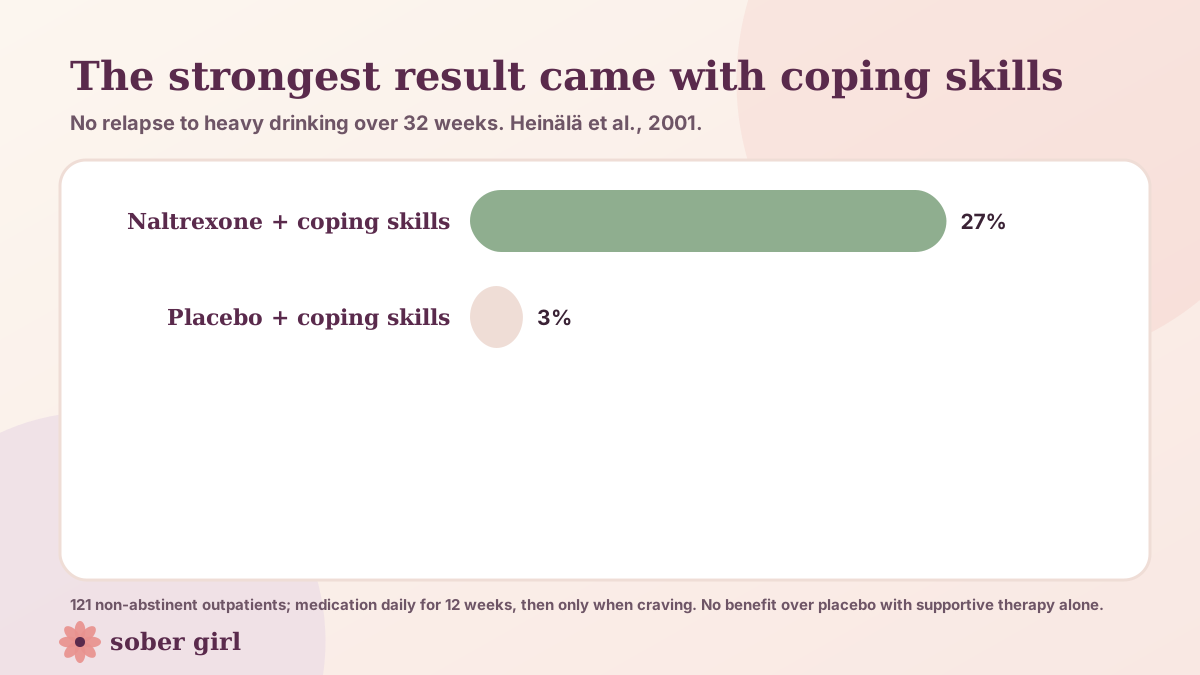
Three things stand out. First, naltrexone did best when it came with coping-skills therapy, and showed no advantage over placebo with supportive therapy alone [2]. Second, the effect in the largest review is on heavy drinking, not on stopping entirely [4]. Third, even the authors of the targeted trial in problem drinkers say the effect was modest and men benefited most [3]. You will see high success figures on websites promoting the method; those usually define success differently from these trials, so compare them with the numbers above.
Safety: what to know before you try it
- Opioids. Naltrexone blocks opioid medicines and street opioids. Taking higher doses to overcome the block can cause serious injury, coma or death, and you should tell any doctor who prescribes for you that you take or took naltrexone [1]. If you use opioids or may need an opioid painkiller, discuss this first.
- Liver. Tell your doctor about kidney or liver disease. Pain in the upper right abdomen, dark urine, light-colored stools or yellow skin or eyes need a call to your doctor right away [1].
- Mood. Naltrexone does not reduce the risk of self-harm. Report new low mood or thoughts of suicide to a doctor immediately; in the US call or text 988 [1] [5].
- Common side effects include nausea, vomiting, stomach pain, headache, dizziness, anxiety and trouble sleeping [1]. In the Cochrane review, nausea and daytime sleepiness were the main ones [4].
- Dependence. If you drink heavily every day, do not suddenly cut back on your own; withdrawal can be dangerous. See delirium tremens.
Who might it suit, and who should look elsewhere
It may suit someone whose goal is to drink less rather than to stop, who has no opioid use, is willing to take a tablet before every drinking occasion, and has a clinician who will prescribe and monitor it. It is a poor fit if you want to be fully sober, since the daily labeled use and a recovery-first plan are built for that, if you drink so heavily that you are physically dependent, or if you cannot reliably take it beforehand.
If your goal is to stop, our guides to naltrexone, acamprosate and Antabuse, acamprosate and quitting on your own are the better next reads. If you want to cut back without medication, see mindful drinking and moderation management.
Is Sober Girl right for you?
- use an iPhone or an Android phone
- want a private tracker, with your journal kept on your device
- want a day counter, money saved and a daily check-in in one calm place
- want a Craving SOS with a breathing exercise and a 10-minute timer
- want to start free and add Plus only if you need the journal, insights or milestone cards
- want a community feed, live coaching or an AI chat
- want a structured multi-week education program
- need medical help for heavy drinking or withdrawal. An app is not treatment, so see the safety notes above
Frequently asked questions
What is the Sinclair Method?
A way of using naltrexone only when you plan to drink, usually described as taking it about an hour beforehand, to reduce drinking over time rather than stop at once. It is an off-label use.
Does the Sinclair Method work?
Evidence is mixed. One trial found 27% of people on targeted naltrexone with coping-skills therapy had no relapse to heavy drinking vs 3% on placebo; another found it helped men but needed extra strategies.
Is the Sinclair Method approved?
The labeled use of naltrexone is daily dosing for people who have stopped drinking. Taking it only before drinking is off-label, so it needs a doctor’s agreement.
Can you take naltrexone only when you drink?
Some trials tested taking it only when craving or in high-risk situations, but the labeled use is once a day. Ask your doctor, and do not change the dosing on your own.
What are the side effects of naltrexone?
Nausea, vomiting, stomach pain, headache, dizziness, anxiety and sleep trouble are common. Liver warning signs and low mood need a call to your doctor right away.
Can you use the Sinclair Method if you take opioids?
No. Naltrexone blocks opioids, and taking higher doses to overcome the block can cause serious injury, coma or death. Tell your doctor about any opioid medicine you use.
Does the Sinclair Method help you quit drinking completely?
It is designed to reduce drinking, not to stop it. The large Cochrane review found a clear effect on heavy drinking but not a significant one on return to any drinking.
Is the Sinclair Method safe if I drink heavily every day?
Not on your own. Daily heavy drinkers can have dangerous withdrawal if they stop or cut back suddenly, so plan any change with a doctor.
Sources
- Naltrexone. MedlinePlus (US National Library of Medicine), revised 15 September 2026.
- Targeted use of naltrexone without prior detoxification in the treatment of alcohol dependence: a factorial double-blind, placebo-controlled trial. Heinälä P, Alho H, Kiianmaa K, Lönnqvist J, Kuoppasalmi K, Sinclair JD. Journal of Clinical Psychopharmacology 2001;21:287–292. 121 non-abstinent outpatients. Naltrexone with coping-skills therapy: 27% had no relapse to heavy drinking over 32 weeks vs 3% with placebo. Naltrexone was not better than placebo with supportive therapy alone. Targeted use, taken only when craving, kept heavy drinking down.
- Targeted naltrexone for problem drinkers. Kranzler HR, Tennen H, Armeli S, et al. Journal of Clinical Psychopharmacology 2009;29:350–357. 163 people aiming to cut down. Targeted naltrexone reduced drinking in men; the authors say additional strategies or more effective medicines are needed to increase the effect.
- Opioid antagonists for alcohol dependence. Rösner S, Hackl-Herrwerth A, Leucht S, et al. Cochrane Database of Systematic Reviews 2010;CD001867. 50 randomized trials, 7,793 people. Naltrexone cut the risk of heavy drinking to 83% of the placebo risk (RR 0.83); the effect on return to any drinking (RR 0.96) was not statistically significant.
- 988 Suicide & Crisis Lifeline. 988 Lifeline. Call, text or chat, free and confidential, 24/7.
How we write these. Every figure above links to the source it came from, and we label self-reported and observational results as such. Where we could not find a source we trust, the page says so instead of filling the gap. Sober Girl is made by ShipAI Lab and this is not medical advice. Sources were checked on 6 October 2026. If you spot an error, email us at [email protected].
Keep reading
Today is day one.
Sober Girl is a private sobriety tracker for women, on iPhone and Android: day counter, money saved, craving SOS and a tree that grows with you. Free to start.