Gabapentin for alcohol use disorder: what the trials show, who it may help, and the risks
It is not an approved alcohol medicine, yet doctors prescribe it for drinking more than you might think. Here is what the evidence supports and where it stops.
Gabapentin is used off-label for alcohol use disorder; it is not approved for it. Its approved uses are seizures, nerve pain after shingles and, in an extended-release form, restless legs syndrome [1]. In a 2020 randomized trial, 27% of adults on gabapentin had no heavy drinking days over 16 weeks versus 9% on placebo, and 18% versus 4% stayed totally abstinent. The benefit was concentrated in people with more withdrawal symptoms before treatment [2]. A 2019 Cleveland Clinic review says it should be a second-line option, prescribed only after screening for opioid or other prescription drug misuse [3].
What is gabapentin, and why is it used for alcohol?
Picture the second week after stopping. The worst withdrawal has eased, but sleep is poor, you feel on edge and the evening urge is loud. A doctor who knows a bit about addiction might suggest gabapentin for that stretch, even though it is not on the short list of medicines approved for alcohol.
MedlinePlus lists gabapentin as an anticonvulsant used with other medicines for certain seizures in epilepsy, to relieve postherpetic neuralgia (nerve pain after shingles), and, as extended-release tablets, for restless legs syndrome [1]. Alcohol is not on that list. A Cleveland Clinic review describes it as used off-label for alcohol-related withdrawal, cravings, anxiety and insomnia [3].
The three medicines approved in the US for alcohol use disorder are naltrexone, acamprosate and disulfiram [4]. Gabapentin sits outside that group, which is why the way it is used and the strength of the evidence both look different.
Track it in Sober Girl
Does gabapentin work for alcohol? The trial evidence
The best-known test is a double-blind trial in JAMA Internal Medicine in 2020. It enrolled treatment-seeking adults with alcohol use disorder who also met recent withdrawal criteria, and randomized 96 of them to gabapentin (up to 1,200 mg a day) or placebo for 16 weeks, alongside nine short medical management visits. Ninety were evaluable [2].
| Outcome over 16 weeks | Gabapentin | Placebo | Number needed to treat |
|---|---|---|---|
| No heavy drinking days | 27% (12 of 44) | 9% (4 of 46) | 5.4 |
| Total abstinence | 18% (8 of 44) | 4% (2 of 46) | 6.2 |
| No heavy drinking days, high-withdrawal group | better than placebo | 3.1 | |
| Total abstinence, high-withdrawal group | better than placebo | 2.7 |
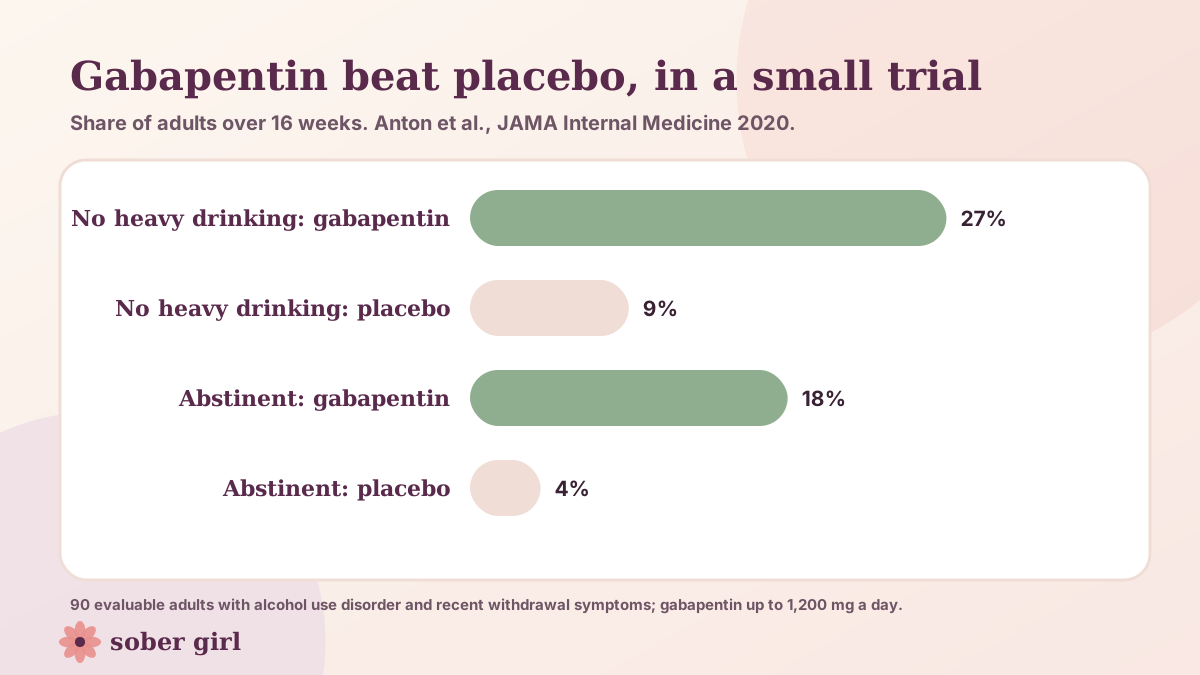
Two cautions. The trial was small, and the people were mostly white men in an academic outpatient setting [2], so it may not predict how you would respond. And the benefit was not even: within the group with low withdrawal symptoms before treatment, there were no significant differences [2]. That is why the main message from the trial is about who may benefit, not that gabapentin helps everyone who drinks.
Who might it suit, and where does it fit?
The 2019 review calls gabapentin well tolerated, with efficacy for mild alcohol withdrawal and early abstinence, but says it should be prescribed only as a second-line alternative to standard therapies [3]. The 2020 trial points the same way: the people who gained most had more withdrawal symptoms [2].
- Someone who cannot take naltrexone or acamprosate, or who has not responded to them, for reasons a doctor can explain. See naltrexone and acamprosate.
- Someone with prominent early-abstinence symptoms such as poor sleep, anxiety and restlessness, where the trial results were strongest [2] [3].
- Someone with no history of misusing opioids or other prescription drugs, since screening for that is advised before prescribing [3].
Do not use it to manage heavy daily drinking withdrawal on your own. Withdrawal can be dangerous and needs a doctor; see delirium tremens for why.
Gabapentin vs naltrexone and acamprosate
| Gabapentin | Acamprosate | Naltrexone (oral, 50 mg) | |
|---|---|---|---|
| Approved for alcohol use disorder in the US? | No (off-label) [1] | Yes [4] | Yes [4] |
| Review of many trials? | Review and one main trial [3] [2] | 118-trial review, NNT 11 for any drinking [5] | 118-trial review, NNT 18 for any drinking, 11 for heavy drinking [5] |
| Where it sits | Second-line, per a review [3] | Approved medicine [4] | Approved medicine [4] |
The 2023 JAMA review of 118 trials reported numbers needed to treat for acamprosate and oral naltrexone, medicines with at least moderate strength of evidence [5]. Gabapentin rests on a smaller evidence base, which is part of why guidance puts it behind them.
Side effects and misuse risk
MedlinePlus says gabapentin may make you drowsy or dizzy, slow your thinking and cause loss of coordination, so you should not drive until you know how it affects you. It adds that alcohol can add to the drowsiness [1]. That matters for a medicine used by people who may still drink: the combination can be sedating.
MedlinePlus also warns that mental health can change in unexpected ways, including thoughts of suicide, in people taking gabapentin [1]. Report any new low mood or self-harm thoughts right away; in the US you can call or text 988 [6].
The misuse concern is real. The Cleveland Clinic review notes the drug can be misused and recommends screening for opioid or other prescription drug misuse first [3]. If you have a history of that, tell your doctor and weigh the alternatives.
Questions to ask your doctor
- Would naltrexone or acamprosate be a better first choice for me?
- Do my withdrawal symptoms or sleep problems make gabapentin more likely to help?
- What dose, for how long, and how will you stop it?
- How does it interact with other medicines I take, and what if I drink while on it?
- Given my history, is there any misuse risk I should discuss?
Is Sober Girl right for you?
- use an iPhone or an Android phone
- want a private tracker, with your journal kept on your device
- want a day counter, money saved and a daily check-in in one calm place
- want a Craving SOS with a breathing exercise and a 10-minute timer
- want to start free and add Plus only if you need the journal, insights or milestone cards
- want a community feed, live coaching or an AI chat
- want a structured multi-week education program
- need medical help for heavy drinking or withdrawal. An app is not treatment, so see the safety notes above
Frequently asked questions
Is gabapentin approved for alcohol use disorder?
No. The FDA-approved alcohol medicines are naltrexone, acamprosate and disulfiram. Gabapentin is used off-label for alcohol, and is approved for seizures, nerve pain after shingles and restless legs syndrome.
Does gabapentin reduce alcohol cravings?
In a 2020 trial, more people on gabapentin had no heavy drinking days (27% vs 9%) and total abstinence (18% vs 4%). The review calls it useful for early abstinence symptoms, but it is second-line.
Does gabapentin help with alcohol withdrawal?
A review says it has shown efficacy for mild alcohol withdrawal and early abstinence. Severe withdrawal needs a doctor and often hospital care, and should not be self-treated.
Who benefits most from gabapentin for alcohol?
In the JAMA trial, people with more withdrawal symptoms before treatment gained the most; there was no significant difference in the low-withdrawal group.
Is gabapentin better than naltrexone for alcohol?
There is no head-to-head proof. Naltrexone and acamprosate have stronger evidence from a 118-trial review and are approved medicines; a review calls gabapentin second-line.
Can you drink on gabapentin?
It is not advisable. MedlinePlus says alcohol can add to the drowsiness gabapentin causes, and the combination can affect coordination and thinking.
Can gabapentin be misused?
Yes. The Cleveland Clinic review notes a misuse potential, especially in people with opioid or other prescription drug misuse, and advises screening before prescribing.
How long is gabapentin taken for alcohol in trials?
The JAMA trial ran 16 weeks at up to 1,200 mg a day with short medical visits. Your own plan, dose and duration should come from your doctor.
Sources
- Gabapentin. MedlinePlus (US National Library of Medicine), read 7 November 2026. Drug information page. Approved uses are seizures in epilepsy, postherpetic neuralgia and (extended-release) restless legs syndrome. May cause drowsiness, dizziness and loss of coordination; alcohol adds to the drowsiness.
- Efficacy of Gabapentin for the Treatment of Alcohol Use Disorder in Patients With Alcohol Withdrawal Symptoms: A Randomized Clinical Trial. Anton RF, Latham P, Voronin K, et al. JAMA Internal Medicine 2020;180:728–736. Double-blind trial, 96 randomized and 90 evaluable adults, gabapentin up to 1200 mg a day vs placebo for 16 weeks. No heavy drinking days: 27% vs 9% (NNT 5.4). Total abstinence: 18% vs 4% (NNT 6.2). Benefit was concentrated in people with more withdrawal symptoms before treatment.
- Gabapentin for alcohol use disorder: A good option, or cause for concern?. Modesto-Lowe V, Barron GC, Aronow B, Chaplin M. Cleveland Clinic Journal of Medicine 2019;86:815–823. Review. Used off-label for withdrawal, cravings, anxiety and insomnia. Well tolerated, with efficacy for mild withdrawal and early abstinence, but a potential for misuse. Should be second-line, after screening for opioid or other prescription drug misuse.
- Treatment for Alcohol Problems: Finding and Getting Help. NIAAA, updated February 2025.
- Pharmacotherapy for Alcohol Use Disorder: A Systematic Review and Meta-Analysis. McPheeters M, O’Connor EA, Riley S, et al. JAMA 2023;330:1653–1665. Meta-analysis of 118 trials and 20,976 participants. Number needed to treat to prevent a return to any drinking: 11 for acamprosate (95% CI 1 to 32) and 18 for oral naltrexone 50 mg a day (95% CI 4 to 32); to prevent a return to heavy drinking, 11 for oral naltrexone. Diarrhea was more common with acamprosate (risk ratio 1.58).
- 988 Suicide & Crisis Lifeline. 988 Lifeline. Call, text or chat, free and confidential, 24/7.
How we write these. Every figure above links to the source it came from, and we label self-reported and observational results as such. Where we could not find a source we trust, the page says so instead of filling the gap. Sober Girl is made by ShipAI Lab and this is not medical advice. Sources were checked on 6 October 2026. If you spot an error, email us at [email protected].
Keep reading
Today is day one.
Sober Girl is a private sobriety tracker for women, on iPhone and Android: day counter, money saved, craving SOS and a tree that grows with you. Free to start.