Urge surfing: how to ride out a craving without giving in
A craving is not a command. Urge surfing is a way to watch one rise and fall without acting on it. Here is how it works, how to try it, and what the research does and does not show.
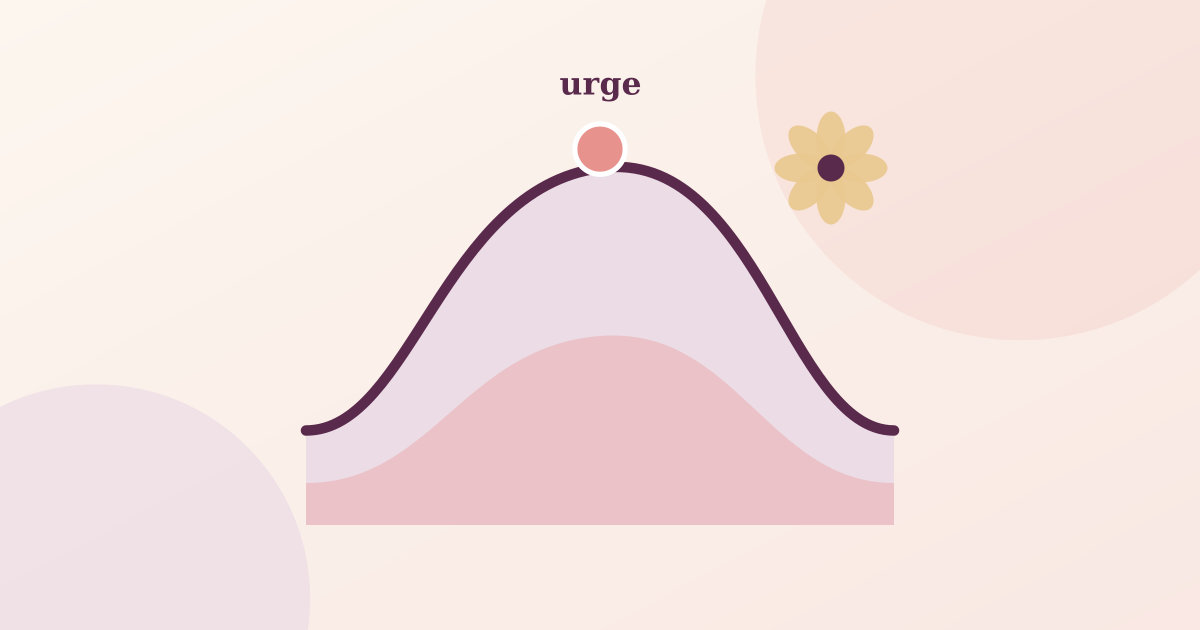
Urge surfing is a relapse-prevention technique in which you notice a craving, observe it like a wave as it rises and falls, and do not act on it. NIAAA’s Rethinking Drinking advises accepting an urge as normal and temporary, and says urges to drink are short-lived, predictable and controllable [1]. The research is early: in a randomised study of 123 student smokers, a brief urge-surfing instruction did not reduce urges but reduced cigarettes smoked over seven days [2].
What urge surfing is
The technique comes from the relapse-prevention work of the psychologist Alan Marlatt, who described it as treating an urge like a wave. You do not fight it and you do not feed it. You watch it build, crest and fall [2]. NIAAA’s Rethinking Drinking puts it this way: instead of fighting an urge, accept it as normal and temporary, and keep in mind that it will soon crest like an ocean wave and pass [1].
Track it in Sober Girl
How to do it, step by step
This is a practical adaptation of the idea, not a clinical protocol:
- Notice and name it. Say to yourself, “This is an urge to drink.” Naming it creates a little distance.
- Find it in your body. Where do you feel it: chest, throat, hands, stomach? Describe it as if to someone who has never felt it.
- Breathe slowly. A few slow breaths in and out while you keep watching.
- Watch it change. Urges move. Notice whether it gets stronger, shifts or fades. You are an observer, not a participant.
- Set a timer. Ten minutes is a workable length. You are not promising never to drink, only to wait for the wave to pass first.
- Then do something else. Move, call someone, make tea. Do not sit and wait for the urge to be gone before you do anything.
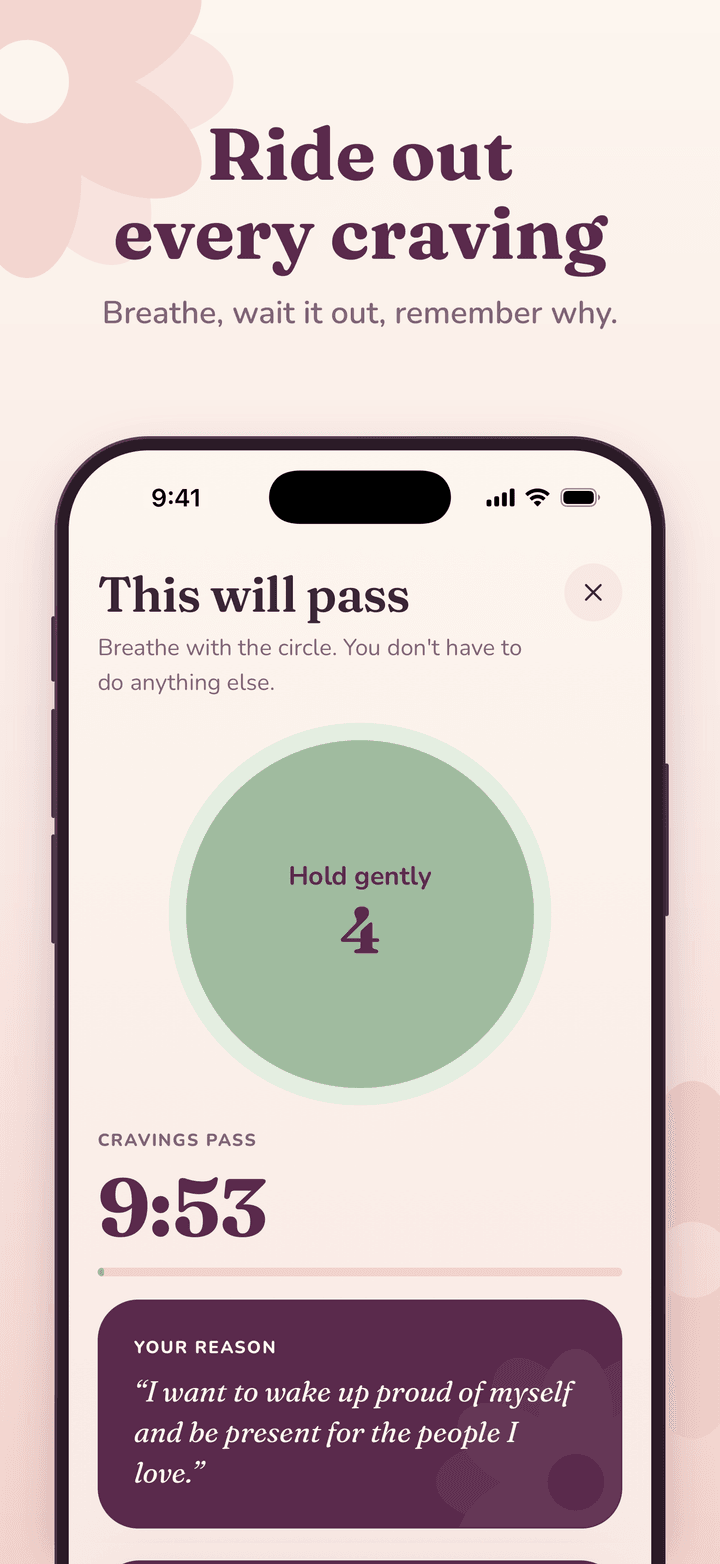
Sober Girl’s Craving SOS is built around the same idea: a breathing exercise, a 10-minute timer and the reason you wrote for yourself.
What the evidence shows
Be clear about how much is known. The best-known study of urge surfing, by Bowen and Marlatt, randomised 123 undergraduate smokers to brief mindfulness instructions based on urge surfing or to no instructions. The two groups did not differ significantly in their urges. But the mindfulness group smoked significantly fewer cigarettes over the following 7 days. The authors concluded the technique may not reduce urges at first, but may change how people respond to them, and called the data preliminary [2].
That study was about smoking, in students, over a week. We did not find a trial that tests urge surfing for alcohol on its own, so we do not claim it works for drinking. What we can say is that NIAAA recommends riding out urges as one of several strategies [1].
Other strategies NIAAA lists
- Remind yourself of your reasons for change.
- Talk it through with someone you trust.
- Distract yourself with a healthy activity.
- Challenge the thought that is driving the urge.
- Leave a tempting situation quickly [1].
See our guide to stopping alcohol cravings for how to combine these.
When it is not enough
If urges are frequent, strong or hard to manage, that is worth telling a doctor. NIAAA notes that three medications are FDA-approved for alcohol use disorder [3]. The SAMHSA National Helpline (1-800-662-4357) is free, confidential and open 24/7 [4].
Is Sober Girl right for you?
- use an Android phone (the iPhone app is coming soon)
- want a private tracker, with your journal kept on your device
- want a day counter, money saved and a daily check-in in one calm place
- want a Craving SOS with a breathing exercise and a 10-minute timer
- want to start free and add Plus only if you need the journal, insights or milestone cards
- need it on an iPhone today (the App Store version is coming soon)
- want a community feed, live coaching or an AI chat
- want a structured multi-week education program
- need medical help for heavy drinking or withdrawal. An app is not treatment, so see the safety notes above
Frequently asked questions
What is urge surfing?
A technique in which you notice a craving, watch it rise and fall like a wave, and do not act on it. It comes from the relapse-prevention work of Alan Marlatt.
Does urge surfing work for alcohol cravings?
NIAAA recommends riding out urges as a strategy. In the main study we found, with student smokers, brief urge-surfing instructions did not reduce urges but did reduce cigarettes smoked over seven days. We found no trial of it for alcohol alone.
How long does an alcohol craving last?
NIAAA says urges to drink are short-lived, predictable and controllable, and that an urge will soon crest like a wave and pass. It does not give a fixed number of minutes, so we do not either.
What if the craving does not pass?
Talk to a doctor. Medications are available for alcohol use disorder, and the SAMHSA National Helpline can point you to help.
Sources
- How to Stop Alcohol Cravings. NIAAA, Rethinking Drinking.
- Surfing the urge: brief mindfulness-based intervention for college student smokers. Bowen S, Marlatt A. Psychology of Addictive Behaviors, 2009. A study of 123 student smokers, not drinkers. The authors call the data preliminary.
- Professional support. NIAAA, Rethinking Drinking. Lists the three FDA-approved medications for alcohol use disorder and when to see a health professional.
- National Helpline. SAMHSA. Free, confidential, 24/7 treatment referral line: 1-800-662-4357.
How we write these. Every figure above links to the source it came from, and we label self-reported and observational results as such. Where we could not find a source we trust, the page says so instead of filling the gap. Sober Girl is made by ShipAI Lab and this is not medical advice. Sources were checked on 6 October 2026. If you spot an error, email us at integrateopenai@gmail.com.
Keep reading
Today is day one.
Sober Girl is a private sobriety tracker for women, on Android now and coming soon to iPhone: day counter, money saved, craving SOS and a tree that grows with you. Free to start.