Alcohol-free days: how many to aim for, and how to track them
Counting alcohol-free days is the simplest way to see your pattern. Here is what official guidance says and how to track it, with an app or on paper.
The NHS advises people not to drink more than 14 units a week on a regular basis, to spread drinking over 3 or more days if they drink that much, and, to cut down, to have several drink-free days each week [1]. In the US, NIAAA defines heavy drinking for women as 4 or more drinks on any day or 8 or more in a week, and says the less alcohol, the better [2]. Tracking alcohol-free days takes one tick a day.
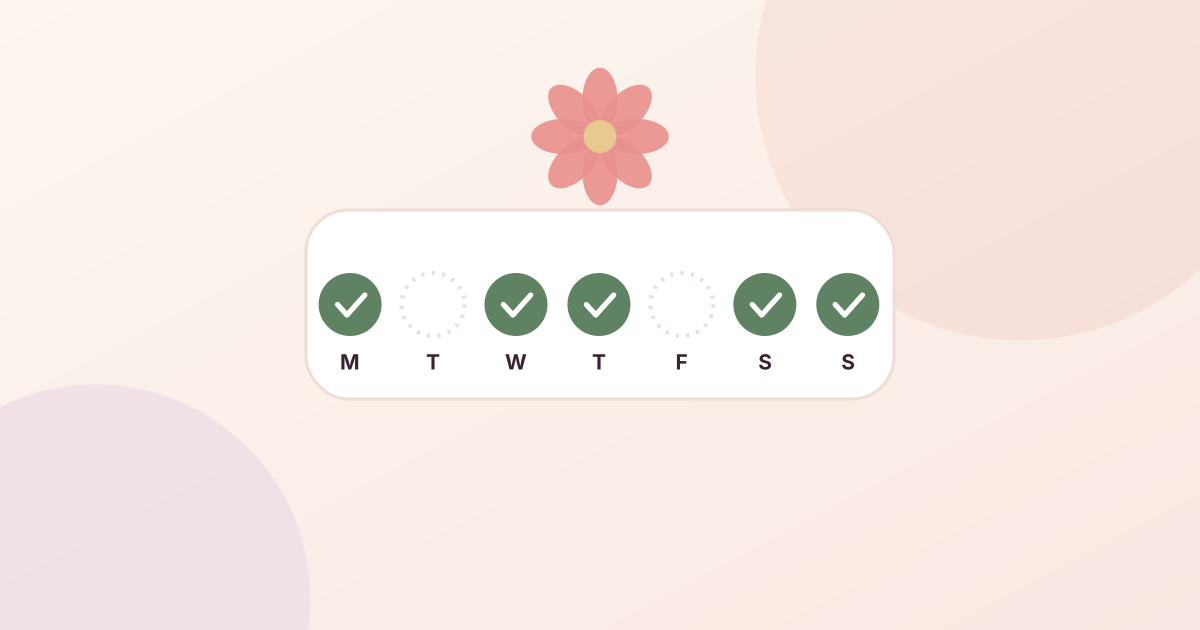
What counts as an alcohol-free day
A day with no alcohol at all. That is the whole definition, and its simplicity is the point: you do not need to measure anything to know whether a day was alcohol-free, which makes it the easiest thing to track honestly.
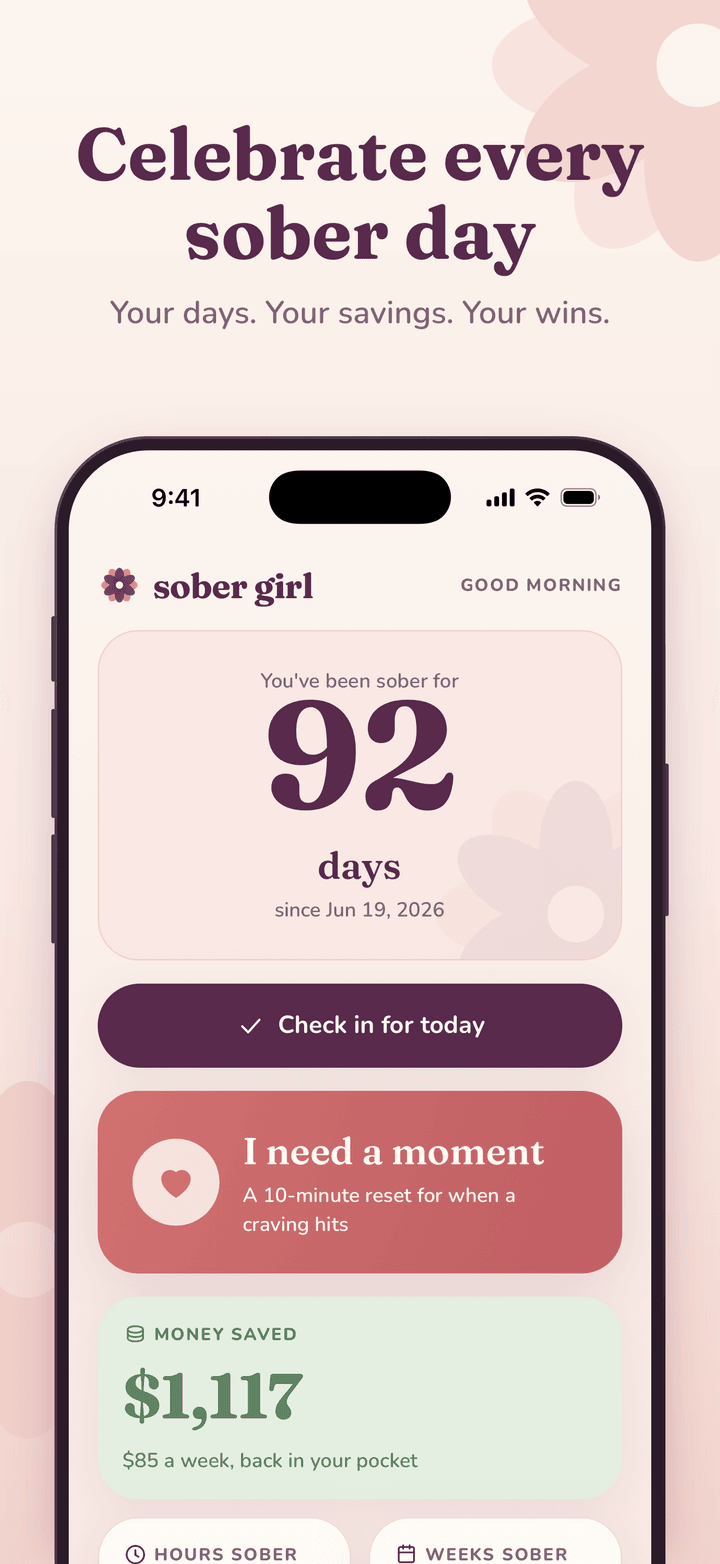
Track it in Sober Girl
What the guidance says
The NHS says men and women are advised not to drink more than 14 units a week on a regular basis, to spread drinking over 3 or more days if they regularly drink as much as 14 units, and, if they want to cut down, to try to have several drink-free days each week [1]. That is UK guidance, and it uses UK alcohol units.
US guidance is expressed in standard drinks, each holding 14 grams of pure alcohol. For women, NIAAA defines binge drinking as 4 or more drinks within about 2 hours, and heavy drinking as 4 or more drinks on any day or 8 or more in a week. It also says the less alcohol, the better [2]. We have not converted between the two systems because the definitions differ, so use the one that matches your country.
A simple way to track
- Count a baseline week. Do not change anything. Tick each day you did not drink. This tells you where you are starting.
- Set a small target. Add one alcohol-free day, or pick specific days. A target you can hit beats an ambitious one you cannot.
- Tick it daily. Do it in the evening, in the same place every time.
- Note the hard days. Beside any day you drank, write what led to it. Patterns show up within a few weeks.
- Review monthly. Count the days, notice the trend, and adjust the target.
Why a longer run is informative
If you want to learn what alcohol does for you, a longer run of alcohol-free days is more informative than isolated ones. In a BMJ Open study, 94 people who abstained for a month saw significant falls in insulin resistance, blood pressure, weight and two cancer-related growth factors. It was observational and excluded people with liver disease or alcohol dependence, so it is suggestive rather than proof [3].
Tools for tracking
A calendar and a pen work. If you want an app, two kinds exist. Apps that count units and drinks suit cutting down: Try Dry is free, with no ads, and tracks units, calories and money, with drinking goals and dry-day streaks [4]. Day counters suit stretches of alcohol-free days: Sober Girl counts your days and money saved, with a daily check-in, on Android now and iPhone coming soon. For a full comparison, see our guide to the best sober tracker apps.
A note on safety
Is Sober Girl right for you?
- use an Android phone (the iPhone app is coming soon)
- want a private tracker, with your journal kept on your device
- want a day counter, money saved and a daily check-in in one calm place
- want a Craving SOS with a breathing exercise and a 10-minute timer
- want to start free and add Plus only if you need the journal, insights or milestone cards
- need it on an iPhone today (the App Store version is coming soon)
- want a community feed, live coaching or an AI chat
- want a structured multi-week education program
- need medical help for heavy drinking or withdrawal. An app is not treatment, so see the safety notes above
Frequently asked questions
How many alcohol-free days a week should I have?
The NHS advises that if you want to cut down you try to have several drink-free days each week, and to spread drinking over 3 or more days if you regularly drink as much as 14 units. There is no single US number; NIAAA says the less alcohol, the better.
What is the NHS weekly limit?
The NHS advises men and women not to drink more than 14 units a week on a regular basis. UK units differ from US standard drinks.
How do I track alcohol-free days?
Tick each day you did not drink on a calendar or in an app. Count a baseline week first, then set a small target and review monthly.
Is there a free app for tracking alcohol-free days?
Yes. Try Dry is free with no ads, and Sober Girl’s day counter is free.
Sources
- Alcohol units. NHS (UK), last reviewed 27 August 2024. UK guidance, which uses UK alcohol units. US guidance uses standard drinks of 14 g of alcohol.
- The Basics: Defining How Much Alcohol Is Too Much. NIAAA.
- Short-term abstinence from alcohol and changes in cardiovascular risk factors, liver function tests and cancer-related growth factors: a prospective observational study. Mehta G, Macdonald S, Cronberg A, et al. BMJ Open 2018;8:e020673. Observational study. 94 people who chose to abstain for a month and 47 who kept drinking.
- TRY DRY: The Dry January App on the App Store (US). Apple App Store listing, retrieved 6 October 2026.
- Alcohol withdrawal. MedlinePlus (US National Library of Medicine), reviewed 1 January 2025 by Frank D. Brodkey, MD.
- National Helpline. SAMHSA. Free, confidential, 24/7 treatment referral line: 1-800-662-4357.
How we write these. Every figure above links to the source it came from, and we label self-reported and observational results as such. Where we could not find a source we trust, the page says so instead of filling the gap. Sober Girl is made by ShipAI Lab and this is not medical advice. Sources were checked on 6 October 2026. If you spot an error, email us at integrateopenai@gmail.com.
Keep reading
Today is day one.
Sober Girl is a private sobriety tracker for women, on Android now and coming soon to iPhone: day counter, money saved, craving SOS and a tree that grows with you. Free to start.