How long does alcohol stay in your system?
There are two different questions here: how long until you are sober, and how long a test can still find alcohol. The answers range from hours to weeks.
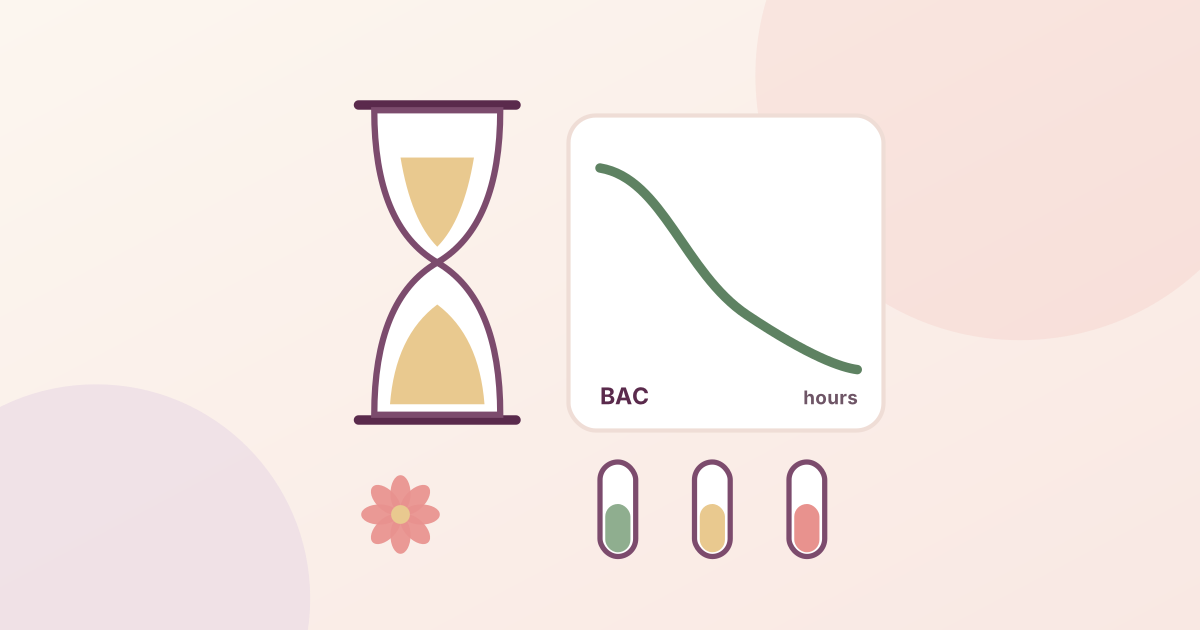
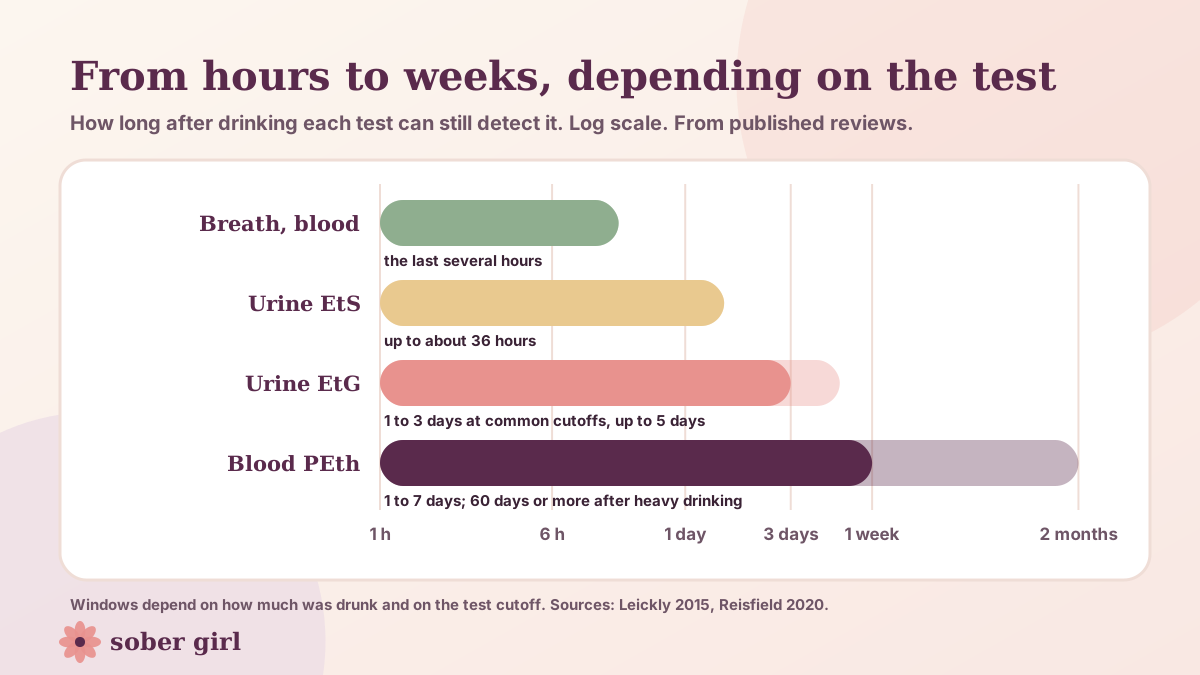
Your body clears alcohol from the blood at an average of about 0.015% blood alcohol concentration (BAC) an hour, and between 0.010% and 0.025% an hour in most people [1]. So a BAC of 0.08% takes about 5 hours to reach zero on average, and anywhere from about 3 to 8 hours. Tests can find traces for longer: breath and blood tests detect the last several hours, urine EtS up to about 36 hours, urine EtG 2 to 5 days [2], and the blood test PEth up to 60 days or longer after long-term heavy drinking [3]. Women reach a higher BAC than men from the same drinks, because alcohol sits in body water and women have less of it pound for pound [4].
How long alcohol stays in your system, by test
| Test | What it measures | Usual detection window |
|---|---|---|
| Breath (breathalyzer) | Alcohol itself | The last several hours [2] |
| Blood alcohol | Alcohol itself | The last several hours [2] |
| Urine EtS | A breakdown product of alcohol | Up to about 36 hours [2] |
| Urine EtG | A breakdown product of alcohol | 2 to 5 days [2]; 1 to 3 days at common cutoffs, up to 5 days after very heavy drinking with a low cutoff [3] |
| Blood PEth | A marker that builds up in red blood cells | The past 1 to 7 days [2]; 60 days or longer after long-term heavy drinking [3] |
Track it in Sober Girl
How long until you are sober: the blood alcohol math
Once you stop drinking, the liver removes alcohol at a fairly steady rate. A forensic review puts the average at 0.15 grams per liter of blood an hour, which is 0.015% BAC an hour, with most people between 0.010% and 0.025% [1]. Divide your peak BAC by that rate and you have the hours until it reaches zero:
| Peak BAC | Average (0.015% an hour) | Fast (0.025% an hour) | Slow (0.010% an hour) |
|---|---|---|---|
| 0.05% | about 3 hours | about 2 hours | about 5 hours |
| 0.08% (US driving limit) | about 5 hours | about 3 hours | about 8 hours |
| 0.10% | about 7 hours | about 4 hours | about 10 hours |
| 0.15% | about 10 hours | about 6 hours | about 15 hours |
| 0.20% | about 13 hours | about 8 hours | about 20 hours |
Two practical points follow. After a heavy evening that peaks at 0.15%, you can still be over the driving limit the next morning. And the clock starts when you stop drinking, not when you start. Chronic heavy drinkers clear alcohol faster, about 0.022% an hour on average in people going through detox, because the liver adapts [1]. That is a sign of how much the liver has been working, not a benefit.
Why the same drinks hit women harder
Alcohol spreads mainly through body water, and pound for pound women have less water in their bodies than men, so after the same drinks a woman’s blood alcohol concentration tends to be higher [4]. A higher peak means more hours to clear it at the same rate [1]. If you are trying to work out whether you are safe to drive, assume the slow column, or do not drive.
Can you get alcohol out of your system faster?
Not in any useful way. The rate is set by the liver’s enzymes [1], so coffee, a cold shower, water or a big meal after drinking may make you feel more awake but do not bring your BAC down faster. The only reliable fix is time. Eating before and while you drink slows how quickly alcohol reaches your blood, which lowers the peak, but it does not speed up removal.
If you are being tested because you are in treatment or a monitoring program, be aware that EtG tests are sensitive enough that the cutoff matters: higher cutoffs shorten the window to 1 to 3 days [3]. Ask the program which cutoff it uses rather than guessing.
What stays longer than the alcohol
Liver blood tests are not alcohol tests, but they do reflect recent drinking. GGT usually returns to normal within 2 to 3 weeks of stopping, and red blood cell size (MCV) takes 2 to 4 months [5]. If you are planning a blood test to see what a break has done, see liver recovery after quitting alcohol.
Is Sober Girl right for you?
- use an iPhone or an Android phone
- want a private tracker, with your journal kept on your device
- want a day counter, money saved and a daily check-in in one calm place
- want a Craving SOS with a breathing exercise and a 10-minute timer
- want to start free and add Plus only if you need the journal, insights or milestone cards
- want a community feed, live coaching or an AI chat
- want a structured multi-week education program
- need medical help for heavy drinking or withdrawal. An app is not treatment, so see the safety notes above
Frequently asked questions
How long does alcohol stay in your blood?
Until your liver clears it, at about 0.015% BAC an hour on average. A BAC of 0.08% takes about 5 hours to reach zero, and 3 to 8 hours depending on the person. Blood tests for alcohol itself detect the last several hours.
How long does alcohol stay in your urine?
Alcohol itself only for hours, but its breakdown products last longer: EtS up to about 36 hours and EtG 2 to 5 days, or 1 to 3 days at common test cutoffs.
How long does it take to sober up from one drink?
It depends on the BAC that drink produces, which depends on your size, sex and whether you have eaten. As a rough guide the liver clears about 0.015% BAC an hour; women reach a higher BAC from the same drink.
How long can a PEth test detect alcohol?
A PEth blood test usually reflects the past 1 to 7 days of drinking, and up to 60 days or longer after long-term heavy drinking.
Does coffee or water help you sober up faster?
No. They can make you feel more alert, but the liver clears alcohol at its own rate. Only time lowers your blood alcohol.
Can I drive the morning after drinking?
Not always. A peak of 0.15% can take about 10 hours to clear on average and up to about 15 hours. If you drank heavily, assume you may still be over the limit.
Sources
- Impact of Trauma, Massive Blood Loss and Administration of Resuscitation Fluids on a Person’s Blood-Alcohol Concentration and Rate of Ethanol Metabolism. Jones AW. Academic Forensic Pathology 2016;6(1):77–88. Forensic review. Mean elimination of alcohol from blood is 0.15 g/L an hour (0.015% BAC), 0.10 to 0.25 g/L an hour in most people, faster in chronic heavy drinkers (mean 0.22 g/L an hour in detox).
- High levels of agreement between clinic-based ethyl glucuronide (EtG) immunoassays and laboratory-based mass spectrometry. Leickly E, McDonell MG, Vilardaga R, et al. American Journal of Drug and Alcohol Abuse 2015;41(3):246–250. Background on alcohol tests: breath and blood detect the last several hours, urine EtS up to 36 hours, urine EtG 2 to 5 days, PEth the past 1 to 7 days.
- The roles of phosphatidylethanol, ethyl glucuronide, and ethyl sulfate in identifying alcohol consumption among participants in professionals health programs. Reisfield GM, Teitelbaum SA, Opie SO, et al. Drug Testing and Analysis 2020;12(8):1102–1108. Urine EtG and EtS: 1 to 3 days at common cutoffs, up to 5 days after very heavy drinking at a low (100 ng/mL) cutoff. Blood PEth: half-life 2.4 to 13.6 days, detectable 60 days or longer after chronic heavy drinking.
- Women and Alcohol. NIAAA fact sheet, updated December 2025.
- Biomarker-Based Approaches for Assessing Alcohol Use Disorders. Niemelä O. International Journal of Environmental Research and Public Health 2016;13(2):166. A review of alcohol biomarkers. Raised GGT usually returns to normal within 2 to 3 weeks of abstinence, red cell size (MCV) within 2 to 4 months. GGT is not specific to alcohol: fatty liver linked to obesity is its most common other cause.
- Alcohol withdrawal. MedlinePlus (US National Library of Medicine), reviewed 1 January 2025 by Frank D. Brodkey, MD.
- National Helpline. SAMHSA. Free, confidential, 24/7 treatment referral line: 1-800-662-4357.
How we write these. Every figure above links to the source it came from, and we label self-reported and observational results as such. Where we could not find a source we trust, the page says so instead of filling the gap. Sober Girl is made by ShipAI Lab and this is not medical advice. Sources were checked on 6 October 2026. If you spot an error, email us at [email protected].
Keep reading
Today is day one.
Sober Girl is a private sobriety tracker for women, on iPhone and Android: day counter, money saved, craving SOS and a tree that grows with you. Free to start.