Liver recovery after quitting alcohol: what your blood tests show, week by week
Liver tests change on different clocks once you stop drinking. Here is what each marker means, when it usually returns to normal, and how to measure your own before and after.
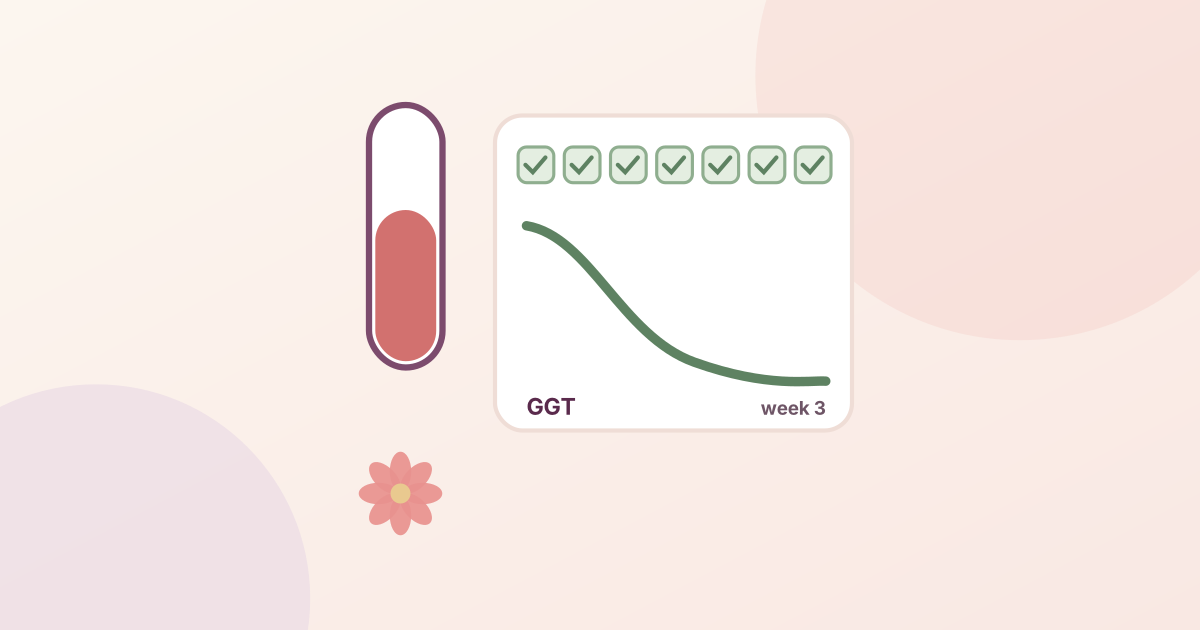
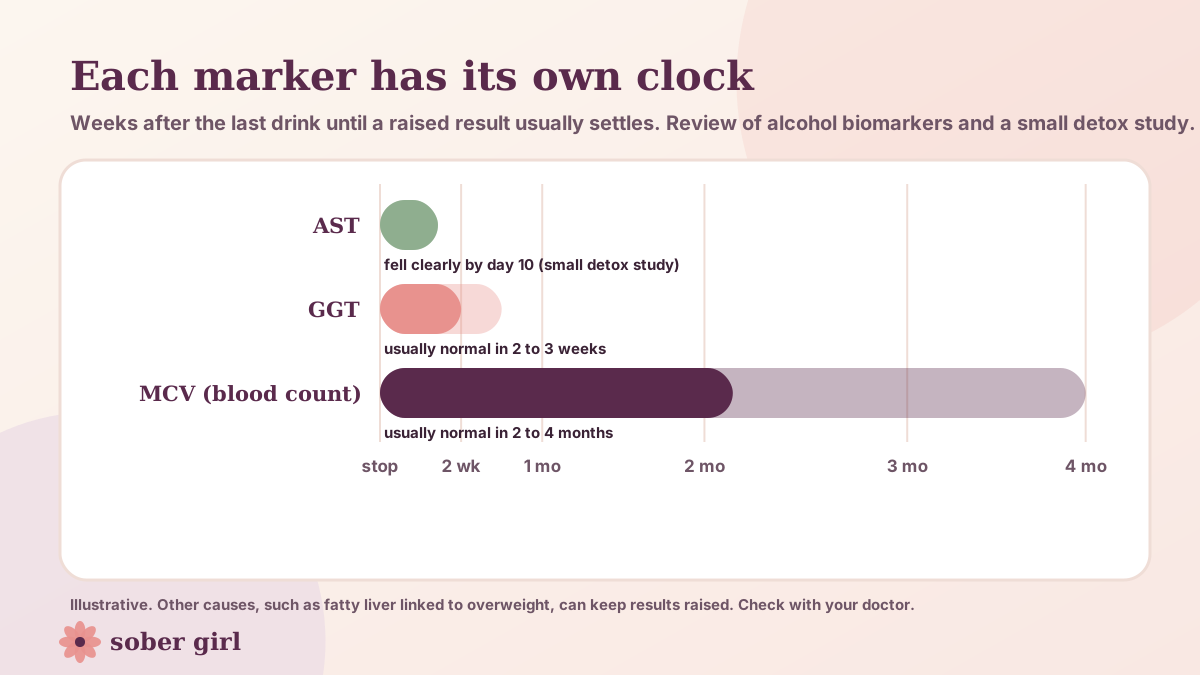
After you stop drinking, a raised GGT, the liver test people most often watch, usually returns to normal within 2 to 3 weeks [1]. In a small study of men in alcohol detox, AST fell clearly within the first 10 days, while GGT fell on average but not significantly [2]. In healthy moderate drinkers, GGT was lower after one month without alcohol and rose again when they drank [3]. Red blood cell size (MCV), another sign of heavy drinking on a blood count, takes 2 to 4 months [1]. Alcohol-related fatty liver can reverse with abstinence [4]. To see your own change, compare a test from before you stop with one 3 to 4 weeks later.
Liver blood tests after quitting: the timeline
No single study measures every day, but a review of alcohol biomarkers and a handful of studies give a clear outline. Times are counted from your last drink.
| Time without alcohol | What the evidence shows | Strength of evidence |
|---|---|---|
| Days 1 to 7 | Withdrawal, if any, peaks at 24 to 72 hours [5]. Too early for meaningful liver test changes. | Clinical guidance |
| Day 10 | In 25 men in inpatient detox, AST fell clearly by day 10; GGT fell on average but not significantly [2]. | Small study |
| Weeks 2 to 3 | A raised GGT usually returns to normal in this window [1]. | Review |
| 1 month | In healthy moderate drinkers, GGT was lower after a month without alcohol and rose again when they drank [3]. Insulin resistance, blood pressure and weight also fell in another one-month study [6]. | Studies |
| 2 to 4 months | Red blood cell size (MCV) returns to normal [1]. | Review |
| Longer | Alcohol-related fatty liver can reverse; in advanced disease, abstinence can stabilize it [4]. | Review |
Track it in Sober Girl
What each liver test means
- GGT (gamma-glutamyl transferase). The liver test most people watch when they stop drinking. It is not specific to alcohol: fatty liver linked to overweight is the most common other reason for raised GGT and ALT [1].
- ALT and AST. Enzymes released when liver cells are damaged. AST fell clearly within 10 days in the small detox study [2].
- MCV (mean corpuscular volume). Not a liver test but a measure of red blood cell size on a full blood count. Long-term heavy drinking raises it, and it takes 2 to 4 months to settle after stopping [1].
What counts as normal depends on the lab. Compare results from the same lab, and read them against the reference range printed on your report.
Can your liver heal after drinking?
Often, yes, at least in part. Alcohol-related fatty liver, the earliest stage, can reverse when drinking stops, while in more advanced liver disease abstinence can stabilize the damage rather than undo it [4]. Normal blood tests are encouraging but do not prove the liver itself is healthy, and some damage does not show on routine blood tests at all. If you have drunk heavily for years, ask your doctor whether you need more than blood work.
You may see claims that fatty liver always clears in a set number of weeks. We did not find a reliable timeline for that, so we do not give one.
Why your numbers might not drop
- Another cause. Fatty liver linked to overweight raises GGT and ALT too [1], and those will only partly fall without alcohol.
- Too early. MCV needs 2 to 4 months [1]. A blood count at two weeks tells you little about it.
- Advanced disease. Abstinence can stabilize advanced liver disease without returning tests to normal [4].
- Different labs. Results from two labs are only roughly comparable.
If your tests are still raised after a month without alcohol, see your doctor. It is not a reason to panic, but it is a reason to find the cause.
How to measure your own before and after
- Before you stop: ask your doctor for liver tests (GGT, ALT, AST) and a full blood count with MCV. Saying you are taking a break and want a baseline is enough.
- After 3 to 4 weeks: repeat the liver tests, at the same lab if you can.
- After 3 months: repeat the blood count if your MCV was raised [1].
- Log your weight and sleep alongside. They help explain what the lab numbers show.
For what a full month changes beyond the liver, see 30 days sober and 30 days no alcohol: before and after.
Is Sober Girl right for you?
- use an iPhone or an Android phone
- want a private tracker, with your journal kept on your device
- want a day counter, money saved and a daily check-in in one calm place
- want a Craving SOS with a breathing exercise and a 10-minute timer
- want to start free and add Plus only if you need the journal, insights or milestone cards
- want a community feed, live coaching or an AI chat
- want a structured multi-week education program
- need medical help for heavy drinking or withdrawal. An app is not treatment, so see the safety notes above
Frequently asked questions
How long does it take for liver enzymes to return to normal after quitting alcohol?
A raised GGT usually returns to normal within 2 to 3 weeks. AST fell clearly within 10 days in a small detox study. Red blood cell size (MCV) takes 2 to 4 months.
Can your liver heal after years of drinking?
Often in part. Alcohol-related fatty liver can reverse when drinking stops, while advanced liver disease can be stabilized rather than undone. Your doctor can tell you which applies to you.
Will my liver tests be normal after 30 days sober?
Often, if alcohol was the only reason they were raised. GGT usually normalizes in 2 to 3 weeks and was lower after a month in healthy moderate drinkers. MCV can still be raised at 30 days.
Why is my GGT still high after quitting alcohol?
GGT is not specific to alcohol. Fatty liver linked to overweight is the most common other cause. It may also be too early, or there may be another liver problem worth checking with a doctor.
What blood tests show heavy drinking?
GGT, AST, ALT and MCV are routine tests that rise with heavy drinking, though none is specific to alcohol. Specialized tests such as PEth detect recent drinking more directly.
When should I get my liver tested after quitting?
Once before you stop and again after 3 to 4 weeks, ideally at the same lab. Recheck MCV after about 3 months if it was raised.
Sources
- Biomarker-Based Approaches for Assessing Alcohol Use Disorders. Niemelä O. International Journal of Environmental Research and Public Health 2016;13(2):166. A review of alcohol biomarkers. Raised GGT usually returns to normal within 2 to 3 weeks of abstinence, red cell size (MCV) within 2 to 4 months. GGT is not specific to alcohol: fatty liver linked to obesity is its most common other cause.
- Trajectory of liver function tests during the initial alcohol detoxification period: A preliminary analysis. Kethawath SM, Jain R, Dhawan A, Sarkar S. Indian Journal of Psychiatry 2020;62(2):225-226 (research letter). 25 men in inpatient alcohol detox, liver tests on days 1, 5 and 10. Small preliminary study.
- Biochemical Effects on the Liver of 1 Month of Alcohol Abstinence in Moderate Alcohol Consumers. Munsterman ID, Groefsema MM, Weijers G, et al. Alcohol and Alcoholism 2018;53(4):435-438. Healthy moderate drinkers. GGT fell after one month without alcohol and returned to baseline once they drank again.
- Alcoholic Liver Disease: Pathogenesis and Current Management. Alcohol Research: Current Reviews, vol. 38, no. 2, NIAAA.
- Alcohol withdrawal. MedlinePlus (US National Library of Medicine), reviewed 1 January 2025 by Frank D. Brodkey, MD.
- Short-term abstinence from alcohol and changes in cardiovascular risk factors, liver function tests and cancer-related growth factors: a prospective observational study. Mehta G, Macdonald S, Cronberg A, et al. BMJ Open 2018;8:e020673. Observational study. 94 people who chose to abstain for a month and 47 who kept drinking.
- National Helpline. SAMHSA. Free, confidential, 24/7 treatment referral line: 1-800-662-4357.
How we write these. Every figure above links to the source it came from, and we label self-reported and observational results as such. Where we could not find a source we trust, the page says so instead of filling the gap. Sober Girl is made by ShipAI Lab and this is not medical advice. Sources were checked on 6 October 2026. If you spot an error, email us at [email protected].
Keep reading
Today is day one.
Sober Girl is a private sobriety tracker for women, on iPhone and Android: day counter, money saved, craving SOS and a tree that grows with you. Free to start.