Emotional sobriety: what it means and how to practice it
Not drinking is the first part. Emotional sobriety is the next one: feeling a hard feeling without reaching for something to make it stop. Here is the idea in plain words, where it came from, and a short daily practice.
Emotional sobriety is the ability to feel a strong emotion, name it and ride it out without drinking or swapping in another escape. The phrase comes from Bill W., AA’s co-founder, whose letter on it to a friend with recurring depression was printed in the AA Grapevine in January 1958 [1]. Therapist Tian Dayton describes the opposite as managing stress with outside “mood managers” such as food, work, shopping or alcohol [2]. It matters because negative emotional states are linked with the highest rate of relapse in Marlatt’s research [3].
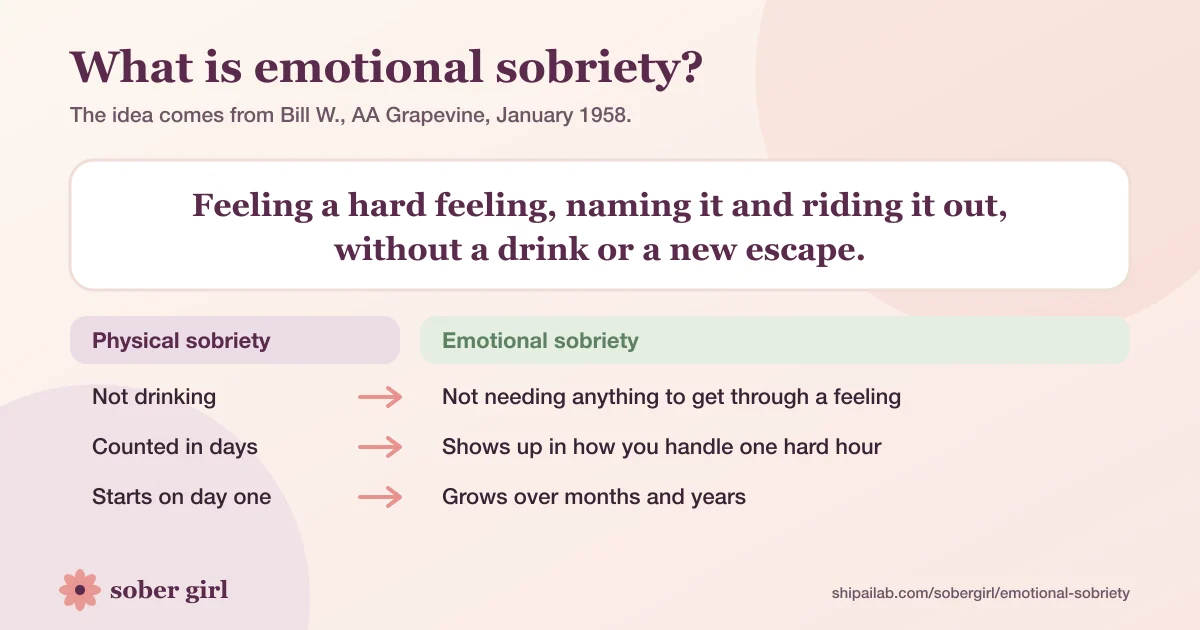
What emotional sobriety means
Physical sobriety is about the glass. Emotional sobriety is about what happens inside you when the glass is not there. A bad day still lands. The difference is that you can let a feeling rise, give it a name, and let it pass without needing to numb it.
Tian Dayton’s book Emotional Sobriety: From Relationship Trauma to Resilience and Balance (Health Communications, 2007) treats it as a skill you build. Her publisher sums up the missing piece as reaching for outside “mood managers” such as food, sex, work, shopping, gambling, drugs and alcohol instead of healthier ways to soothe yourself, and describes “emotional literacy” as turning feelings into words so you can think about them [2].
| Physical sobriety | Emotional sobriety |
|---|---|
| Not drinking | Not needing a drink, or anything else, to get through a feeling |
| Counted in days | Shows up in how you handle one hard hour |
| Starts on day one | Grows slowly, often over months and years |
| Other people can see it | Mostly only you can see it |
Track it in Sober Girl
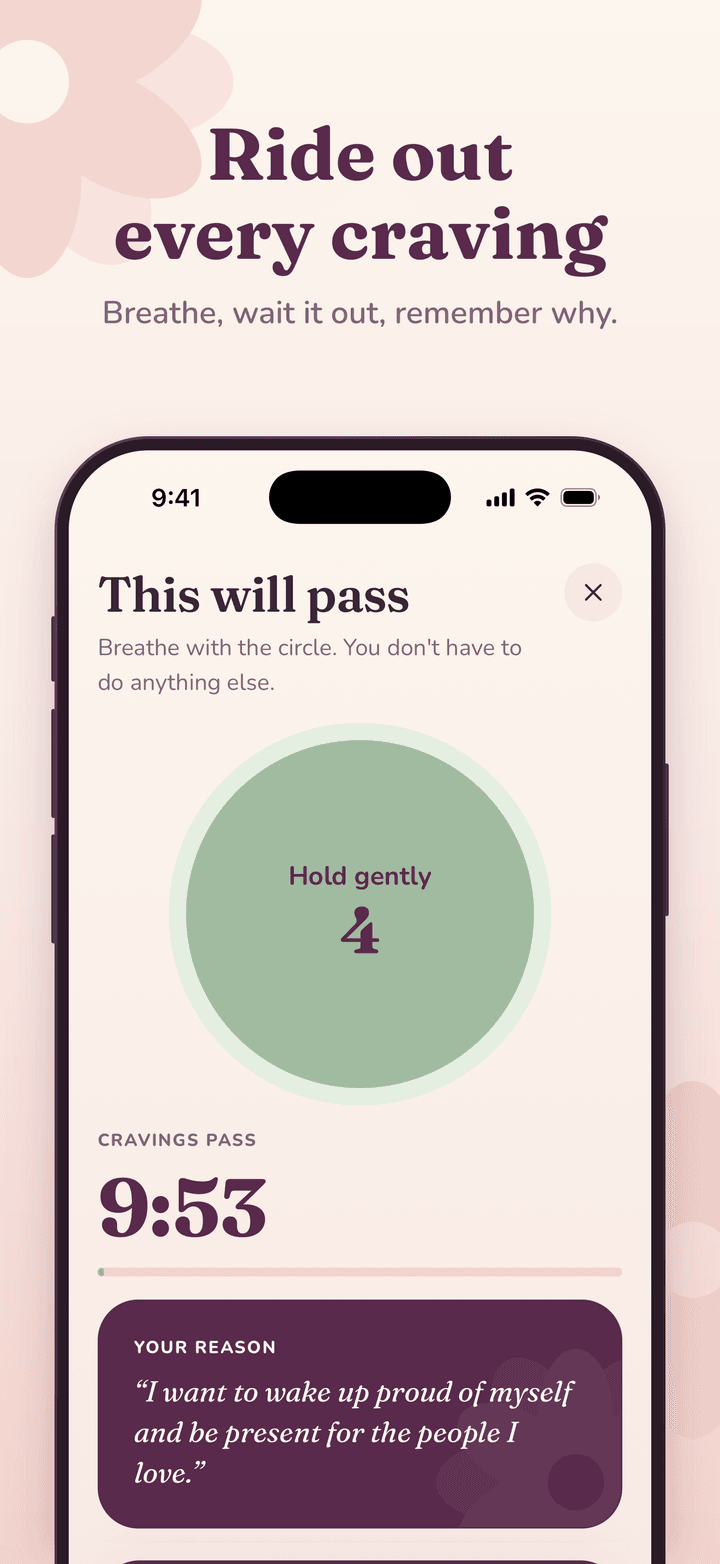
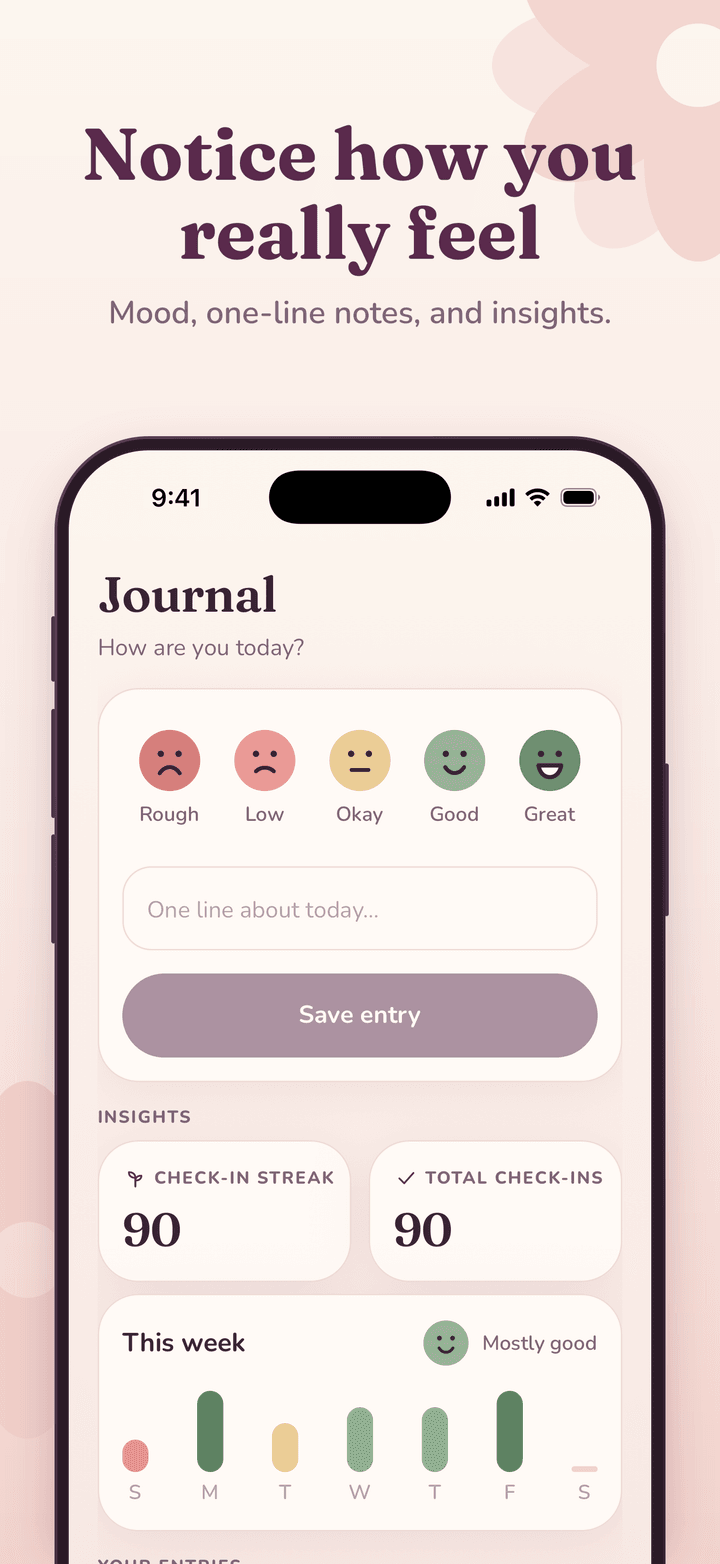
Where the idea came from: Bill W.’s 1958 letter
In January 1958 the AA Grapevine printed “The Next Frontier: Emotional Sobriety” by Bill W. The editors explain that it was the substance of a letter Bill had written several years earlier to a close friend who also had “troublesome depressions”, and that both men were by then “in the clear” [1].
That is the useful part for anyone in early recovery. Stopping drinking did not settle everything, even for the man who co-founded AA. Years into his own sobriety he was still working out how to live with low moods, and he wrote about it openly. The full letter is behind a Grapevine subscription, so we do not quote it here.
Emotional sobriety vs a “dry drunk”
“Dry drunk” is recovery slang for someone who has stopped drinking but still lives with the same restlessness, resentment or all-or-nothing moods. It is not a diagnosis. Dayton’s book sets emotional sobriety up as its opposite: sober and settled, rather than sober and still at war with yourself [2].
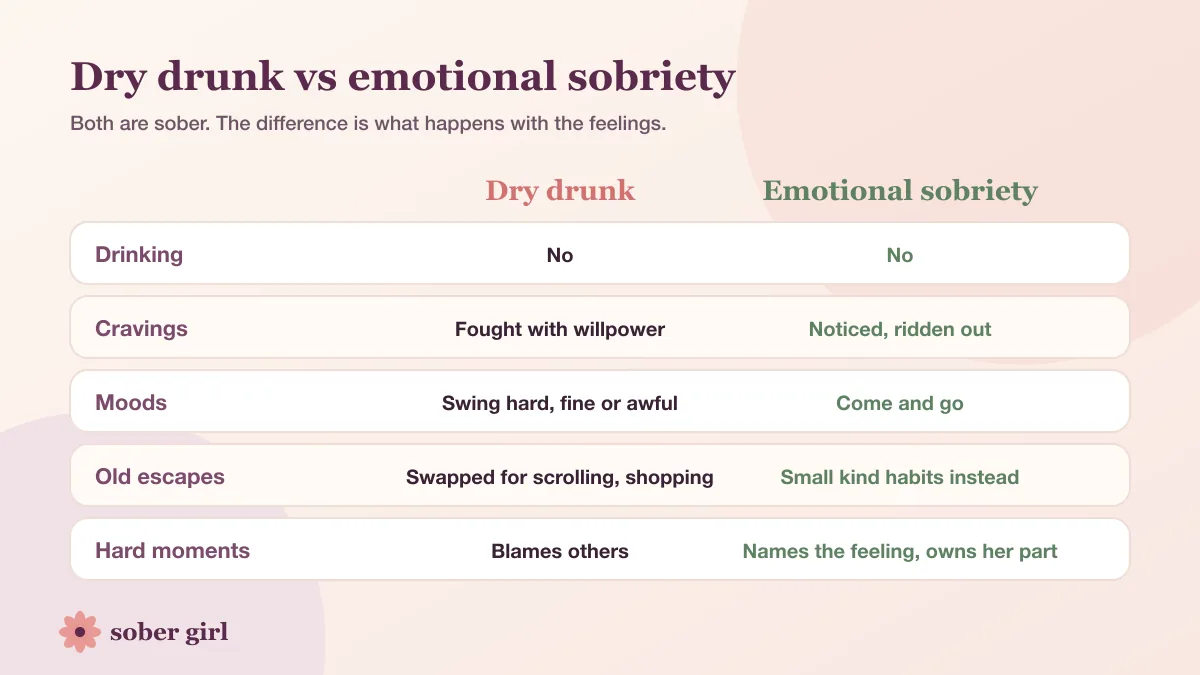
If the left column sounds familiar, you are not failing. It often describes the stretch after the pink cloud, when the early lift fades and everyday feelings come back at full volume. It is also what white-knuckling tends to look like after a few months of pure willpower.
Signs your emotional sobriety needs work
These are common patterns, not a test. If several fit, they point to where to practise, nothing more.
- A small thing, like a late reply or a comment at work, ruins your whole day.
- You swap one escape for another: scrolling until 2 am, sugar, shopping, overwork.
- You feel either fine or terrible, with little in between.
- You avoid hard conversations, then explode about something unrelated.
- You keep score of what other people owe you.
- Cravings show up after an argument, not at your usual drinking hour.
The last one matters most. In Marlatt’s relapse-prevention research, negative emotional states such as anger, anxiety, depression, frustration and boredom were linked with the highest rate of relapse. Together with conflict with other people, they set off more than half of the relapse episodes analysed [3].
How to practise emotional sobriety: five minutes a day
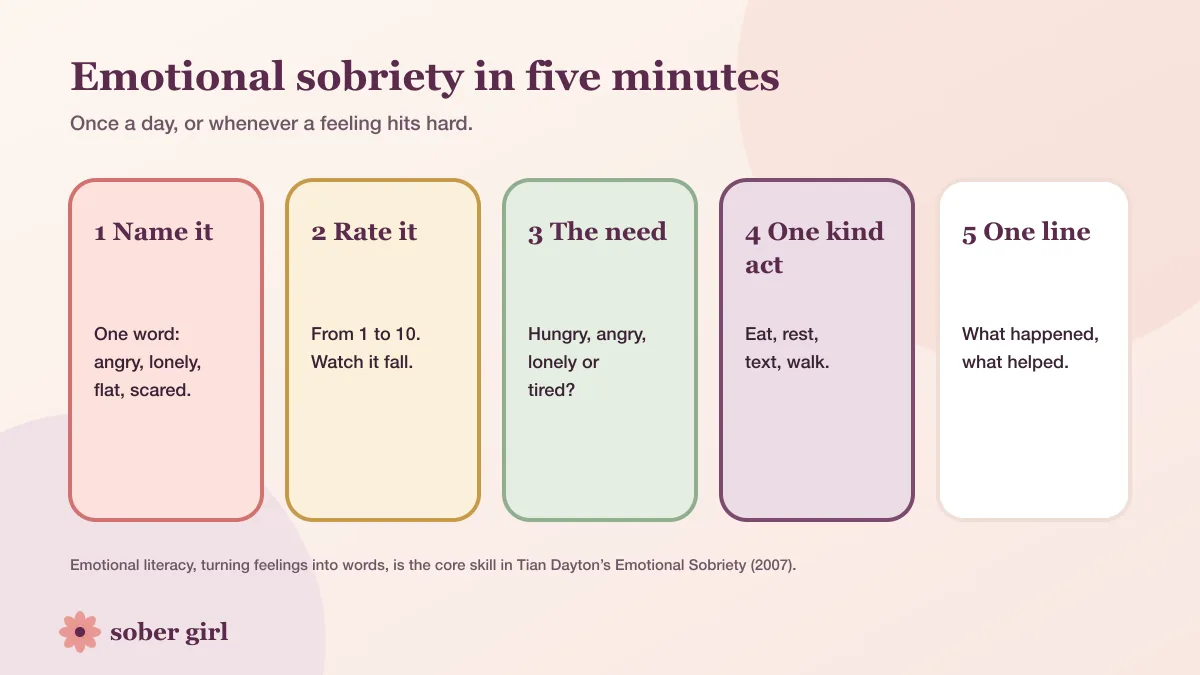
You build it the way you built your day count: one small repetition at a time. This routine takes about five minutes, once a day or whenever a feeling hits hard.
- Name it. Pick one word for what you feel: angry, lonely, ashamed, flat, scared. Putting feelings into words is the “emotional literacy” Dayton writes about [2].
- Rate it. Give it a number from 1 to 10. Strong feelings rarely stay at the same number for long, and watching the number fall teaches you that they pass.
- Find the need. Ask whether you are hungry, angry, lonely or tired. Many people in recovery use these four as a quick check before deciding anything.
- Do one kind thing. Eat, rest, text someone, walk round the block. Small and specific beats big and vague.
- Write one line. A sentence about what happened and what helped. After a few weeks the lines show patterns your memory smooths over.
When a feeling turns into a craving
Feelings and cravings often arrive together. Treat the craving as its own wave: it rises, peaks and falls. NIAAA suggests riding it out, distracting yourself and reminding yourself why you changed [6]. Our guides to urge surfing and stopping cravings go step by step.
Once the craving has passed, come back to the feeling that started it. The craving was loud, but the feeling underneath is the part emotional sobriety works on, and it will be there again next week unless you look at it.
Track your feelings, not just your days
Sober Girl, which we make, counts your days and grows a tree as you go. When a craving hits, the free SOS screen runs a breathing circle and a 10-minute timer and shows you the reason you wrote when you started. Afterwards you can note what set the craving off (stress, being out, boredom, feeling low, celebrating or routine), and over time the app shows which comes up most and when.
With Sober Girl Plus, the journal lets you write a line with a mood whenever you like, and each entry opens a blossom on your tree in that mood’s colour. A few weeks of entries show whether your hard days cluster around certain people, places or times. There is no account, and your journal stays on your phone.
Is Sober Girl right for you?
- use an iPhone or an Android phone
- want a private tracker, with your journal kept on your device
- want a day counter, money saved and a daily check-in in one calm place
- want a Craving SOS with a breathing exercise and a 10-minute timer
- want to start free and add Plus only if you need the journal, insights or milestone cards
- want a community feed, live coaching or an AI chat
- want a structured multi-week education program
- need medical help for heavy drinking or withdrawal. An app is not treatment, so see the safety notes above
Frequently asked questions
What is emotional sobriety in simple terms?
Being able to feel a strong emotion, name it and let it pass without drinking or using something else to escape it.
Who came up with emotional sobriety?
AA co-founder Bill W. used the phrase in a letter to a friend who had depression. The AA Grapevine printed it in January 1958 as “The Next Frontier: Emotional Sobriety”.
What is the difference between sobriety and emotional sobriety?
Sobriety usually means not drinking. Emotional sobriety is about how you handle feelings once you are not drinking.
What book is about emotional sobriety?
The best-known is Tian Dayton’s Emotional Sobriety: From Relationship Trauma to Resilience and Balance, published by Health Communications in 2007.
How long does emotional sobriety take?
There is no set timeline. It builds with practice, often over months and years, and it is uneven: steady for weeks, then shaken by one hard event.
Is being a dry drunk the same as lacking emotional sobriety?
“Dry drunk” is slang, not a diagnosis, but people use it for the same gap: sober from alcohol, still unsettled inside.
Sources
- The Next Frontier: Emotional Sobriety. Bill W., AA Grapevine, January 1958. Editor’s note: the substance of a letter Bill wrote several years earlier to a close friend who also had troublesome depressions. Full text needs a Grapevine subscription; we cite only the public introduction.
- Emotional Sobriety: From Relationship Trauma to Resilience and Balance. Tian Dayton, Health Communications Inc., 2007 (Simon & Schuster listing). Publisher description: lacking emotional sobriety means managing stress with outside “mood managers” such as food, work, shopping, drugs and alcohol instead of healthier self-soothing; emotional literacy is translating feelings into words.
- Relapse Prevention: An Overview of Marlatt’s Cognitive-Behavioral Model. Larimer ME, Palmer RS, Marlatt GA. Alcohol Research & Health 1999;23(2):151-160 (NIAAA).
- National Helpline. SAMHSA. Free, confidential, 24/7 treatment referral line: 1-800-662-4357.
- 988 Suicide & Crisis Lifeline. 988 Lifeline. Call, text or chat, free and confidential, 24/7.
- How to Stop Alcohol Cravings. NIAAA, Rethinking Drinking.
How we write these. Every figure above links to the source it came from, and we label self-reported and observational results as such. Where we could not find a source we trust, the page says so instead of filling the gap. Sober Girl is made by ShipAI Lab and this is not medical advice. Sources were checked on 6 October 2026. If you spot an error, email us at [email protected].
Keep reading
Today is day one.
Sober Girl is a private sobriety tracker for women, on iPhone and Android: day counter, money saved, craving SOS and a tree that grows with you. Free to start.