Reasons to stay sober: 25 reasons for the hard days
On a good day you do not need a list. This one is for the other days: grouped by what you are feeling, with a tool therapists use to weigh up the next drink, and space to write your own.
The strongest reasons to stay sober are the ones you write yourself, read at the moment you want to drink. Common ones include better sleep, a lower cancer risk (the WHO says no level of drinking is safe for health) [1], steadier moods, money, and being fully present for the people you love. Relapse-prevention therapy uses a “decision matrix” that sets a drink’s quick payoff against its delayed costs [2]. Below are 25 reasons, a matrix to fill in, and how to write your own three.
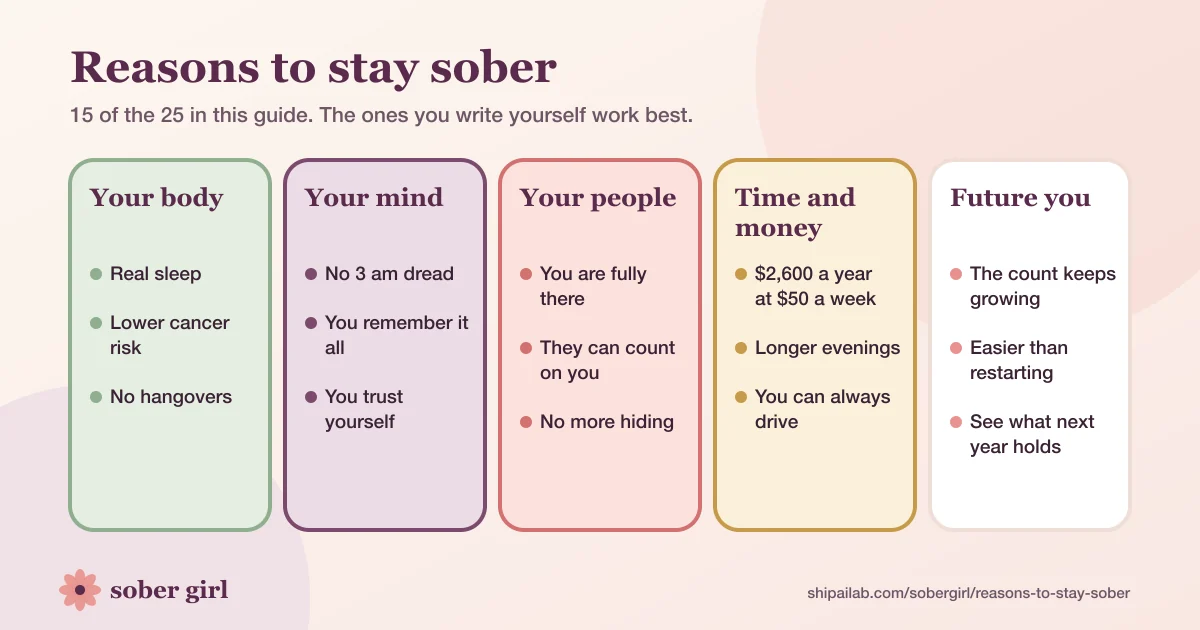
25 reasons to stay sober
For your body
- You sleep properly. Alcohol can help you fall asleep, but it disrupts sleep later in the night [3].
- You cut your cancer risk. Alcohol causes at least seven types of cancer, including breast cancer in women [1].
- No hangovers. Every weekend morning is yours again.
- Your skin, weight and digestion get a break. Our 30 days before and after guide shows what has been measured.
- Your liver gets a chance to repair. See liver recovery after quitting for what the research shows.
For your mind
- The 3 am dread stops. No lying awake replaying the night; see hangxiety.
- You remember everything. No blackouts, no checking your phone in a panic.
- You trust yourself again. Every day you keep the promise adds to that trust.
- You find out who you are without it. Hobbies, opinions and a sense of humour that do not need a drink first.
- You learn to get through feelings. That skill is what people call emotional sobriety.
For the people you love
- You are there, fully. At the school play, at dinner, on the phone at 10 pm.
- People can count on you. Plans you make on Monday still happen on Saturday.
- You stop hiding. No counting bottles, no rehearsed excuses.
- If you have children, they watch you choose yourself.
- Your friendships get more honest. You find out which ones were about the drink.
For your time and money
- You keep the money. At $50 a week, that is about $2,600 a year; try our money saved calculator.
- Your evenings get longer. The hours after 8 pm are usable again.
- Mornings come back. Saturday at 8 am becomes an option, not a punishment.
- You stop planning around alcohol. Where to buy it, how much is left, who will notice.
- Driving is never a question. You can always take the car, and always be the one who picks someone up.
For the future you
- The count becomes part of who you are. Day 400 feels different from day 4.
- Staying is easier than restarting. Coming back is always possible, but the first weeks are the hardest part to repeat.
- You keep what sobriety has given you. The job, the friendship, the savings.
- You become someone others can lean on. People early in recovery look for someone a little further along.
- You get to see what next year looks like. The only way to find out is to stay.
Track it in Sober Girl
The decision matrix: weigh the drink before you have it
Relapse-prevention therapy, developed by psychologist Alan Marlatt, uses a simple grid called a decision matrix. You list the immediate and the delayed results of drinking and of staying sober, good and bad. Putting the delayed costs of drinking next to its quick payoff helps you question what you expect a drink to do for you [2].
| Right away | Later | |
|---|---|---|
| Drinking: the upside | Relief, warmth, an easier evening | Hard to name one |
| Drinking: the cost | Less control, a broken promise | Hangover, guilt, poor sleep, money, starting the count again |
| Staying sober: the cost | Sitting with the craving, an awkward moment | Very little |
| Staying sober: the upside | Pride, a clear head | Better sleep, trust, savings, the next milestone |
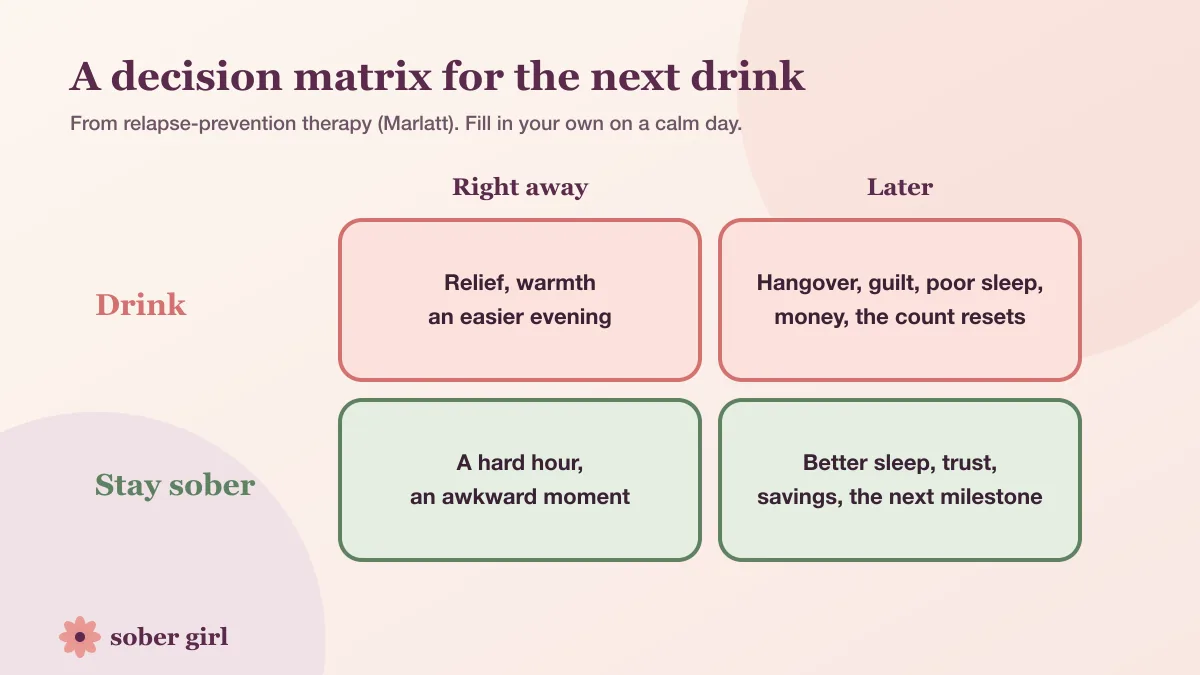
Fill in your own copy when you are calm, then keep it where you will see it at your hardest hour of the day.
Reasons for the moments that test you
Marlatt found that negative feelings such as anger, anxiety, boredom and frustration, together with conflict with other people, were behind more than half of the relapse episodes he analysed, and that social pressure was another common trigger [2]. So pick the reason that answers the feeling in front of you:
| When you feel… | Reach for this reason |
|---|---|
| Stressed after work | A drink adds a hangover to tomorrow’s stress |
| Lonely | The people who matter want the sober you |
| Bored | Boredom passes in an hour; a slip takes longer to undo |
| Angry after an argument | The argument does not get to have the rest of your night |
| Out with people who are drinking | Nobody remembers who had what, but you will remember the night |
| Celebrating | You are celebrating the life sobriety gave you |
How to write your own three reasons
- Make them specific. “Be healthier” is weak. “Wake up without the 3 am panic” is strong.
- Make them yours. Not what your partner or your doctor wants: what you want.
- Write them in the present tense. “I am the mum who drives home” works better than a wish.
- Keep each one to a sentence. Short enough to read in the middle of a craving.
- Put them where the craving happens. On your phone, on the fridge, in your wallet.
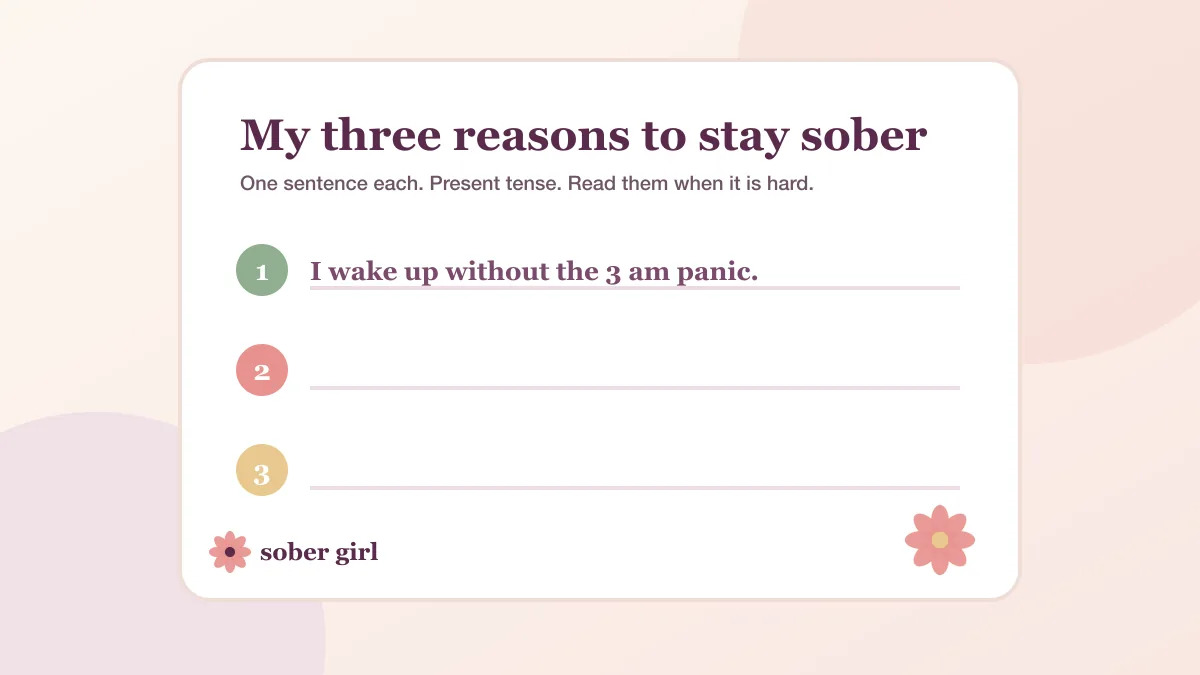
Reasons change. The one that got you to day 30 may not be the one that gets you to day 300, so reread them every month and rewrite any that have gone flat.
If you have a slip
A slip is not the end of the list; it is a reason to read it again. Relapse rates for substance use disorders are similar to those for other chronic illnesses such as high blood pressure and asthma [4]. The real danger is the shame spiral after a first drink, which Marlatt called the abstinence violation effect [2]. See lapse vs relapse for what to do in the next 24 hours.
Keep your reason where the craving happens
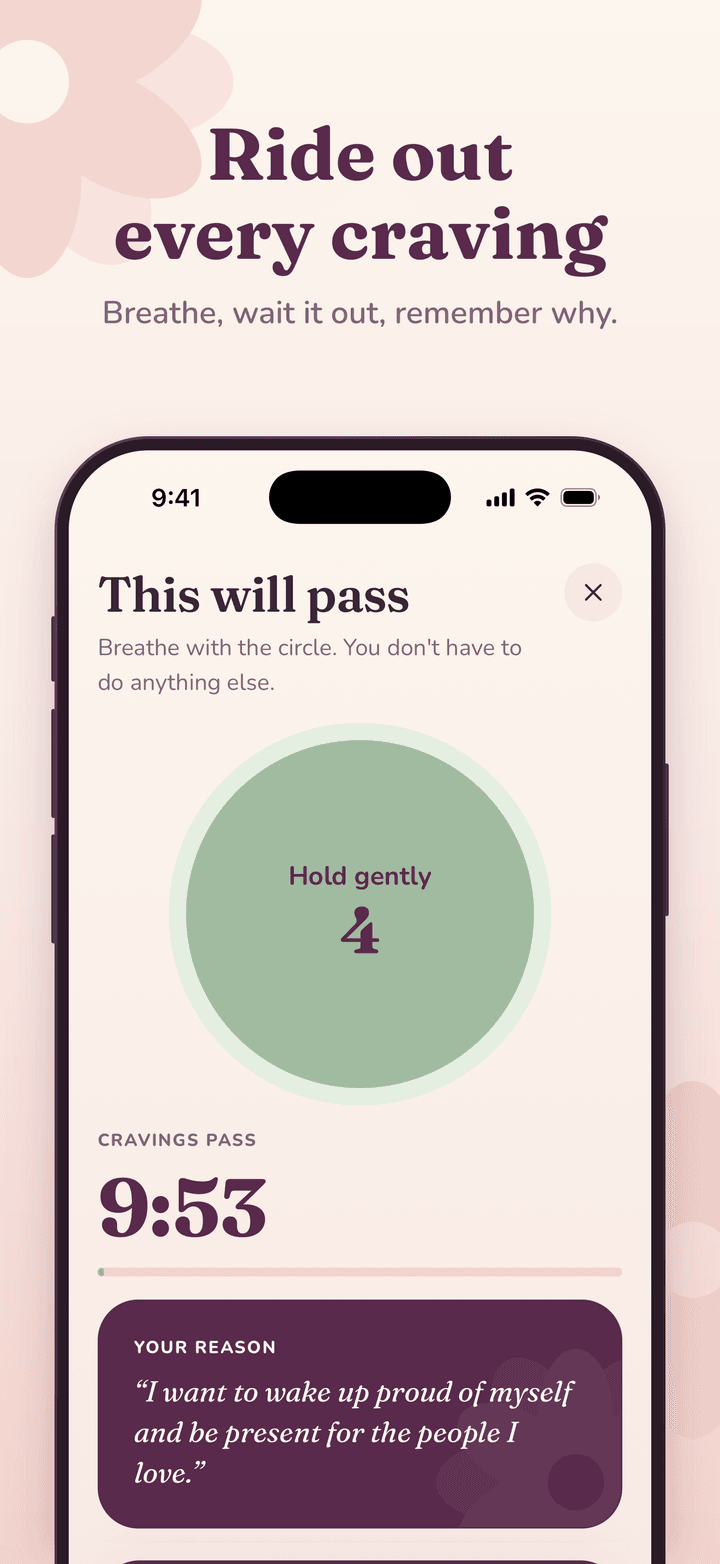
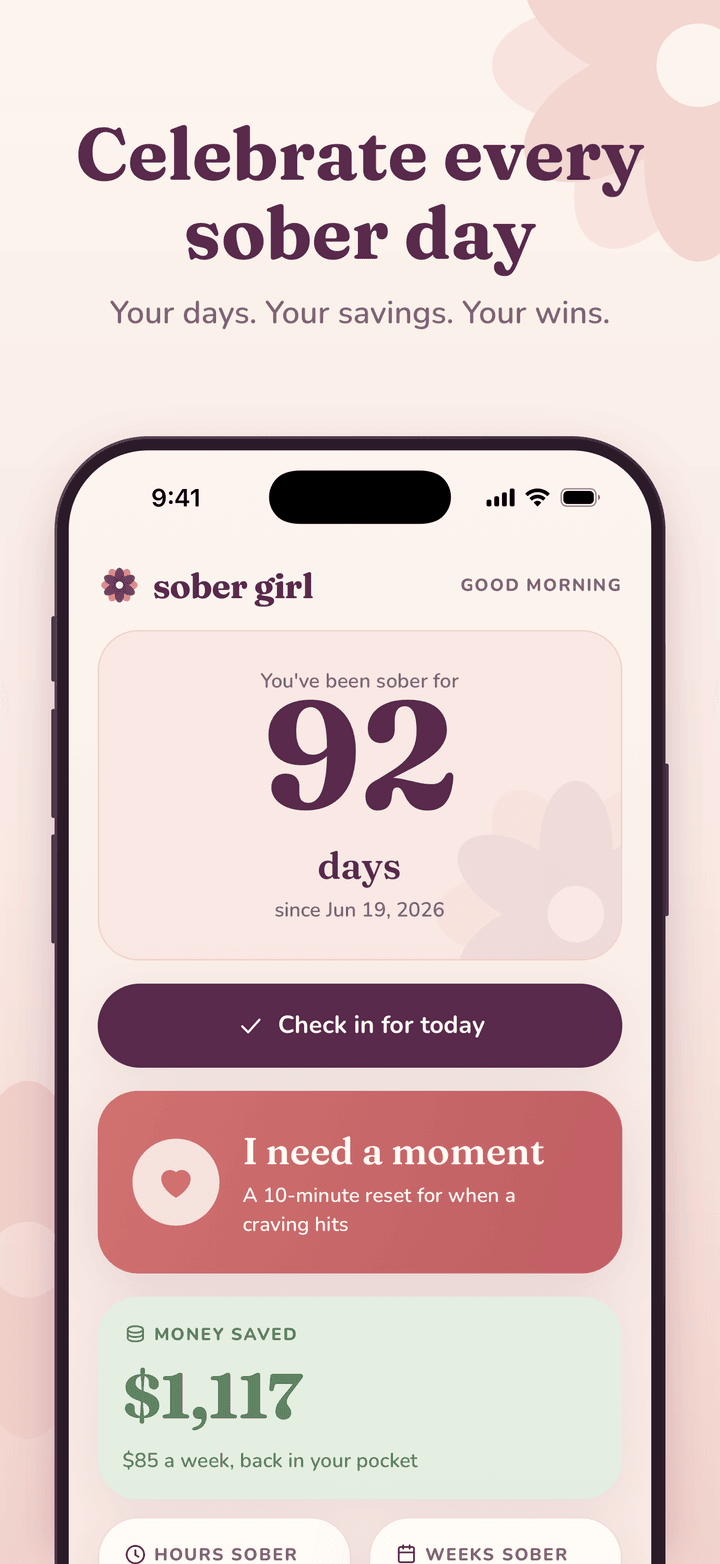
Sober Girl, which we make, asks for your reason when you start (“Why are you doing this?”) in a sentence or two. When a craving hits, the free SOS screen shows that reason back to you, next to a breathing circle and a 10-minute timer. If you slip, your count starts again from today, but your tree keeps half of its growth and your check-ins and milestones stay.
Is Sober Girl right for you?
- use an iPhone or an Android phone
- want a private tracker, with your journal kept on your device
- want a day counter, money saved and a daily check-in in one calm place
- want a Craving SOS with a breathing exercise and a 10-minute timer
- want to start free and add Plus only if you need the journal, insights or milestone cards
- want a community feed, live coaching or an AI chat
- want a structured multi-week education program
- need medical help for heavy drinking or withdrawal. An app is not treatment, so see the safety notes above
Frequently asked questions
What are good reasons to stay sober?
Better sleep, lower cancer risk, steadier moods, money, trust and being present for people you love. The ones that work best are specific ones you write yourself.
How do I stay motivated to stay sober?
Keep your reasons where the craving happens, update them monthly, mark milestones, and have someone to text on hard days.
What do I do when I forget why I quit?
Read your written reasons, or fill in a decision matrix: the quick payoff of a drink next to its delayed costs. If you never wrote them down, do it today while you are calm.
Is it normal to lose motivation after a few months?
Yes. The early lift often fades after the first weeks or months, which some people call the end of the pink cloud. It is a good moment to rewrite your reasons.
Does writing down reasons really help?
Weighing the costs and benefits of drinking is part of relapse-prevention therapy, where it is called a decision matrix. It helps most when you read it at the moment you need it.
Sources
- No level of alcohol consumption is safe for our health. WHO Regional Office for Europe, news release, 4 January 2023. Statement published in The Lancet Public Health. Alcohol is a Group 1 carcinogen and causes at least seven cancers, including female breast cancer.
- Relapse Prevention: An Overview of Marlatt’s Cognitive-Behavioral Model. Larimer ME, Palmer RS, Marlatt GA. Alcohol Research & Health 1999;23(2):151-160 (NIAAA).
- Alcohol and the Sleeping Brain. PubMed Central, US National Library of Medicine.
- Treatment and Recovery (Drugs, Brains, and Behavior: The Science of Addiction). National Institute on Drug Abuse (NIDA). Relapse rates for substance use disorders are similar to those for other chronic illnesses such as high blood pressure and asthma.
- Alcohol withdrawal. MedlinePlus (US National Library of Medicine), reviewed 1 January 2025 by Frank D. Brodkey, MD.
- National Helpline. SAMHSA. Free, confidential, 24/7 treatment referral line: 1-800-662-4357.
How we write these. Every figure above links to the source it came from, and we label self-reported and observational results as such. Where we could not find a source we trust, the page says so instead of filling the gap. Sober Girl is made by ShipAI Lab and this is not medical advice. Sources were checked on 6 October 2026. If you spot an error, email us at [email protected].
Keep reading
Today is day one.
Sober Girl is a private sobriety tracker for women, on iPhone and Android: day counter, money saved, craving SOS and a tree that grows with you. Free to start.