Hangover cure: what the trials found, and the only thing that reliably works
You are lying on the bathroom floor at 9 a.m. and a hangover cure is a very appealing idea. Here is what the research says about the ones people sell.
There is no proven hangover cure, and NIAAA says only time helps [1]. A systematic review in the BMJ of eight randomized trials found no compelling evidence that any intervention prevents or treats a hangover, and concluded that the most effective way to avoid one is abstinence or moderation [2]. A 2017 update found that a few products improved some symptoms, such as tiredness, nausea and stomachache, but none helped every symptom, and the authors called for more research [3]. Hangovers also get worse the more often you have them [4].
Is there a hangover cure that works?
The morning after, you will try anything: a greasy breakfast, a sports drink, a supplement from the pharmacy shelf, the cure your friend swears by. The honest answer is that nothing has been shown to work reliably.
The BMJ review searched the medical literature for trials of any intervention for preventing or treating a hangover. It found eight double-blind randomized trials that tested eight different things, and concluded: no compelling evidence exists that any conventional or complementary intervention is effective. The most effective way to avoid the symptoms is to practise abstinence or moderation [2].
Track it in Sober Girl
What was actually tested
| Tested | Beat the comparison on symptoms? |
|---|---|
| Propranolol | No |
| Tropisetron | No |
| Tolfenamic acid (a painkiller) | Yes |
| Fructose or glucose | No |
| Borage (gamma linolenic acid) | Yes |
| Artichoke | No |
| Prickly pear | No |
| A yeast-based preparation | Yes |
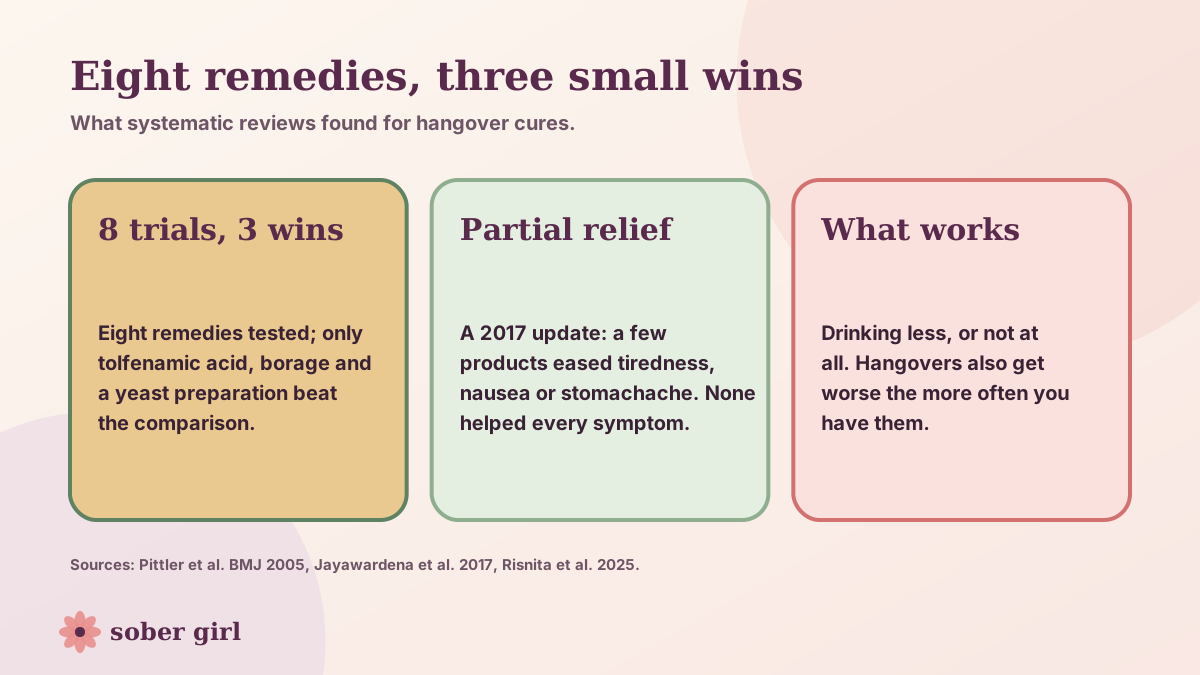
Three of the eight showed a significant difference [2], but they were small trials and none became a standard treatment. The 2017 update, covering 2009 to mid-2016, found six controlled studies. Products including a polysaccharide-rich extract of Acanthopanax senticosus, a red ginseng drink, Korean pear juice and a formula called KSS improved some symptoms, mainly tiredness, nausea and vomiting, and stomachache, but none helped all of them [3].
Why hangovers get worse, not better
You might expect a regular drinker to build tolerance to hangovers. The data point the other way. When researchers combined five studies of 924 people, hangover frequency and severity moved together (r = 0.69, and 0.53 after adjusting for sex, age and weekly drinking). The authors call this a reverse tolerance: the more often you have hangovers, the more severe they tend to be [4].
It is an association, not proof that drinking more causes worse hangovers, but it fits what many people notice in their thirties and later. The next-morning cost goes up, not down.
What to do the morning after
- Give it time. The trials found no fast fix, so plan for a slow day rather than a cure.
- Be careful with painkillers. Alcohol plus acetaminophen can be toxic to the liver, and aspirin and ibuprofen can irritate the stomach, so proceed with caution before or after drinking [1].
- Rehydrate and rest. Mild dehydration and disrupted sleep are part of the cause, and the body needs time to clear alcohol by-products and recover [1].
- Do not treat the hangover with more alcohol. It only delays the problem and keeps the pattern going.
- Notice the pattern. If bad mornings are a regular thing, that is useful information. Our pages on hangxiety and how much alcohol is too much can help you read it.
The only reliable prevention
The reviews agree on one thing: drink less, or not at all. If you are trying to, our guide to mindful drinking covers cutting back, and the benefits of quitting covers what changes if you stop. The Sober Girl app keeps a count of your days and what you are saving, so the clear mornings add up where you can see them.
What a hangover is, and what causes it
NIAAA defines a hangover as a set of symptoms that occur as a consequence of drinking too much. Typical ones are fatigue, weakness, thirst, headache, muscle aches, nausea, stomach pain, vertigo, sensitivity to light and sound, anxiety, irritability, sweating and higher blood pressure, and it varies from person to person [1].
| Factor | What it does |
|---|---|
| Mild dehydration | Alcohol suppresses vasopressin, so you lose more fluid; likely behind thirst, fatigue and headache |
| Disrupted sleep | You may fall asleep faster, but sleep is fragmented and you wake earlier |
| Stomach irritation | Alcohol irritates the stomach lining and increases acid, causing nausea and discomfort |
| Inflammation | Alcohol increases inflammation, which adds to the sick, run-down feeling |
| Acetaldehyde | A toxic, short-lived by-product of alcohol metabolism that inflames the liver and other organs |
| Mini-withdrawal | When the buzz wears off, the brain overcorrects and you can feel more restless and anxious |
Other parts of a drink can add to it. Congeners, compounds made during fermentation, are higher in darker spirits such as bourbon and could worsen symptoms for some people, and people sensitive to sulfites in wine may get a headache [1].
How long does a hangover last?
Hangover symptoms peak when your blood alcohol concentration returns to about zero, and they can last 24 hours or longer [1]. That is why the worst of it often lands at midday rather than at 7 a.m. For how long alcohol itself stays detectable, see how long alcohol stays in your system.
A hangover is also not just a nuisance. During one, attention, decision-making and muscle coordination can all be impaired, which affects driving, operating machinery and caring for others [1]. If you drank enough to have a hangover, you may still be impaired the next day.
Hangover myths, checked
| The belief | What the evidence says |
|---|---|
| Coffee or a shower cures a hangover | No. There is no cure other than time, and neither speeds the brain’s recovery |
| Beer before liquor, never sicker | No. In general, the more you drink, the worse the hangover, whatever the order or type |
| A morning drink (hair of the dog) helps | It may mute symptoms briefly but can prolong the malaise |
| Sports drinks or IV fluids fix it | Research has not linked electrolyte disruption to hangover severity or shown that added electrolytes help; the body restores balance quickly once alcohol clears |
| Painkillers before bed prevent it | Alcohol plus acetaminophen can be toxic to the liver; aspirin and ibuprofen can irritate the stomach |
Is Sober Girl right for you?
- use an iPhone or an Android phone
- want a private tracker, with your journal kept on your device
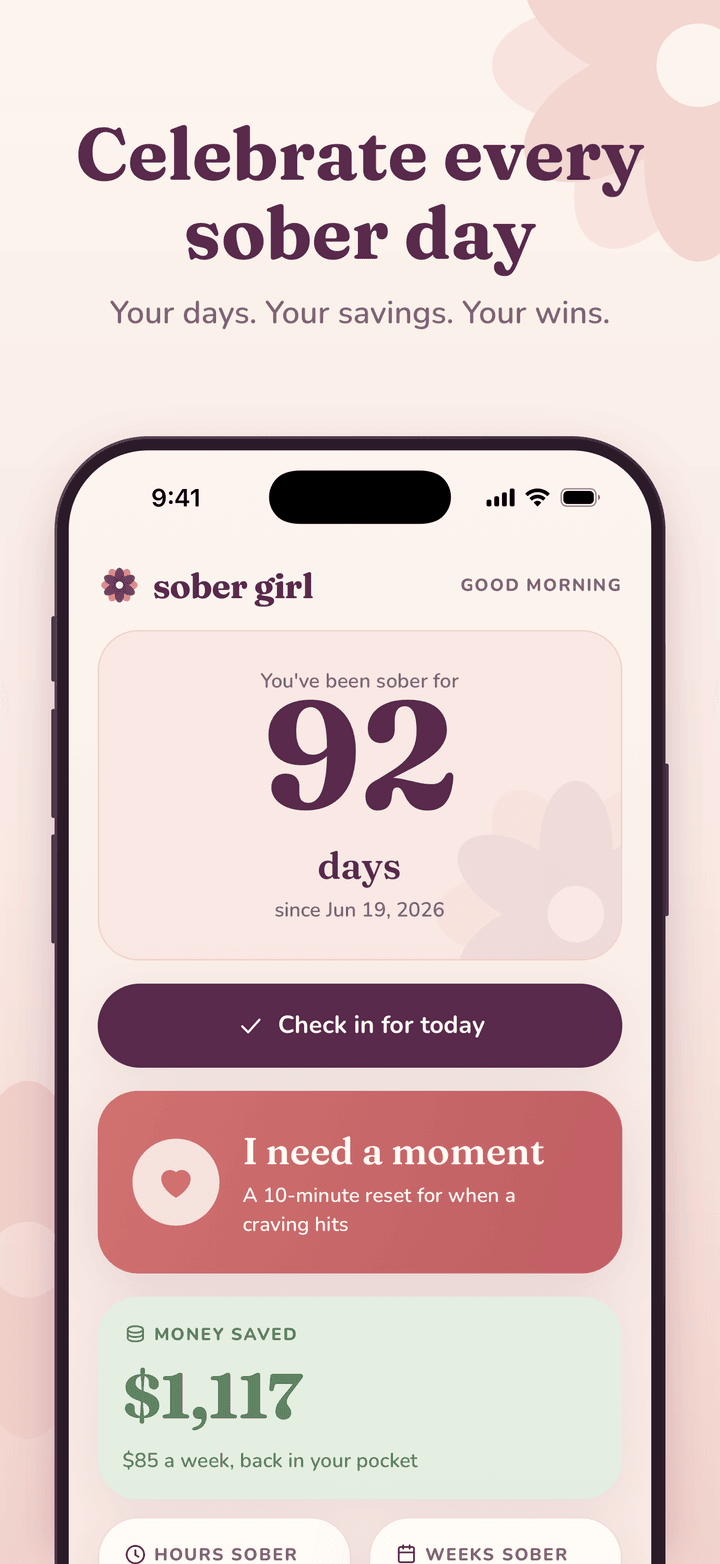
- want a day counter, money saved and a daily check-in in one calm place
- want a Craving SOS with a breathing exercise and a 10-minute timer
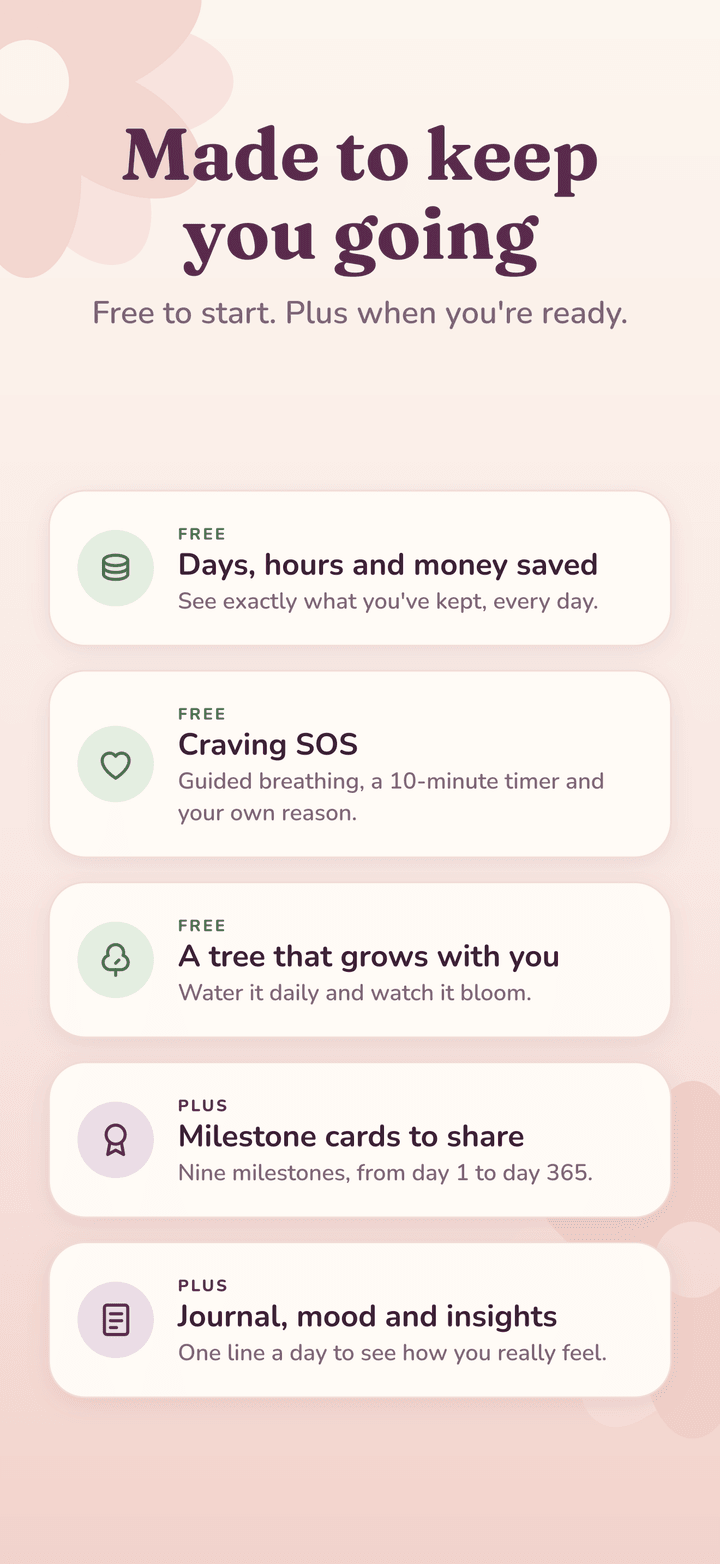
- want to start free and add Plus only if you need the journal, insights or milestone cards
- want a community feed, live coaching or an AI chat
- want a structured multi-week education program
- need medical help for heavy drinking or withdrawal. An app is not treatment, so see the safety notes above
Frequently asked questions
Is there a proven hangover cure?
No. A BMJ systematic review of eight randomized trials found no compelling evidence that any intervention works, and a 2017 update found only partial symptom relief from a few products.
Do hangover pills and supplements work?
Trials found small effects from a few, such as tolfenamic acid, borage and a yeast-based preparation, but the trials were small and none is a standard treatment. None helped every symptom.
Why do hangovers get worse as you drink more often?
A pooled analysis of 924 people found hangover frequency and severity rise together, a pattern the authors call reverse tolerance. It shows an association, not a proven cause.
What is the best way to avoid a hangover?
Drink less or not at all. The BMJ review concluded that abstinence or moderation is the most effective way to avoid hangover symptoms.
Can I take painkillers for a hangover?
Be careful. Alcohol and acetaminophen together can be toxic to the liver, and aspirin and ibuprofen can irritate the stomach, so use caution and ask a pharmacist.
How long does a hangover last?
NIAAA says hangover symptoms peak when blood alcohol returns to about zero and can last 24 hours or longer.
Does coffee cure a hangover?
No. NIAAA says coffee and a shower do not cure a hangover, and there is no way to speed up the brain’s recovery. Only time helps.
Does hair of the dog work?
It may mute some symptoms for a while, but it can prolong the hangover and keeps the drinking going. It does not cure it.
Sources
- Hangovers. NIAAA fact sheet, read 7 November 2026. A hangover is a set of symptoms after drinking too much. Causes include mild dehydration, disrupted sleep, stomach irritation, inflammation, acetaldehyde and a mini-withdrawal. Symptoms peak when blood alcohol returns to about zero and can last 24 hours or longer. No remedy has been proven; only time helps.
- Interventions for preventing or treating alcohol hangover: systematic review of randomised controlled trials. Pittler MH, Verster JC, Ernst E. BMJ 2005;331:1515–1518. Eight double-blind randomized trials of eight interventions. Only tolfenamic acid, borage (gamma linolenic acid) and a yeast-based preparation beat the comparison on symptoms. Conclusion: no compelling evidence that any intervention works; the most effective way to avoid a hangover is abstinence or moderation.
- Interventions for treatment and/or prevention of alcohol hangover: Systematic review. Jayawardena R, Thejani T, Ranasinghe P, Fernando D, Verster JC. Human Psychopharmacology 2017. Update covering 2009 to mid-2016: six controlled human studies. Several products improved some symptoms (tiredness, nausea and vomiting, stomachache), none improved all, and the authors call for more research.
- The Relationship Between Alcohol Hangover Frequency and Hangover Severity. Rîșniță S, Išerić E, Zijlstra MN, Stock AK, Verster JC. Journal of Clinical Medicine 2025;14(7):2428. Five studies combined (924 people). Hangover frequency and severity were positively correlated (r = 0.692; 0.526 after adjusting for sex, age and weekly drinking): people who have hangovers more often have worse ones.
How we write these. Every figure above links to the source it came from, and we label self-reported and observational results as such. Where we could not find a source we trust, the page says so instead of filling the gap. Sober Girl is made by ShipAI Lab and this is not medical advice. Sources were checked on 6 October 2026. If you spot an error, email us at [email protected].
Keep reading
Today is day one.
Sober Girl is a private sobriety tracker for women, on iPhone and Android: day counter, money saved, craving SOS and a tree that grows with you. Free to start.