Adenomyosis vs fibroids: how they differ, and why they get mixed up
Both cause heavy, painful periods, both affect the womb, and both often show up on the same scan report, so they are easy to confuse. But they are different conditions with different treatments. Here they are side by side, with endometriosis added because it is the third one people mix up.
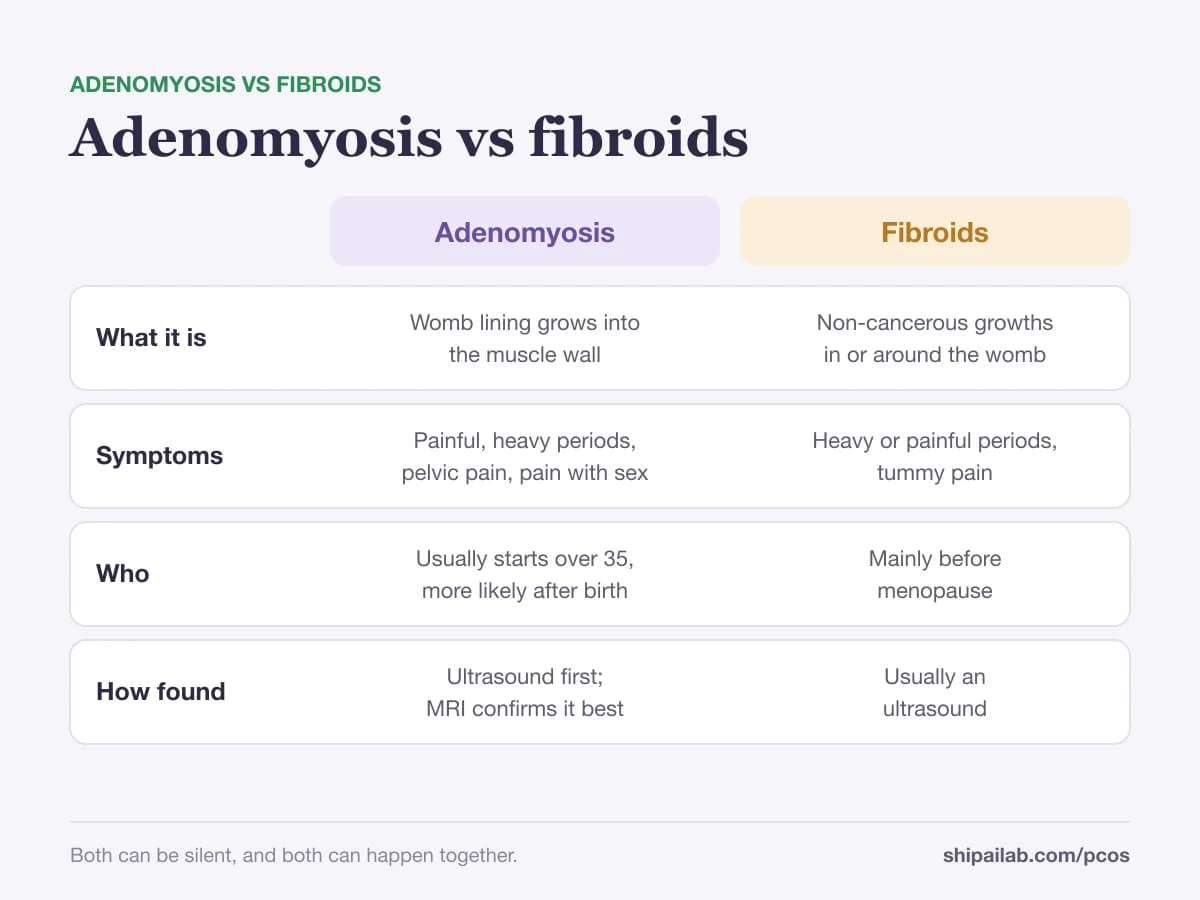
Side by side
| Adenomyosis | Fibroids (leiomyoma) | Endometriosis | |
|---|---|---|---|
| What it is | The womb lining grows into the muscle wall of the womb | Non-cancerous growths in or around the womb | Tissue like the womb lining grows outside the womb |
| Main symptoms | Painful, heavy periods; pelvic pain; pain during or after sex | Heavy or painful periods, tummy pain, difficulty getting pregnant | Pelvic pain, painful periods, pain during sex, bowel or bladder pain around periods |
| Who | Symptoms usually start over age 35; more likely after giving birth | Mainly before menopause | Women and girls of reproductive age |
| How found | Transvaginal ultrasound first; MRI confirms it best and tells it apart from fibroids | Usually an ultrasound | Exam and scan; a normal scan does not rule it out |
| Can be silent? | Yes | Yes | Sometimes |
The key difference
Fibroids are separate lumps of muscle tissue. A scan can usually see their edges, count them and measure them, and surgery can remove them one by one.
Adenomyosis is spread through the wall of the womb rather than forming a separate lump, so there is nothing distinct to remove. That is why it can be harder to diagnose and why MRI is sometimes needed. The NHS says removing the womb (hysterectomy) is the only cure.
They often occur together: up to half of people with adenomyosis also have fibroids, according to a 2022 review in American Family Physician. The NHS notes you have a higher chance of adenomyosis if you have endometriosis.
Treatments compared
| Adenomyosis | Fibroids | |
|---|---|---|
| Pain relief | NSAIDs, paracetamol, heat pads, a TENS machine | Ibuprofen, naproxen or diclofenac |
| Heavy bleeding | Tranexamic acid; the hormonal coil (IUS); the pill, patch or progestogen-only pill | Tranexamic acid; hormone medicine such as the combined pill |
| Procedures | Uterine artery embolisation | Uterine artery embolisation; removing fibroids (myomectomy); endometrial ablation |
| Last resort | Hysterectomy, the only cure | Hysterectomy |
Weight gain and a swollen belly
Questions about adenomyosis and weight gain or "belly fat" are common. An enlarged womb is one of the common signs of adenomyosis, and fibroids can add to it, so the lower tummy can look or feel swollen. That is not the same as gaining fat. If your belly has changed shape, mention it to your doctor along with your period symptoms.
Getting the right diagnosis
Because the symptoms overlap, a clear record helps: how heavy your bleeding is, how many days it lasts, where the pain is and on which days. Our PBAC calculator scores how heavy a period is, and a pain diary shows the pattern. Both make a scan or referral easier to ask for.
Track it in the app
Log heavy days, clots and pain, so your doctor can compare them with what the scan shows.
PCOS & Endo Tracker logs periods, pain, symptoms, food and blood sugar in about 20 seconds a day, and turns it into a summary for your doctor. Free to log, no account, your data stays on your phone.
Questions
What is the difference between adenomyosis and fibroids?
Fibroids are separate non-cancerous growths in or around the womb. Adenomyosis is the womb lining growing into the muscle wall itself. Both can cause heavy, painful periods.
Is a leiomyoma the same as a fibroid?
Yes. Leiomyoma is the medical name for a fibroid.
Can you get pregnant with adenomyosis?
Yes, but it may be harder. In an IVF analysis, people with adenomyosis had a 28% lower chance of clinical pregnancy. Many treatments for it prevent pregnancy, so tell your doctor if you are planning one.
Can you have adenomyosis and fibroids at the same time?
Yes. Up to half of people with adenomyosis also have fibroids, which is one reason they get confused.
Are fibroids cancer?
No. The NHS describes fibroids as non-cancerous growths.
Sources
- NHS: Adenomyosis
- NHS: Fibroids
- Struble J et al. Adenomyosis: diagnosis and management. Am Fam Physician, 2022
- World Health Organization: Endometriosis fact sheet
Written by Hicham Zaidi, maker of PCOS & Endo Tracker, from the sources above. General information, not medical advice. Updated November 13, 2026.