Ferriman-Gallwey score calculator for excess hair growth
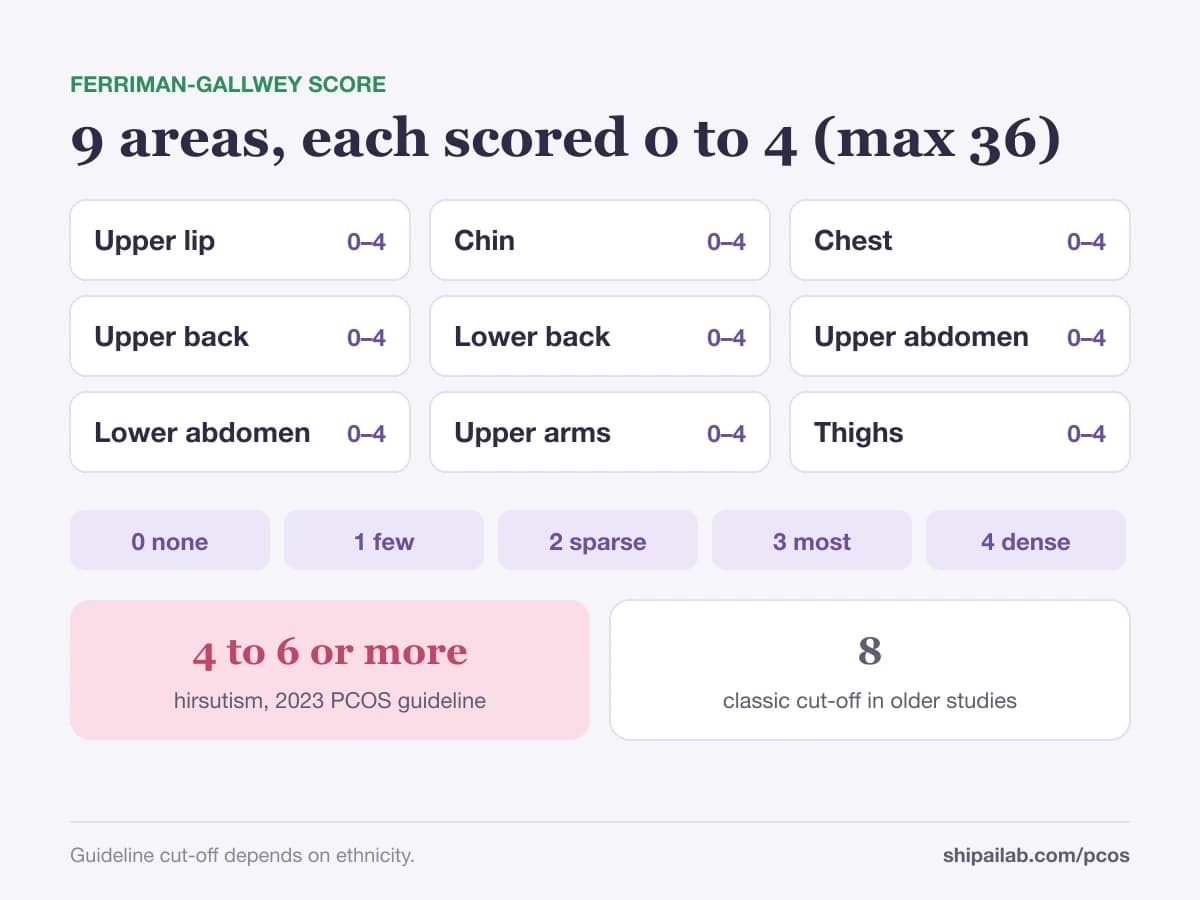
Doctors measure excess hair growth, called hirsutism, with the modified Ferriman-Gallwey (mFG) score. It rates 9 body areas from 0 to 4. Search for it and you mostly find research papers with no way to score yourself. Here you can score each area and see what the total means, including how far to trust a self-score.
Score yourself
For each area, pick how much coarse, dark hair grows there when you have not removed it. 0 means none, 4 means full coverage like a typical adult man. Fine, light “peach fuzz” does not count.
Score each of the 9 areas. Unscored areas count as 0.
A self-score, not a diagnosis. Self-scores tend to run high (see below). Nothing you pick is sent anywhere.
How the score works
Each of 9 areas gets a score from 0 (no coarse hair) to 4 (full coverage, like a typical adult man). The 9 scores are added up, so the total runs from 0 to 36.
The original scale, published by Ferriman and Gallwey in 1961, rated 11 areas. A 1981 revision by Hatch and colleagues dropped the forearms and lower legs. The 9-area version is the one doctors use today.
Only terminal hair counts: the coarse, dark hair that grows in response to androgens. Fine, light vellus hair does not.
| Score | What it looks like |
|---|---|
| 0 | No coarse hair |
| 1 | A few scattered hairs |
| 2 | More hairs, but sparse |
| 3 | Covers most of the area |
| 4 | Full, dense coverage |
What total counts as hirsutism
There is no single cut-off. The 2023 international PCOS guideline says an mFG score of 4 to 6 should be used to detect hirsutism, depending on ethnicity. Older studies, mostly in white women, used 8. A 2024 Brazilian study used 6 for Latin-American women.
The guideline also notes that the amount of hair varies by ethnicity, while the share of women with hirsutism looks similar across groups. That is why one number does not fit everyone.
| Cut-off | Where it comes from |
|---|---|
| 4 to 6 | 2023 international PCOS guideline, depending on ethnicity |
| 6 | Used for Latin-American women in recent studies |
| 8 | The classic cut-off from older studies, mostly in white women |
How far to trust a self-score
Not very far on its own. In a 2024 study, 188 women scored themselves and two trained doctors scored them separately. The self-scores caught 95% of the women the doctors found to be hirsute, but they also flagged many women who were not (specificity 56%). The authors concluded that self-scores should not be used to diagnose hirsutism.
So a high self-score is a reason to ask a doctor, not an answer. A low self-score is more reassuring, because few women with real hirsutism scored themselves low.
Hair removal makes it harder. The guideline notes that self-treatment is common and limits assessment. Score what grows back, not the day after you shave, wax or use a laser.
Hirsutism and PCOS
Hirsutism is one of the signs of high androgens, which is one of the three PCOS criteria. The 2023 guideline says that in adults, hirsutism alone predicts high androgen levels on a blood test and PCOS. Acne or hair thinning on their own are weaker signs.
If your score is high, a doctor may check total and free testosterone; the free androgen index is one way to estimate the free part. Hair growth that starts suddenly or gets worse quickly needs a prompt visit, because the guideline treats fast onset as a reason to look for other causes.
Keeping track
Excess hair is one of the symptoms you can log each day in PCOS & Endo Tracker, next to your cycle, acne and other symptoms. It shows up in the doctor report, so you can show how long it has been going on.
Track it in the app
Log hair growth in the app and re-score every few months, so a doctor sees whether treatment is working.
PCOS & Endo Tracker logs periods, pain, symptoms, food and blood sugar in about 20 seconds a day, and turns it into a summary for your doctor. Free to log, no account, your data stays on your phone.
Questions
What is a normal Ferriman-Gallwey score?
Below 4 is under every cut-off in common use. The 2023 international guideline uses 4 to 6 depending on ethnicity, and older studies used 8.
Which 9 areas does the mFG score cover?
Upper lip, chin, chest, upper back, lower back, upper abdomen, lower abdomen, upper arms and thighs.
Does a high score mean I have PCOS?
No. Hirsutism is one sign of high androgens, which is one of three PCOS criteria. Other conditions can cause it too. A doctor confirms it with an exam and blood tests.
Should I score myself before or after hair removal?
Score the hair that grows when you have not removed it. A score taken right after shaving, waxing or laser will be too low.
Why do cut-offs differ by ethnicity?
How much body and facial hair is typical varies between ethnic groups, so the guideline uses a range of 4 to 6 instead of one number.
Sources
- Ferriman D, Gallwey JD. Clinical assessment of body hair growth in women (1961), J Clin Endocrinol Metab
- Hatch R et al. Hirsutism: implications, etiology, and management (1981), Am J Obstet Gynecol
- Recommendations from the 2023 International Evidence-based Guideline for PCOS (rec. 1.3.1 to 1.3.7), Fertility and Sterility via ASRM
- Comparison of self-assessed and clinician-assessed hirsutism by the mFG scale (2024), Arch Endocrinol Metab
Written by Hicham Zaidi, maker of PCOS & Endo Tracker, from the sources above. General information, not medical advice. Updated November 13, 2026.