HOMA-IR calculator for insulin resistance and PCOS
HOMA-IR turns two numbers from one fasting blood test, glucose and insulin, into a rough score for insulin resistance. Insulin resistance is common with PCOS, so it is a number many people end up asking about. Enter your results below in the units on your lab report.
Calculate your HOMA-IR
Enter both numbers from the same fasting blood test.
Works in your browser. Nothing you type is sent anywhere. Not a diagnosis.
The formula
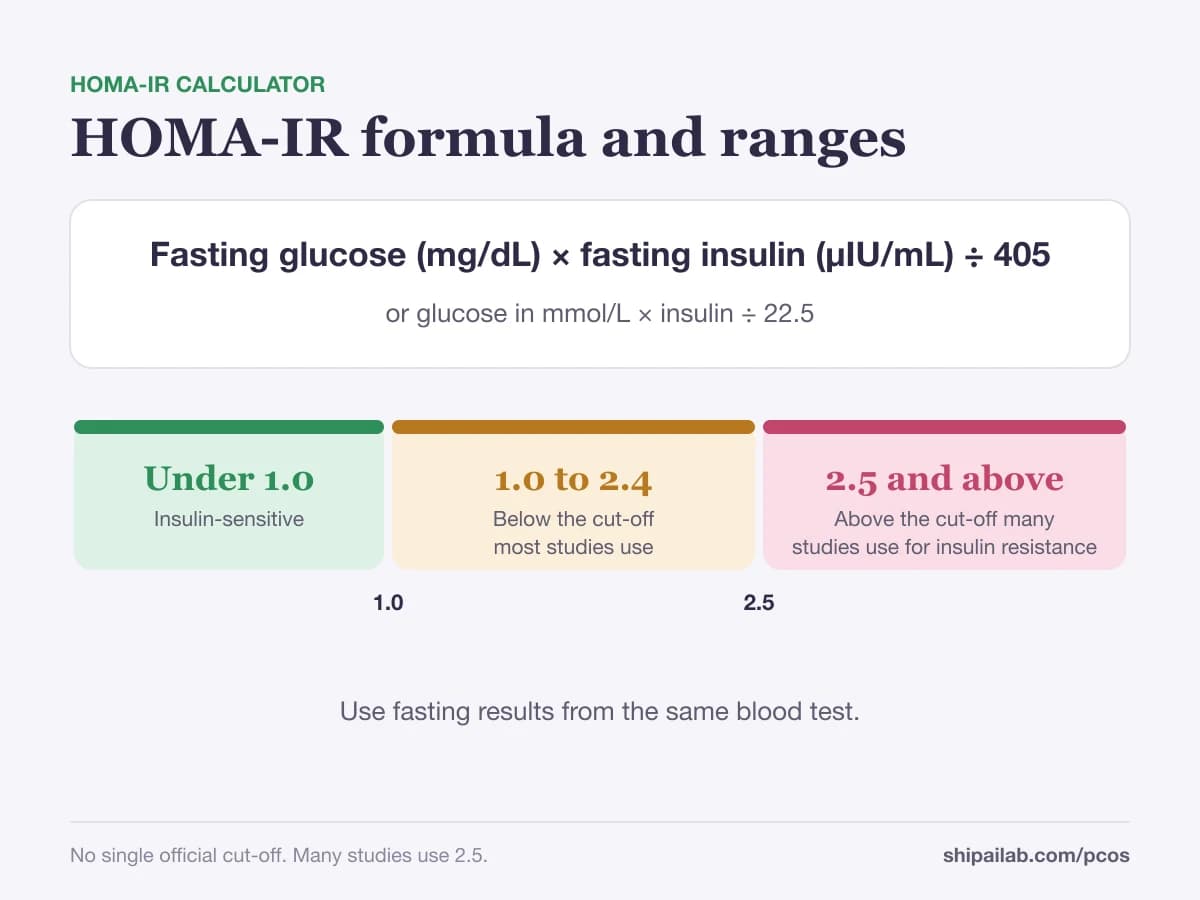
HOMA-IR = fasting glucose (mg/dL) × fasting insulin (µIU/mL) ÷ 405.
If your glucose is in mmol/L, the divisor is 22.5 instead: glucose (mmol/L) × insulin (µIU/mL) ÷ 22.5. Both give the same result. If your insulin is in pmol/L, divide it by 6 first to get µIU/mL. The calculator above does both conversions for you.
Worked example: glucose 92 mg/dL and insulin 12 µIU/mL gives 92 × 12 ÷ 405 = 2.73.
What the number means
There is no single official cut-off. Many studies use 2.5 as the point above which insulin resistance is likely. Others use values anywhere from about 1.9 to 3.8, depending on the population studied, and lower numbers are usually described as more insulin-sensitive.
Because of that spread, the most useful reading is your own number over time: the same lab, the same fasting conditions, months apart. A single value is a starting point for a conversation, not a diagnosis.
| HOMA-IR | How it is commonly described |
|---|---|
| Under 1.0 | Insulin-sensitive |
| 1.0 to 2.4 | Below the cut-off most studies use |
| 2.5 and above | Above the cut-off many studies use for insulin resistance |
Why it comes up with PCOS
Insulin resistance is common with PCOS, including in people who are not overweight. Higher insulin can push the ovaries to make more androgens, which is one reason it is linked to irregular cycles, acne and extra hair growth.
Insulin resistance is not one of the criteria used to diagnose PCOS. The 2023 international PCOS guideline calls it a key feature of PCOS, but says commercial insulin tests are not recommended in routine care because they are not accurate enough. So many doctors will not order fasting insulin at all. If yours does, HOMA-IR is a simple way to read it next to your glucose.
Getting a result you can compare
- Fast for 8 to 12 hours before the test. Water is fine.
- Glucose and insulin must come from the same blood draw.
- Note the date and, if you can, the cycle day. Illness, poor sleep and some medicines can move the numbers.
- Keep each result. One number tells you little; three over a year tell you a direction.
Keeping track over time
PCOS & Endo Tracker already logs everyday blood sugar readings next to your cycle and symptoms. The next app update adds a Labs tab: you enter fasting glucose and insulin from a test and it works out HOMA-IR with this same formula, keeps every result, and puts them in the doctor report.
Track it in the app
Log your fasting glucose with each test, so your doctor sees the trend instead of one number.
PCOS & Endo Tracker logs periods, pain, symptoms, food and blood sugar in about 20 seconds a day, and turns it into a summary for your doctor. Free to log, no account, your data stays on your phone.
Questions
What is a normal HOMA-IR?
There is no single normal value. Under 1.0 is usually described as insulin-sensitive, and many studies use 2.5 as the cut-off for insulin resistance. Ask which cut-off your doctor or lab uses.
Can I use a finger-prick glucose reading?
Use fasting glucose from the same lab draw as your insulin. A meter reading taken at a different time will not match the insulin value and makes the score meaningless.
Is HOMA-IR the same as HOMA2?
No. This page uses the original HOMA formula (HOMA1-IR). HOMA2 is an updated computer model from the University of Oxford that gives slightly different numbers; it is available as a separate download.
Does a high HOMA-IR mean I have PCOS?
No. Insulin resistance can happen with or without PCOS, and PCOS is diagnosed from cycles, androgen levels or signs, and ovary ultrasound, not from HOMA-IR.
Is anything I type saved?
No. The calculation runs in your browser and nothing is sent or stored.
Sources
- Matthews DR et al. Homeostasis model assessment (1985), Diabetologia
- HOMA2 calculator, University of Oxford
- Teede HJ et al. Recommendations from the 2023 International Evidence-based Guideline for PCOS, JCEM
Written by Hicham Zaidi, maker of PCOS & Endo Tracker, from the sources above. General information, not medical advice. Updated November 13, 2026.