PCOS vs endometriosis: how to tell them apart
Both are common, both affect women of the same ages, and both can make it harder to get pregnant, so they get mixed up a lot. But they are different conditions. Endometriosis is mostly about pain. PCOS, now renamed PMOS, is mostly about hormones, cycles and metabolism. Here is the comparison side by side.
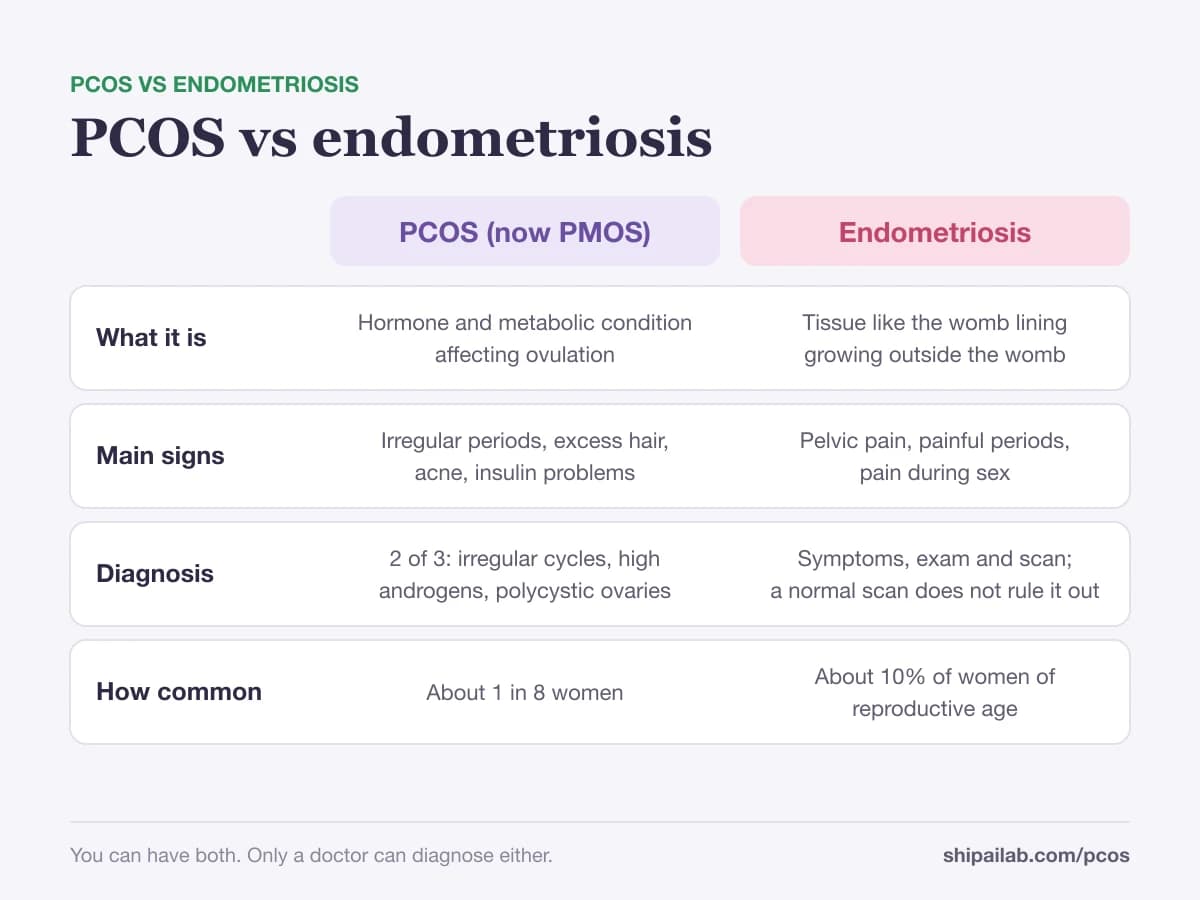
Side by side
| PCOS (now PMOS) | Endometriosis | |
|---|---|---|
| What it is | A hormone and metabolic condition affecting ovulation | Tissue similar to the womb lining growing outside the womb |
| Main symptoms | Irregular or missing periods, excess hair, acne, weight and insulin problems | Pelvic pain, painful periods, pain during sex, pain when pooing or peeing around periods |
| How it is diagnosed | Two of three: irregular cycles, high androgens, polycystic ovaries on a scan or high AMH | Symptoms, an exam and a scan. A normal scan does not rule it out. Sometimes surgery confirms it |
| How common | About 1 in 8 women | About 10% of women and girls of reproductive age |
| Fertility | Can affect it, mainly through irregular ovulation | Can affect it |
| First treatments | Depends on symptoms. The combined pill can help make periods regular | Painkillers such as paracetamol or ibuprofen, and hormones such as the combined pill |
The quickest way to tell them apart
Ask what bothers you most. If it is pain, especially pain that tracks your period, start with endometriosis. If it is cycles that are too long, too short or unpredictable, with signs such as excess hair or acne, start with PCOS.
Our two quizzes follow the official criteria for each: the NICE symptom list for endometriosis, and the 2023 international guideline for PCOS. Taking both takes about 3 minutes.
Can you have both?
Yes, but it seems to be uncommon. A nationwide Korean study of 157,662 women aged 15 to 45 found the two rarely occurred together. It also found different patterns around them: PCOS was linked with more metabolic conditions such as high cholesterol and type 2 diabetes, and endometriosis mainly with pain. Infertility was linked with both.
If you have symptoms of both, say so. A PCOS diagnosis does not explain severe pelvic pain, and endometriosis does not explain excess hair growth.
Track both in one place
Because the symptoms differ, the useful records differ too: cycle dates for PCOS, and pain by day and by place for endometriosis. A diary that holds both makes it much easier for a doctor to see which pattern you have.
Track it in the app
Log cycle dates for PCOS and pain by day and place for endometriosis, in one diary.
PCOS & Endo Tracker logs periods, pain, symptoms, food and blood sugar in about 20 seconds a day, and turns it into a summary for your doctor. Free to log, no account, your data stays on your phone.
Questions
What is the main difference between PCOS and endometriosis?
Endometriosis is mainly a pain condition, caused by tissue like the womb lining growing outside the womb. PCOS, now called PMOS, is a hormone and metabolic condition that mainly affects cycles and ovulation.
Can you have PCOS and endometriosis at the same time?
Yes, though a large Korean study found it is rare. If you have symptoms of both, tell your doctor about all of them.
Which is more painful, PCOS or endometriosis?
Pain is the main symptom of endometriosis. PCOS is not mainly a pain condition, so severe pelvic pain deserves its own check.
Does an ultrasound show both?
An ultrasound can show polycystic ovaries. It can show some endometriosis, but NICE says a normal scan does not rule endometriosis out.
Sources
- Jeong HG et al. Similar but distinct comorbidity patterns between PCOS and endometriosis in Korean women. J Korean Med Sci, 2024
- Teede HJ et al. Polyendocrine metabolic ovarian syndrome, the new name for PCOS. The Lancet, 2026
- World Health Organization: Endometriosis fact sheet
- NICE NG73: Endometriosis, diagnosis and management
- NHS: Endometriosis treatment
- NHS: Irregular periods
Written by Hicham Zaidi, maker of PCOS & Endo Tracker, from the sources above. General information, not medical advice. Updated November 13, 2026.