Period blood clots: normal, or a sign of heavy bleeding?
Clots during a period are common, and most are nothing to worry about. Size is what matters. The NHS lists clots larger than about 2.5 cm as one sign of heavy periods. Below, the full list of signs, and a PBAC calculator: the chart doctors and researchers use to score how heavy a period is.
Score your period (PBAC)
Count everything you used over one whole period, from the first day to the last. Use your best guess if you did not keep a chart; next period you can count as you go.
Enter at least one number to see your score.
An estimate, not a measurement. It does not work for menstrual cups, discs or period underwear. Nothing you type is sent anywhere.
When clots are a sign of heavy periods
A clot is blood that has thickened before leaving your body. Small clots on heavier days are common. The NHS does not list small clots as a problem. It lists clots larger than about 2.5 cm, the size of a 10p coin (close to a US quarter), as a sign of heavy periods. The NHS signs are:
- Changing your pad or tampon every 1 to 2 hours.
- Needing 2 types of period product together, such as a pad and a tampon.
- Periods lasting more than 7 days.
- Blood clots larger than about 2.5 cm.
- Bleeding through to your clothes or bedding.
- Avoiding daily activities, or taking time off work, because of your period.
- Feeling tired or short of breath a lot.
How the PBAC score works
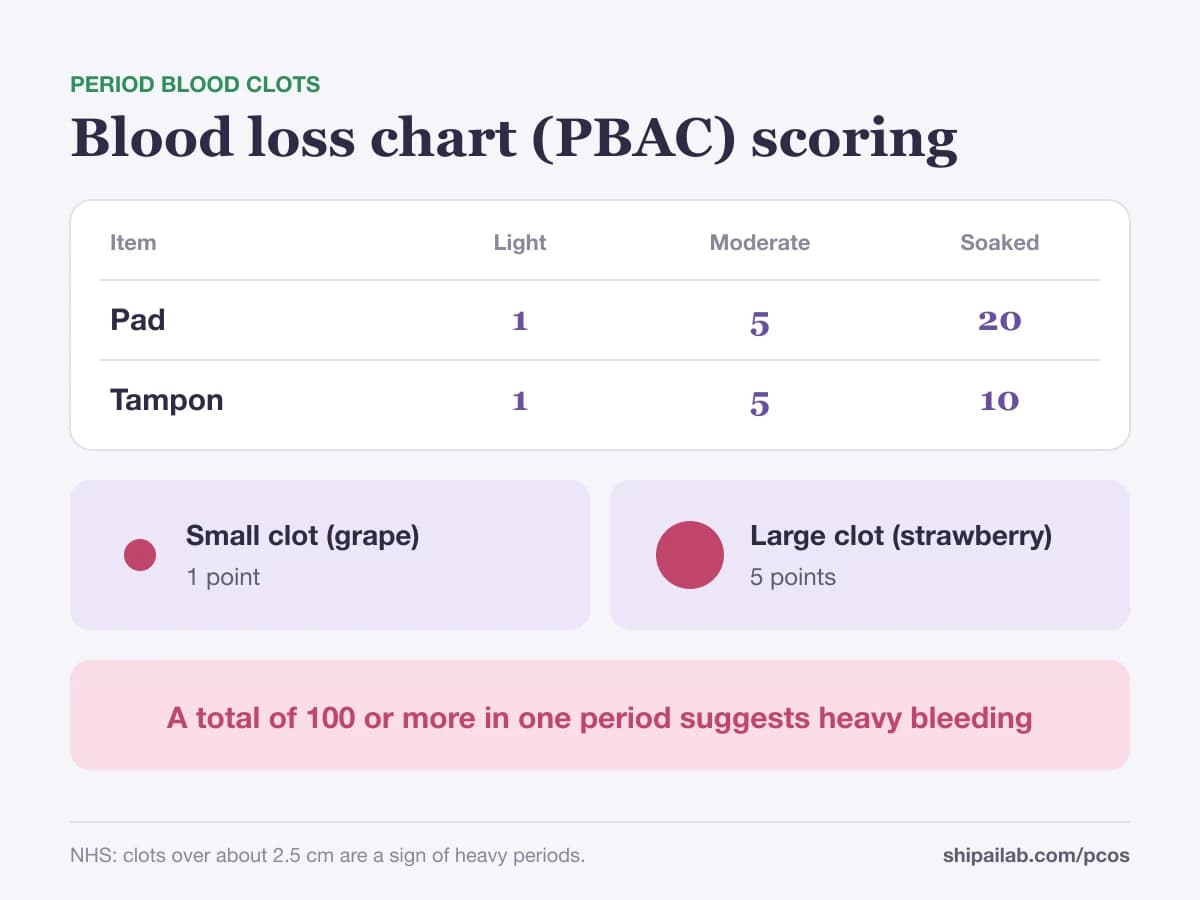
The pictorial blood loss assessment chart (PBAC) was published by Higham and colleagues in 1990. You count each pad or tampon by how soaked it is, plus any clots, and add up the points. In their study, a total of 100 or more picked out heavy bleeding with more than 80% sensitivity and specificity.
| Item | Light | Moderate | Soaked |
|---|---|---|---|
| Pad | 1 | 5 | 20 |
| Tampon | 1 | 5 | 10 |
| Clot | Small (grape): 1 | Large (strawberry): 5 |
How much blood is a heavy period?
In research, heavy menstrual bleeding means losing 80 mL or more in one period. Almost nobody measures that at home, and doctors rarely do either. In the UK, NICE defines heavy bleeding by its effect on your life: physical, social, emotional or practical. So if your periods are getting in the way of your life, that counts, whatever your score.
For scale, US tampon absorbency labels are set by the FDA: regular tampons hold 6 to 9 grams of fluid and super plus 12 to 15 grams. Soaking a super plus tampon every 1 to 2 hours is a lot of blood.
How many pads a day is normal?
There is no official normal number, because pads, flow and habits vary so much. The sign the NHS uses is how often you need to change: every 1 to 2 hours is heavy. The PBAC score above is a better guide than a count, because it weighs how soaked each one was.
When to see a doctor
The NHS says to see a GP if:
- Heavy periods are affecting your life.
- You have had heavy periods for some time.
- You have severe pain during your periods.
- You bleed between periods or after sex.
- You have heavy periods with other symptoms, such as pain when peeing, pooing or having sex.
Track it in the app
Log clots and pad changes each day. Your doctor can read a PBAC-style record far better than a memory.
PCOS & Endo Tracker logs periods, pain, symptoms, food and blood sugar in about 20 seconds a day, and turns it into a summary for your doctor. Free to log, no account, your data stays on your phone.
Questions
Are blood clots during a period normal?
Small clots are common. The NHS lists clots larger than about 2.5 cm, the size of a 10p coin, as a sign of heavy periods.
Are jelly-like clots during a period normal?
Clots often look dark red and jelly-like. What matters is their size and how often you get them. Large clots, or clots with other signs of heavy bleeding, are worth mentioning to a doctor.
What PBAC score is heavy?
A score of 100 or more. In the original 1990 study it matched measured blood loss over 80 mL with more than 80% sensitivity and specificity.
How much blood do you lose on your period?
Research defines heavy bleeding as 80 mL or more per period. In the UK, doctors judge heavy bleeding by its effect on your life rather than by volume.
Does PBAC work with a menstrual cup?
No. The chart was built for pads and tampons. With a cup you can read the volume off its markings instead.
Sources
- Higham JM, O’Brien PM, Shaw RW. Assessment of menstrual blood loss using a pictorial chart. BJOG, 1990
- National Bleeding Disorders Foundation: Menstrual chart and scoring system (PBAC)
- NHS: Heavy periods
- NICE NG88: Heavy menstrual bleeding, assessment and management
- Magnay JL et al. A systematic review of methods to measure menstrual blood loss. BMC Womens Health, 2018
- US FDA: 21 CFR 801.430, tampon absorbency labeling
Written by Hicham Zaidi, maker of PCOS & Endo Tracker, from the sources above. General information, not medical advice. Updated November 13, 2026.