Period every 2 weeks? Check your cycle against the normal limits
Doctors use limits set by FIGO, the international federation of gynecologists, to decide whether a cycle is normal. A period every 2 weeks falls outside them, and so does one that lasts 10 days. Enter your numbers below to see where you stand, then read the common causes and when it is worth seeing a doctor.
Check your cycle
Fill in at least one cycle length or your period length.
Checks your numbers against the FIGO 2018 limits. Not a diagnosis. Nothing you type is sent anywhere.
What a normal cycle looks like
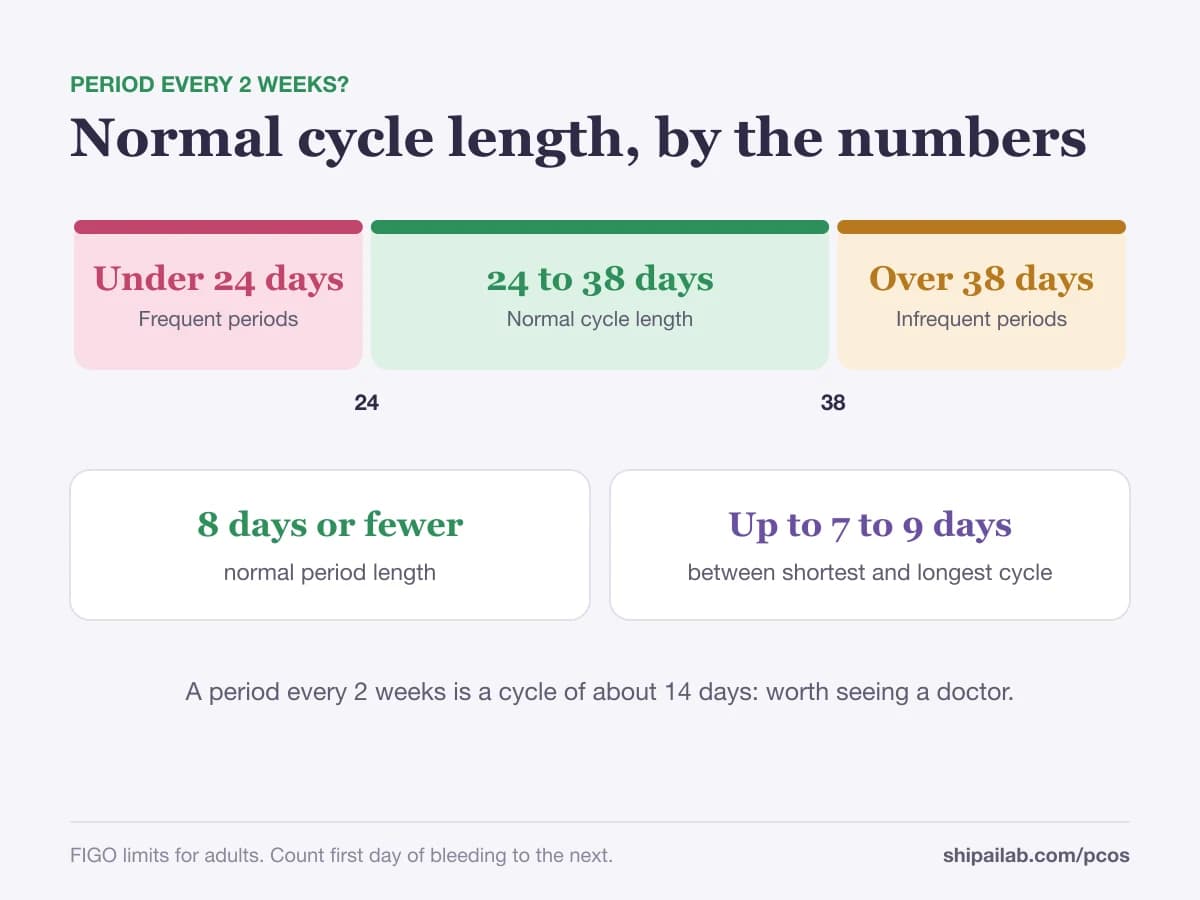
A cycle runs from the first day of one period to the first day of the next. These are the FIGO limits for ages 18 to 45:
| Measure | Normal | Outside the limits |
|---|---|---|
| Cycle length | 24 to 38 days | Under 24 days is frequent. Over 38 days is infrequent. |
| Period length | 8 days or fewer | Over 8 days is prolonged. |
| Regularity (shortest vs longest cycle) | Up to 7 days apart at 26 to 41. Up to 9 days at 18 to 25 and 42 to 45. | More than that is irregular. |
Why your period might come every 2 weeks
First check whether it is really a period. Bleeding or spotting between periods is a separate symptom, and the NHS says it is always worth seeing a GP about.
For cycles that change length, the NHS lists these common causes:
- Puberty, in the first years after periods start.
- The run-up to menopause (perimenopause).
- Pregnancy.
- Some hormonal contraceptives, such as the pill, implant, injection or hormonal coil.
- Losing or gaining a lot of weight.
- Stress and anxiety.
- Exercising a lot.
- Conditions such as PMOS (the new name for PCOS) or thyroid problems.
A period lasting 10 days
FIGO calls bleeding for more than 8 days prolonged. The NHS goes further: it lists periods lasting more than 7 days as a sign of heavy periods and a reason to see a GP. If long periods come with soaked pads or large clots, the PBAC score on our period clots page gives you a number to bring along.
When to see a doctor
The NHS says to see a GP if:
- Your periods are irregular.
- Your periods last longer than 7 days.
- You bleed between periods.
- Your periods are irregular and you are struggling to get pregnant.
- You have irregular periods with weight gain, tiredness, facial hair growth or changes in how oily your skin is.
What to bring
The start date of every period for the last 3 to 6 months, how many days each lasted, and any bleeding in between. With those dates a doctor can see your pattern in a minute. Logging each period in an app as it starts is the easiest way to have them ready.
Track it in the app
Log every bleeding day for two or three cycles, so a doctor can tell periods from spotting.
PCOS & Endo Tracker logs periods, pain, symptoms, food and blood sugar in about 20 seconds a day, and turns it into a summary for your doctor. Free to log, no account, your data stays on your phone.
Questions
Is it normal to get your period every 2 weeks?
No. A cycle of about 14 days is well under the 24-day lower limit FIGO uses, so it is worth seeing a doctor, especially if it keeps happening.
Can stress make my period come twice a month?
Stress and anxiety are on the NHS list of common causes of irregular periods. A doctor can check for other causes too.
Is a 10-day period normal?
No. FIGO calls bleeding for more than 8 days prolonged, and the NHS says to see a GP if periods last longer than 7 days.
Can PCOS cause frequent periods?
It can. The 2023 international PCOS guideline counts cycles shorter than 21 days as irregular, as well as cycles longer than 35 days.
How do I count my cycle length?
Count from the first day of one period to the day before the next one starts. Day 1 is the first day of real bleeding, not spotting.
Sources
- Munro MG et al. The two FIGO systems for normal and abnormal uterine bleeding: 2018 revisions. Int J Gynaecol Obstet
- StatPearls: Physiology, Menstrual Cycle (FIGO normal limits)
- NHS: Irregular periods
- NHS: Heavy periods
- International evidence-based guideline for PCOS, 2023 (rec 1.1.1)
Written by Hicham Zaidi, maker of PCOS & Endo Tracker, from the sources above. General information, not medical advice. Updated November 13, 2026.