LH:FSH ratio calculator and what it means for PCOS
LH and FSH are the two hormones that drive the menstrual cycle. Some people with PCOS have LH that runs high compared with FSH, which is why the ratio shows up on so many forums. Enter both numbers from the same blood test.
Calculate your LH:FSH ratio
Enter LH and FSH from the same test, ideally taken on day 2 to 5 of your cycle.
Works in your browser. Nothing you type is sent anywhere. Not a diagnosis.
How the ratio is worked out
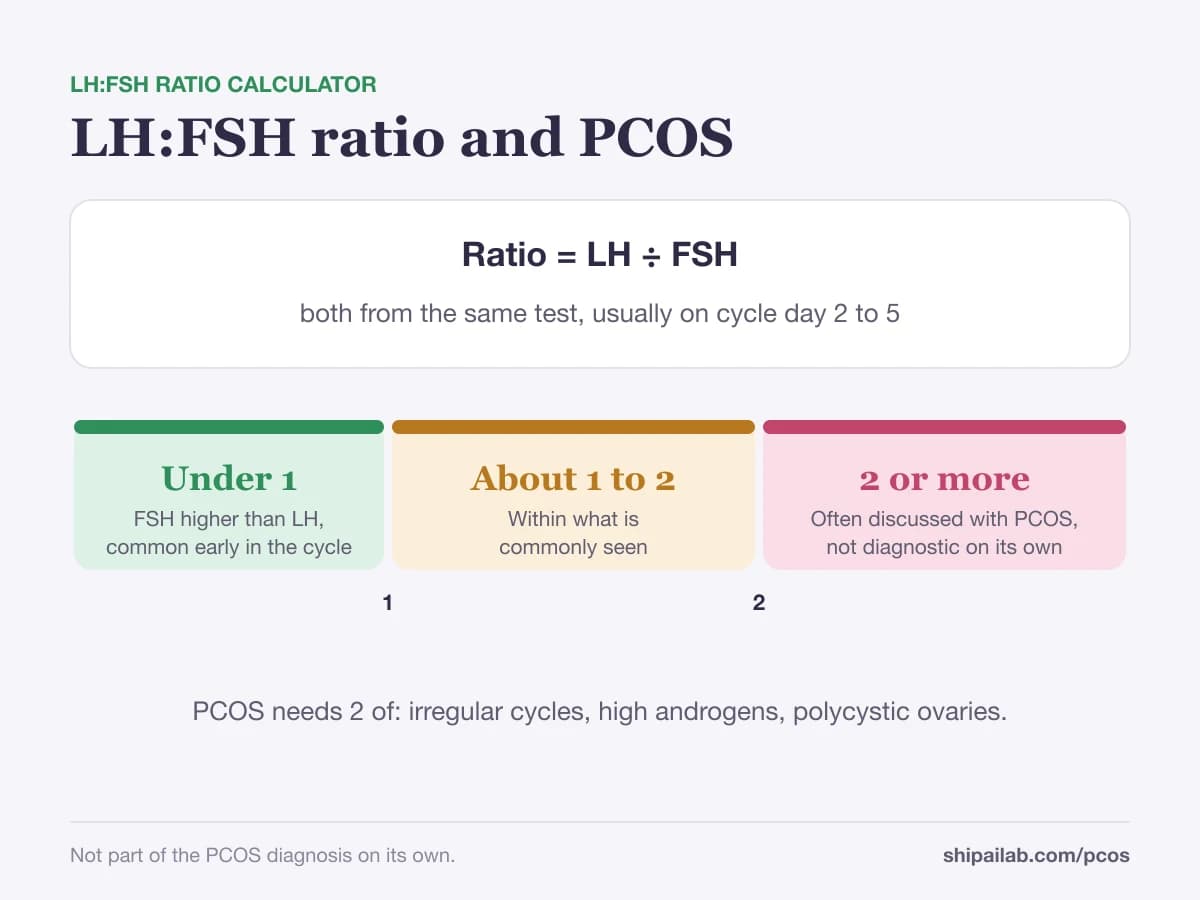
Divide LH by FSH. Both are usually reported in IU/L or mIU/mL, which are the same size unit, so no conversion is needed. LH 10 and FSH 5 gives a ratio of 2, written 2:1.
Timing matters. LH rises sharply just before ovulation, so a test taken mid-cycle can show a high ratio in anyone. That is why doctors usually ask for these hormones on day 2 to 5 of a cycle, or on a random day if periods are very irregular or absent.
What a ratio of 2:1 or more means
In the early part of a typical cycle LH and FSH are similar, so the ratio is around 1. A ratio of 2:1 or 3:1 is often described in older studies of PCOS.
But many people with PCOS have a normal ratio, and neither LH nor the LH:FSH ratio is among the diagnostic criteria in the 2023 international PCOS guideline. Doctors mainly use LH and FSH to rule out other causes of missing periods.
| Ratio | What it usually reflects |
|---|---|
| Under 1 | FSH higher than LH, common early in the cycle |
| About 1 to 2 | Within what is commonly seen |
| 2 or more | Often discussed with PCOS, but not diagnostic on its own |
How PCOS is actually diagnosed
Under the Rotterdam criteria, used by the international guideline, a diagnosis needs two of these three, after other causes are ruled out:
- Irregular or absent ovulation, usually seen as irregular or missing periods.
- Signs of high androgens: blood tests or symptoms such as extra hair growth or acne.
- Polycystic ovaries on ultrasound, or a high AMH level in adults.
Keeping track over time
PCOS & Endo Tracker logs your cycles and symptoms, which is the first criterion above. The next app update adds a Labs tab: enter LH and FSH from a test and it shows the ratio with this same formula, next to your cycle history and in the doctor report.
Track it in the app
Your cycle history is the first PCOS criterion. Log period days so you know which day your blood test fell on.
PCOS & Endo Tracker logs periods, pain, symptoms, food and blood sugar in about 20 seconds a day, and turns it into a summary for your doctor. Free to log, no account, your data stays on your phone.
Questions
What is a normal LH:FSH ratio?
In the early follicular phase (day 2 to 5) LH and FSH are usually close, so a ratio around 1 is typical. Your lab report gives separate reference ranges for each hormone.
Can I have PCOS with a normal LH:FSH ratio?
Yes. Many people with PCOS have a normal ratio. It is not one of the diagnostic criteria.
My ratio is 3:1. Do I have PCOS?
Not necessarily. A mid-cycle LH surge alone can give that ratio. Bring the numbers, the cycle day of the test and your cycle history to your doctor.
Do I need to convert units?
No, as long as both are in the same unit. IU/L and mIU/mL are equal.
Sources
- Teede HJ et al. Recommendations from the 2023 International Evidence-based Guideline for PCOS, JCEM
- Rotterdam ESHRE/ASRM consensus on PCOS diagnostic criteria (2004)
Written by Hicham Zaidi, maker of PCOS & Endo Tracker, from the sources above. General information, not medical advice. Updated November 13, 2026.