Free androgen index calculator: testosterone and SHBG
The free androgen index (FAI) estimates how much testosterone is free to act in your body. It needs two numbers from the same blood test: total testosterone and SHBG. The sum is easy. The hard part is the normal range, which differs from lab to lab, so this page shows real examples.
Calculate your FAI
Enter both results from the same blood test.
Works in your browser. Nothing you type is sent anywhere. Not a diagnosis.
The formula
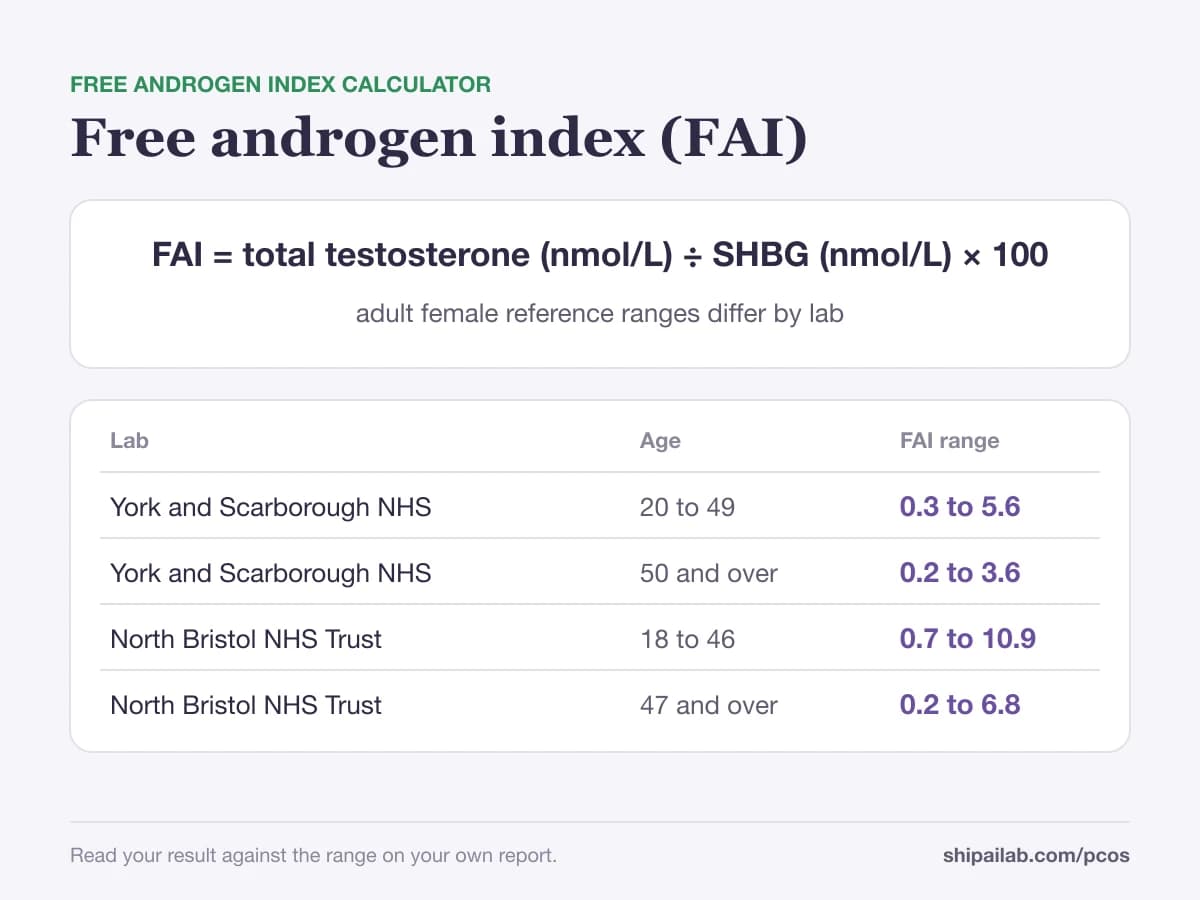
FAI = total testosterone (nmol/L) ÷ SHBG (nmol/L) × 100.
If your testosterone is in ng/dL, multiply by 0.0347 to get nmol/L first. The calculator does this for you.
Worked example: testosterone 1.8 nmol/L and SHBG 40 nmol/L gives 1.8 ÷ 40 × 100 = 4.5.
Why SHBG matters
SHBG (sex hormone-binding globulin) is a protein that holds on to testosterone. Testosterone bound to SHBG is not active. So two people with the same total testosterone can have very different amounts of active hormone, depending on their SHBG.
Low SHBG means a higher FAI. That is why a “normal” total testosterone can still come with a high FAI.
What is a normal FAI? It depends on the lab
There is no single normal range. Each lab sets its own, based on its testing method and population. Two UK NHS labs show how wide the gap can be:
| Lab (women) | Age | Reference range |
|---|---|---|
| York and Scarborough Teaching Hospitals NHS | 20 to 49 | 0.3 to 5.6 |
| York and Scarborough Teaching Hospitals NHS | 50 and over | 0.2 to 3.6 |
| North Bristol NHS Trust | 18 to 46 | 0.7 to 10.9 |
| North Bristol NHS Trust | 47 and over | 0.2 to 6.8 |
FAI and PCOS
High androgens are one of the three PCOS criteria. The 2023 international guideline says doctors should use total and free testosterone to check for them, and that free testosterone can be estimated with the free androgen index.
If those are normal, the guideline says androstenedione and DHEA-S could be measured, though they are less specific. It also asks labs to use a more accurate method (LC-MS/MS) for testosterone, which is one reason results vary between labs.
The combined pill raises SHBG, which pushes FAI down. The guideline says androgen tests are hard to read while on the pill, and that if testing is essential the pill would need to be stopped for at least three months. That is a decision to make with your doctor.
Keeping track
The next update of PCOS & Endo Tracker adds a Labs tab. It keeps testosterone, free testosterone and SHBG results with their dates and units, next to your cycle history, and puts them in the doctor report.
Track it in the app
Log acne, hair growth and hair loss days next to your cycles, the signs a doctor weighs with your FAI.
PCOS & Endo Tracker logs periods, pain, symptoms, food and blood sugar in about 20 seconds a day, and turns it into a summary for your doctor. Free to log, no account, your data stays on your phone.
Questions
What is a normal free androgen index for women?
It depends on the lab. For adult women under 50, York’s NHS lab uses 0.3 to 5.6 and North Bristol’s uses 0.7 to 10.9 for ages 18 to 46. Use the range printed on your own report.
Does a high FAI mean I have PCOS?
No. It points to high androgens, which is one of three PCOS criteria. Other conditions can raise it, so a doctor will look at your cycles and other tests too.
Is FAI the same as free testosterone?
No. FAI is a ratio that estimates free testosterone. Free testosterone can also be calculated with other formulas or measured directly, for example by equilibrium dialysis.
Does the pill affect FAI?
Yes. The combined pill raises SHBG and lowers androgen production, so FAI usually reads lower while you take it.
My testosterone is in ng/dL. What do I do?
Pick ng/dL in the calculator. It converts to nmol/L by multiplying by 0.0347. SHBG is almost always reported in nmol/L.
Sources
- Recommendations from the 2023 International Evidence-based Guideline for PCOS (rec. 1.2.1 to 1.2.6), Fertility and Sterility via ASRM
- Free androgen index, York and Scarborough Teaching Hospitals NHS test directory
- Free androgen index, North Bristol NHS Trust (Severn Pathology)
Written by Hicham Zaidi, maker of PCOS & Endo Tracker, from the sources above. General information, not medical advice. Updated November 13, 2026.