Polycystic ovaries: what the scan result actually means
If a scan report says "polycystic ovaries" or "polycystic ovarian morphology", it describes how your ovaries look. It is not a diagnosis on its own, and despite the name, it is not about cysts. Here is what the words mean, the thresholds doctors use, and how it relates to PCOS, now renamed PMOS.
Follicles, not cysts
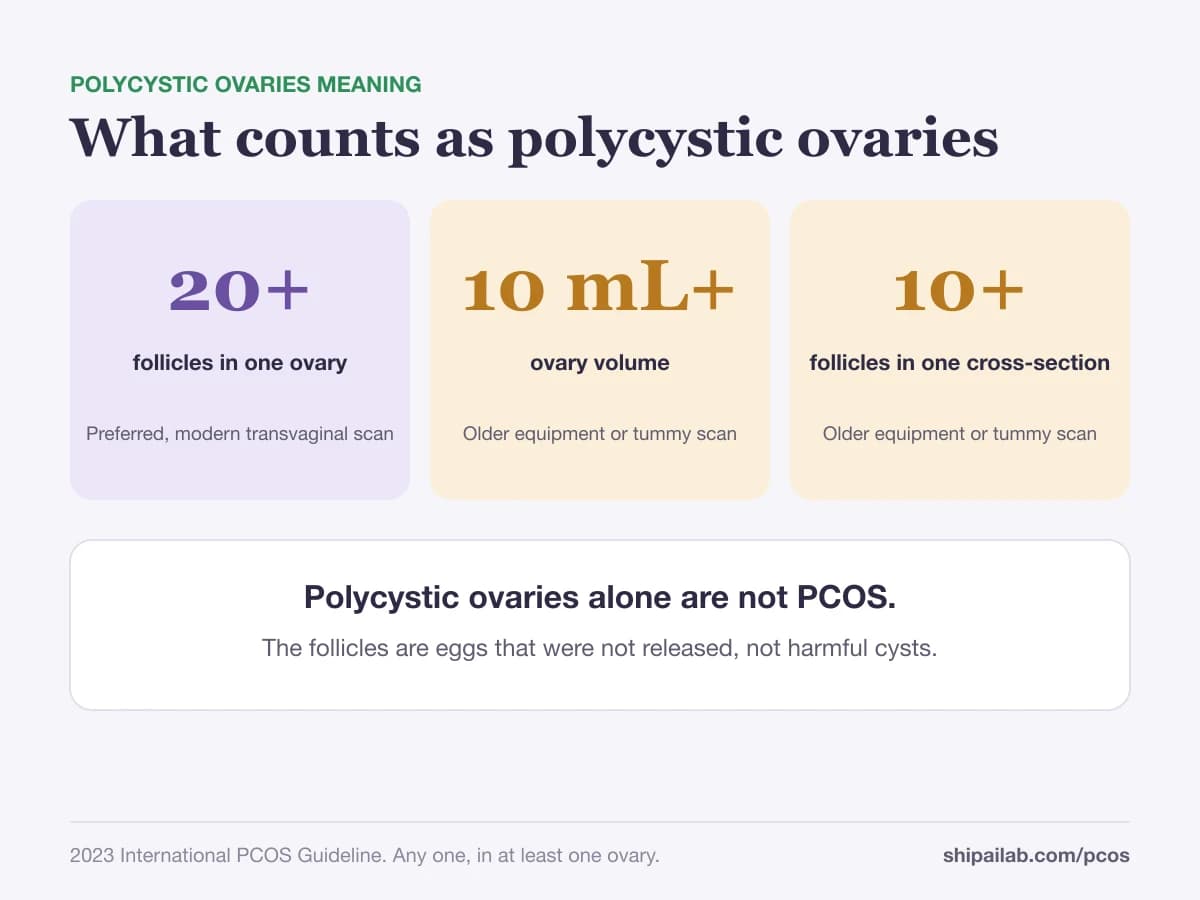
The "cysts" in polycystic ovaries are follicles: small fluid-filled sacs, each holding an egg that has not been released. Every ovary has follicles. Polycystic ovaries simply have more of them, or are larger than usual. This is one reason PCOS was renamed PMOS in 2026: the old name suggested harmful cysts that are not part of the condition.
The thresholds doctors use
The 2023 international guideline sets these thresholds for adults:
| Measure | Counts as polycystic | When it is used |
|---|---|---|
| Follicles in the whole ovary | 20 or more, in at least one ovary | The preferred measure, with a modern transvaginal scan |
| Ovary volume | 10 mL or more, in at least one ovary | With older equipment, or a scan through the tummy |
| Follicles in one cross-section | 10 or more, in at least one ovary | With older equipment, or a scan through the tummy |
Polycystic ovaries are not the same as PCOS
Polycystic ovaries are one of three features of PCOS. The others are irregular cycles and high androgens. You need two of the three for a diagnosis, after other causes are ruled out. So:
- You can have polycystic ovaries on a scan and not have PCOS, if your cycles and androgens are normal.
- You can have PCOS without polycystic ovaries, if you have irregular cycles and high androgens. The guideline says no scan is needed in that case.
- A blood test for AMH can be used instead of a scan in adults.
- Scans are not recommended for diagnosing PCOS in teenagers, because there are no reliable thresholds at that age.
What to do with your result
If your report mentions polycystic ovaries, look at the other two features. Are your cycles irregular? Do you have excess hair growth, acne or thinning hair, or a high testosterone result? Our PCOS symptom check maps your answers to the guideline in about 2 minutes, and gives you the tests to ask about.
Track it in the app
A scan is one of three PCOS criteria. Logging cycles and symptoms covers the other two.
PCOS & Endo Tracker logs periods, pain, symptoms, food and blood sugar in about 20 seconds a day, and turns it into a summary for your doctor. Free to log, no account, your data stays on your phone.
Questions
What is meant by polycystic ovaries?
Ovaries with more follicles than usual (20 or more in one ovary on a modern scan) or a larger volume (10 mL or more). The follicles are eggs that have not been released, not harmful cysts.
Do polycystic ovaries mean I have PCOS?
Not on their own. PCOS needs two of three features: irregular cycles, high androgens and polycystic ovaries.
What is the difference between PCOD and PCOS?
PCOD is a term used mostly in India. The international guideline does not use it as a separate diagnosis. It uses PCOS, now renamed PMOS, with defined criteria.
Can AMH replace the ultrasound?
In adults, yes. The guideline says a blood test for AMH can be used to define polycystic ovaries, but not as a test for PCOS on its own, and not yet in teenagers.
Sources
- Recommendations from the 2023 International Evidence-based Guideline for PCOS (rec. 1.4.1 to 1.4.9, 1.5), Fertility and Sterility via ASRM
- Teede HJ et al. Polyendocrine metabolic ovarian syndrome, the new name for PCOS. The Lancet, 2026
Written by Hicham Zaidi, maker of PCOS & Endo Tracker, from the sources above. General information, not medical advice. Updated November 13, 2026.