Do I have PCOS? A symptom check built on the real criteria
Most PCOS quizzes add up symptoms into a score. Doctors do not diagnose PCOS that way. They check three specific features, defined in the 2023 international guideline. This check asks 7 questions, shows which of the three your answers match, and lists the tests a doctor would use next.
Check your symptoms
Answer every question to see how your answers line up with the criteria.
This compares your answers with published criteria. It cannot diagnose PCOS. Nothing you pick is sent anywhere.
How PCOS is actually diagnosed
Adults need two of these three, after other causes have been ruled out:
- Irregular cycles or not ovulating.
- High androgens: either signs such as excess hair growth, or a blood test.
- Polycystic ovaries on an ultrasound, or a high AMH level on a blood test.
Two shortcuts in the guideline
If you have irregular cycles and signs of high androgens, that is already two of three. The guideline says no ultrasound or AMH test is needed in that case.
Teenagers are treated differently. Both irregular cycles and high androgens are needed, and ultrasound and AMH are not used, because they are not reliable during puberty. A teen with one feature is considered “at risk” and checked again later.
You may also see the name PMOS, polyendocrine metabolic ovarian syndrome. It is a newer name for the same condition.
What counts as an irregular cycle
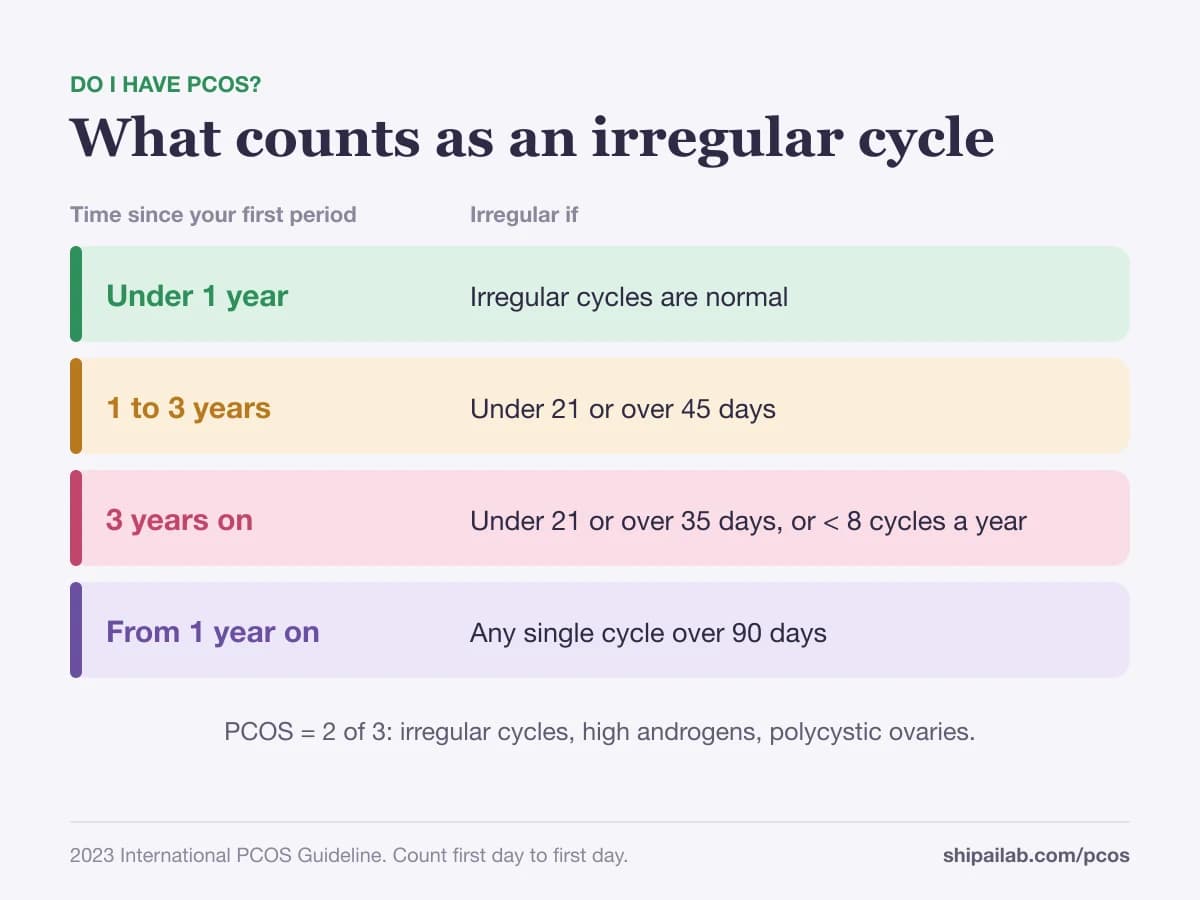
Count from the first day of one period to the first day of the next. The guideline’s definition depends on how long it has been since your first period:
| Time since first period | Irregular if |
|---|---|
| Under 1 year | Irregular cycles are normal at this stage |
| 1 to 3 years | Under 21 or over 45 days |
| 3 years to perimenopause | Under 21 or over 35 days, or fewer than 8 cycles a year |
| From 1 year after the first period | Any single cycle over 90 days |
What counts as high androgens
- Excess hair growth (hirsutism) is the strongest sign. The guideline uses a Ferriman-Gallwey score of 4 to 6 or more, depending on ethnicity.
- Acne or thinning hair on the head count too, but on their own they are weaker signs.
- On a blood test, doctors check total and free testosterone. Free testosterone is often estimated with the free androgen index.
- The combined pill raises SHBG and lowers androgens, so blood tests taken while you are on it are hard to read.
Tests to ask about
On ultrasound, the adult threshold for polycystic ovaries is 20 or more follicles in at least one ovary.
| Test | Why |
|---|---|
| TSH, prolactin, 17-OH progesterone, FSH | To rule out other causes, as the guideline requires |
| Total and free testosterone (or free androgen index) | To check for high androgens |
| Pelvic ultrasound or AMH, not both | Adults only, and only when cycles or androgens alone are not enough |
Before your appointment
The most useful thing you can bring is your cycle history: the start date of each period for the last few months. PCOS & Endo Tracker lists every cycle length, marks the ones outside 21 to 35 days, and puts them in a one-page doctor report with your symptoms.
Track it in the app
Irregular cycles are criterion one. A few months of logged period dates is the evidence your doctor will ask for.
PCOS & Endo Tracker logs periods, pain, symptoms, food and blood sugar in about 20 seconds a day, and turns it into a summary for your doctor. Free to log, no account, your data stays on your phone.
Questions
Can a quiz tell me if I have PCOS?
No. Only a doctor can diagnose PCOS, after ruling out other causes with blood tests. A quiz can show whether your symptoms match the criteria, which helps you decide to book an appointment.
Can I have PCOS with regular periods?
Yes. You can still meet two criteria through high androgens and polycystic ovaries. The guideline also notes that you can have regular cycles without ovulating; a progesterone blood test can check that.
Do I need an ultrasound to be diagnosed?
Not always. If you have irregular cycles and signs of high androgens, the guideline says an ultrasound is not needed. Teens should not be diagnosed by ultrasound at all.
Can I have PCOS if I am not overweight?
Yes. Weight is not one of the criteria. PCOS is diagnosed from cycles, androgens and ovaries.
Do I have to have cysts to have PCOS?
No. The “cysts” are small follicles, and polycystic ovaries are only one of the three criteria. You can meet two criteria without them.
Sources
- Recommendations from the 2023 International Evidence-based Guideline for PCOS (rec. 1.1 to 1.5, Algorithm 1), Fertility and Sterility via ASRM
- Rotterdam ESHRE/ASRM consensus on PCOS diagnostic criteria (2004), Hum Reprod
Written by Hicham Zaidi, maker of PCOS & Endo Tracker, from the sources above. General information, not medical advice. Updated November 13, 2026.